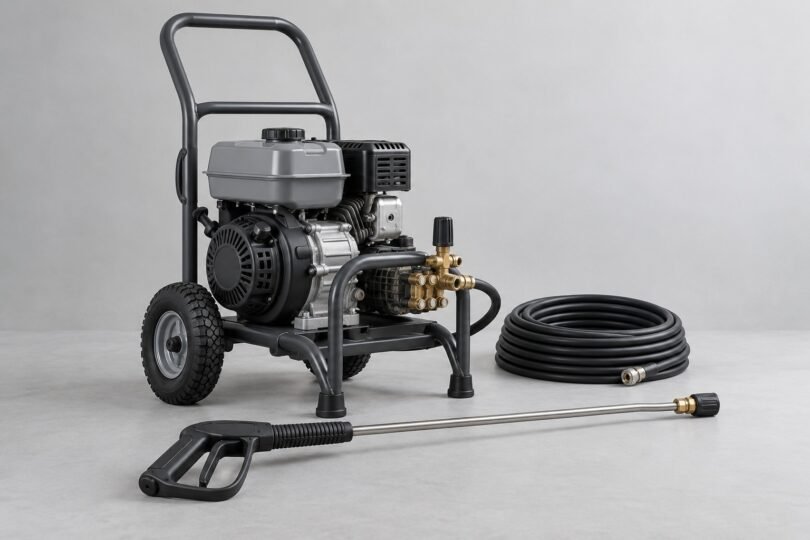

A Porter-Cable power washer needs to be identified by its complete model and type number before you buy a replacement hose, pump, gun or nozzle. The brand’s older electric and gasoline machines have different operating requirements, and a part advertised for “Porter-Cable” is not automatically suitable for all of them.
For an existing machine, start with its identification plate and official manual. For a used purchase, check condition, parts availability and the complete cost of making it serviceable. The archived models below are identification examples, not claims of current production, stock or a transferable warranty.
Start with the model and type number
Porter-Cable’s owner-manual page directs users to ServiceNet and explains that products are indexed by their official distribution model number. Look on the warning/caution label, and record the type and serial number when present. Take a photograph so a service representative can read the complete label.
On a gas machine, also identify the engine and pump separately. A previous owner may have replaced either component. The frame’s original specification therefore cannot prove what is installed now, and an engine-brand label alone does not identify the complete pressure washer.
| Documented model | Original manual rating | What to verify |
|---|---|---|
| PCE1700 | Electric; 1,700 PSI and 1.7 GPM | Electrical condition, original protective features, exact hose/gun connections and model-specific instructions. |
| PCH2425 | Gasoline; the 2004 manual lists 5 horsepower, 2,400 PSI and 2.5 GPM | Model/type, installed engine and pump, fuel-system condition and matching parts diagram. |
| PCV2021, PCH2627, PCH3030 and PCH3540HR | Covered with PCH2425 in an older multi-model manual | Use the section for your model. Shared documentation does not make pumps, wands or maintenance requirements interchangeable. |
Sources: official PCE1700 manual, PCH2425 manual and multi-model manual. These are historical manufacturer ratings, not new measurements of a used machine.
Gas and electric machines have different trade-offs
An electric washer avoids gasoline-engine fueling and exhaust, but you need a suitable electrical supply and an intact cord and protective plug. A gas washer gives more freedom from an outlet, while adding fuel storage, engine maintenance, hot surfaces and carbon-monoxide precautions. Both need a suitable water supply and careful control of the spray.
Use the actual model’s pressure and flow figures rather than choosing solely by engine horsepower or the largest number in an advertisement. PSI describes pressure; GPM describes water flow. A high pressure rating alone does not tell you how quickly the washer will rinse a broad area, how manageable it will be, or whether a particular accessory will work well.
Also check supply requirements separately from output. For example, the PCH2425 manual calls for a water supply of at least 20 PSI and 5 GPM. Its published 2.5 GPM output is not the minimum inlet-supply specification. If your water source is uncertain, resolve that before buying or operating the machine.
Where to find manuals, parts and support
Use Porter-Cable’s current service-and-support page to reach manuals, parts documentation and customer support. Provide the complete model/type information and ask whether the required component remains available. An archived parts drawing is useful identification evidence; it does not promise that every numbered part can still be ordered.
A brand name also does not establish one universal licensed manufacturer or repair route for every generation and region. Follow the maker and service information for the exact unit. Do not redirect a Porter-Cable owner to another brand’s pressure-washer licensee simply because the machines look similar.
The older multi-model manual illustrates why this matters: it distinguishes DAPC, Annovi Reverberi and CAT pump arrangements across the range. Its historical warranty section assigns engine warranties to the engine manufacturer. Ask the current support channel which organization handles the installed component, rather than assuming one warranty or repair shop covers the entire assembly.
How to check hose, gun and nozzle compatibility
Build a short compatibility record before ordering. It should include the washer model/type, the existing component’s part number, photographs of both connection ends, and the specifications required by the manual or parts diagram.
- Hose: match both end connections, working-pressure and temperature ratings, and the intended application. The garden-hose inlet and high-pressure outlet serve different purposes.
- Gun and wand: verify how the hose attaches to the gun and how the wand attaches to the gun. A connection that appears to screw together is not sufficient proof of a correct seal or pressure rating.
- Nozzles: match the attachment system and specified flow/orifice requirements as well as spray angle. Color or a “universal” label alone is insufficient.
- Pump: ask a qualified service source to confirm the complete replacement assembly against the installed engine and frame. Pressure, flow, mounting and drive compatibility all matter.
The historical range includes both a Multi-Reg wand on the PCV2021 and quick-connect turret arrangements on other listed models. That is a concrete reason to avoid assuming one accessory set fits every Porter-Cable washer. Obtain written compatibility confirmation from the supplier when a replacement differs from the original part number.
Assess a used washer before paying
Ask for the identification label, manual, included accessories and maintenance history. Inspect for cracked housings, corrosion, damaged high-pressure hose, unsafe cord repairs, missing guards and evidence of leaks. Missing accessories should be priced as exact replacements rather than guessed from the cheapest generic listing.
If you are not familiar with the machine, arrange inspection by a qualified service technician. A gas engine starting successfully does not establish that the pump, unloader and high-pressure system are healthy. Likewise, an electric motor running does not prove the cord, grounding or protective device is safe.
Compare the asking price plus necessary parts and professional service with a supported replacement machine. Confirm return terms before purchase. A discontinued assembly can make an apparently inexpensive washer costly or impractical to restore.
Safety checks that matter before operation
High-pressure spray can penetrate skin. Keep the wand away from people and animals, and never use your hand to check a suspected leak. Wear the protective equipment specified by the manual, keep bystanders away and use stable footing. If a high-pressure spray injury occurs, seek medical attention promptly even when the wound looks small. The CDC warns that apparently minor wounds can cause serious complications.
Gas engines must stay outdoors. CDC guidance says never use a gasoline-powered pressure washer in an enclosed space or within 20 feet of a window, door or vent. An open garage door is not adequate protection. CDC investigations of pressure-washer carbon-monoxide poisoning show that hazardous exposures can occur even with doors open and ventilation operating. Keep exhaust away from occupied areas and air intakes.
Follow the exact electrical instructions. The PCE1700 manual specifies grounding, a GFCI built into the supply-cord plug and no extension cords. Do not substitute generic extension-cord advice for that model’s prohibition. Keep electrical connections away from runoff, test protective devices as instructed, and stop using equipment with electrical damage or repeated tripping. Have electrical faults evaluated by a qualified professional.
Before disconnecting any high-pressure component, follow the manual’s shutdown and pressure-release procedure. Never bypass safety devices or increase factory-set pressure to chase an advertised number. Use only the water temperature and cleaning chemicals the manual permits; the PCH2425 instructions specify cold water and prohibit bleach.
When to stop troubleshooting and seek service
A damaged hose, fuel leak, electrical fault, cracked pump component or failed safety device calls for stopping use. Do not improvise a repair to a pressurized part or continue resetting a protective device that repeatedly trips.
Porter-Cable’s trigger-release troubleshooting note distinguishes electric motor behavior from a gasoline engine that stalls as pressure builds. It identifies a bypass/unloader issue as a possible gas-machine service problem. Check the exact model’s instructions and have the fault diagnosed rather than adjusting the unloader yourself.
Frequently asked questions
Will any Porter-Cable hose or O-ring fit?
No. Match the model/type and documented part number, then verify the connection and ratings. The same brand name on a listing is not a compatibility check.
Does an available manual mean the washer is still sold?
No. Historical manuals remain valuable for identification and safe use. Confirm current machine and parts availability separately with the manufacturer’s support channel or an authorized supplier.
What should I buy first?
For an existing washer, identify the machine and diagnose the need before ordering anything. For a replacement washer, prioritize the cleaning task, safe power and water access, complete accessory compatibility and dependable parts support.