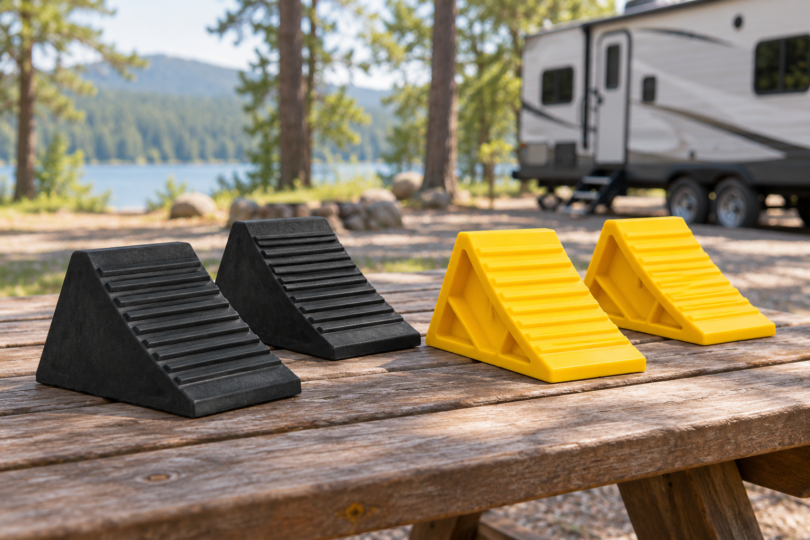

The best wheel chocks for an RV are the ones approved for its tires and parking surface. Start with Camco 44471 for a clearly stated tire-size limit, or consider MaxxHaul 70472 if you want rubber wedges and can confirm their fit for your vehicle. BAL 28012 X-Chocks serve a different purpose: reducing movement between tandem tires after the trailer is secured.
Ground chocks supplement the vehicle’s parking procedure. They do not replace a working parking brake where fitted, and a between-tire stabilizer does not replace ground chocks. Follow your RV, tow-vehicle and chock instructions together. A trailer’s emergency breakaway switch is not a parking brake; Jayco’s towable manual specifically warns against using it that way.
Quick comparison
| Exact selection | Why consider it? | Fit and limits |
|---|---|---|
| Camco 44471, yellow with rope, two-pack | Plastic wedges with a stated tire-diameter limit | Tires up to 26 inches; flat ground; follow the label’s all-tires, front-and-rear placement requirement |
| MaxxHaul 70472, black rubber, two-pack | Molded handles and an 8 × 4 × 6-inch wedge format | Firm surfaces; use in pairs; confirm suitability because the reviewed instructions do not establish a maximum tire diameter, RV weight or slope rating |
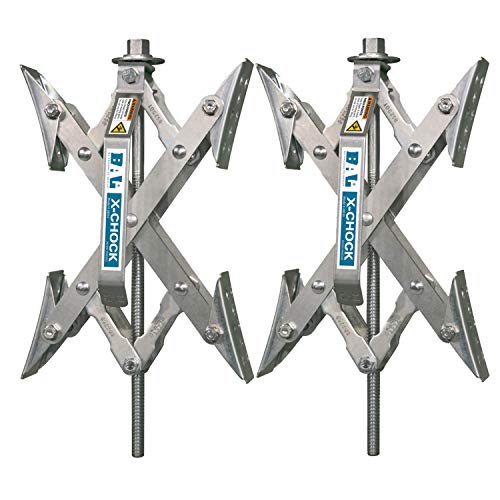
| BAL 28012 Standard X-Chock, double pack with handle | Optional stabilization for tandem tires | Fits a 1⅜–10-inch tire gap; additional to the ground chocks needed for parking |
1. Camco 44471: the clearest choice for tires up to 26 inches
Choose the 44471 yellow Wheel Chock with Rope, two-pack when your tire size and parking setup meet Camco’s instructions. The ropes provide a retrieval point, and the exact package avoids confusing this model with larger Camco chocks or rope-free versions.
The manufacturer’s package label specifies tires up to 26 inches and flat ground. It also calls for chocking all vehicle tires both in front and behind. Two pieces therefore do not necessarily supply the complete setup your vehicle requires. The label excludes commercial use and heavy commercial-type trucks or trailers.
- Pros: explicit tire-size limit; included ropes; easy-to-identify two-piece package.
- Cons: the 26-inch limit excludes larger tires; a two-pack may be insufficient; prolonged sunlight can weaken the chocks, so Camco specifies dry, dark storage.
Buying choice: select model 44471, with ropes, two chocks. Measure the tire’s overall diameter, not its wheel-rim diameter.

Camco 44471 Wheel Chocks with Rope, Yellow, 2-Pack
As an Amazon Associate we earn from qualifying purchases.
2. MaxxHaul 70472: rubber wedges with fit confirmation
The MaxxHaul 70472 two-pack is worth considering when you prefer a molded rubber chock with an integral handle. Each wedge is listed as 8 inches long, 4 inches wide and 6 inches high. This is the specific 70472 set, not the differently sized 50011 or 80681.
The manufacturer’s instructions linked from the 70472 listing identify the individual chock as 70072. They require correct sizing for the vehicle, firm ground and paired use, with the chocks squarely centered against the tire tread. They also require a working parking brake and warn against driving over the chocks.
- Pros: two rubber wedges; molded handles; dimensions are clearly stated.
- Cons: no verified maximum tire diameter, RV weight capacity or permitted slope is established by these documents. “Heavy duty” is not enough to establish suitability for a large motorhome.
Buying choice: get the black 70472 two-pack only after confirming that its size and intended use suit your RV. If you need a documented load or grade rating, choose a manufacturer-approved model that supplies it.

3. BAL 28012 X-Chock: an optional tandem-tire stabilizer
For a parked tandem-axle trailer that still moves as people walk inside, the BAL Standard X-Chock adds opposing pressure between adjacent tires. Model 28012 is the double pack; 28010 is the single version. BAL specifies a 1⅜–10-inch spacing range and includes a ratchet handle.
Buy this for stabilization after completing the trailer’s parking and leveling procedure. Keep conventional ground chocks in the setup. BAL’s trailer-chock guidance separately calls for tire wedges during hitching and unhitching. Follow the exact instructions supplied with your X-Chocks for installation and removal.
- Pros: purpose-built tandem-tire stabilization; two stabilizers in model 28012; supplied manual ratchet.
- Cons: unsuitable for a single axle or tire spacing outside its range; does not establish a ground-chock load or slope rating; requires adjustment.
Buying choice: measure the gap where the stabilizer will sit. Select the 28012 double pack and operate it with the supplied ratchet, following BAL’s warning about powered tools.
How to choose RV wheel chocks
Match the tire, vehicle and ground
Check the chock’s stated tire-size and vehicle restrictions before buying. Ground conditions are part of that fit: Camco specifies flat ground, while MaxxHaul requires a firm surface. Neither document provides a universal claim that these picks hold every RV on gravel, ice, wet pavement or a steep campsite.
Buy enough pieces for the required placement
A two-pack describes the box contents, not a complete parking plan. Follow the placement and quantity required by the chock and vehicle manufacturers. Jayco’s towable instructions, for example, call for a level campsite and chocking all RV wheels before unhitching. Do not use an accessory recommendation to override your own manual.
Keep leveling, stabilization and restraint separate
Leveling blocks change height; between-tire stabilizers reduce movement; ground chocks restrain tires as part of the specified parking procedure. Confirm how these components work together for your RV. Inspect the chocks before use, and replace damaged or weakened pieces according to their manufacturer’s guidance.
Which should you buy?
Camco 44471 is the straightforward first option when all tires are within its 26-inch limit and the site meets its instructions. MaxxHaul 70472 offers a rubber alternative, subject to vehicle-fit confirmation. Add BAL 28012 only when you want tandem-tire stabilization as well as the ground-chock arrangement your trailer requires.
Frequently asked questions
Are X-Chocks a replacement for ordinary RV wheel chocks?
No. Treat the BAL 28012 as an additional tandem-tire stabilizer. Keep the ground chocks and parking procedure specified by your trailer and chock manufacturers, including the required restraint during hitching and unhitching.
How many wheel chocks does an RV need?
Use the quantity and placement required by your vehicle and chock instructions. Camco 44471’s label calls for all tires to be chocked in front and behind, while MaxxHaul requires paired use. One two-pack is not automatically enough for an RV.
Will Camco 44471 fit a tire on a 16-inch wheel?
The 26-inch limit concerns the tire’s overall diameter, not the wheel’s rim size. Check the actual tire diameter and all other label restrictions before choosing it.
Can these chocks hold a heavy RV on any slope?
No such rating is established here. Camco requires flat ground, and MaxxHaul’s reviewed documents do not supply a maximum RV weight or slope rating. Use a suitable parking site and a chock explicitly approved for your vehicle and conditions.
Can I use a trailer’s breakaway switch as its parking brake?
No. Jayco warns against using the emergency breakaway switch as a parking brake. Follow your trailer’s instructions, use the tow vehicle’s parking brake as directed and secure the RV with the specified ground chocks.