

The right chainsaw for a woman is the saw that fits her hands, reach, strength, experience and actual work. Gender does not determine the appropriate bar length or cutting capacity. Start with the job, then compare the complete tool’s balance and weight with its battery, bar, chain and oil included.
For occasional home use, two battery-powered models worth comparing are the STIHL MSA 70 C-B and Husqvarna Power Axe 225i. They offer different bar configurations and battery systems. Neither is a universal beginner’s choice, and a smaller motor or shorter bar does not remove the need for training.
Research checked October 4, 2026. This guide uses manufacturer information and official safety guidance. We have not handled these saws, measured cutting performance or verified prices and stock. The recommendations are buying comparisons, not cutting or tree-felling instructions.
Two battery chainsaws to compare
| Model | Documented configuration | Reason to compare it | Important limitation |
|---|---|---|---|
| STIHL MSA 70 C-B | AK battery system; 12-inch recommended bar in STIHL’s US comparison chart | A compact configuration with variable-speed trigger and quick chain adjustment | Confirm the exact battery and complete assembled weight |
| Husqvarna Power Axe 225i | US 14-inch configuration; bare tool or battery/charger kit | Pass-through battery layout and tool-less chain tensioning | The listed 6.83-pound weight excludes battery and cutting equipment |
STIHL MSA 70 C-B: compare the complete AK setup
STIHL describes the MSA 70 C-B for yard maintenance and firewood work. It has a variable-speed trigger and a quick chain adjuster. Its US comparison chart specifies a 12-inch recommended bar and ¼-inch PM3 chain.
This is a useful model to handle if you already own appropriate AK equipment or want to assess a shorter configuration. Confirm the exact battery, charger and approved bar/chain combination in the package. A unit-only listing does not include the battery and charger.
STIHL advertises up to 45 minutes with an AK 30, while expressly noting that runtime depends on the battery, operating style and conditions. Treat that as a manufacturer estimate, not a promise of 45 minutes on your particular wood. We have not established a reliable, directly comparable ready-to-use weight for the current package.
Husqvarna Power Axe 225i: check what its weight leaves out
The US bare-tool 225i, SKU 970547501, includes a 14-inch bar and H38 chain. Its pass-through battery arrangement and tool-less tensioning make it worth assessing alongside the STIHL for handle reach and balance. Those are features to try, rather than proof that it will feel more comfortable to everyone.
The US kit, SKU 970547511, lists the 40-B140 battery and 40-C80 charger. Its 6.83-pound specification excludes both the battery and cutting equipment. The 2025 operator’s manual lists the 40-B140 at 2.7 pounds. Together that is approximately 9.5 pounds before adding the bar, chain and chain oil; it is not the finished operating weight.
A buyer seeking a sub-seven-pound complete saw should therefore not rely on the headline specification. Ask the dealer to show the assembled configuration you would actually use.
Five fit checks that matter more than a gender label
- Handle grip and control reach. Wearing the gloves you plan to use, check whether both handles and the controls fit your hands without an awkward stretch. Have a dealer demonstrate this with the tool safely disabled.
- Complete weight and balance. Compare like-for-like setups. Bare powerhead, tool without battery and complete working tool are different measurements. A larger battery also changes the configuration you are evaluating.
- Comfortable working reach. You should not need to overreach to control the tool. Being able to lift a saw briefly does not demonstrate comfortable control throughout a task.
- Job size and frequency. Bring a description of the wood, typical diameter, site and expected workload. A tiny saw can be an unsuitable choice for repeated larger work, even if it feels easy to carry.
- Experience and support. Consider available training, local servicing, replacement chains and your willingness to maintain the tool. Include those costs when comparing packages.
Husqvarna’s buying guide likewise relates saw choice to experience and wood size. It notes that excess weight increases fatigue and that too little capability can lead to unnecessary exertion. Our recommendation is to choose the smallest suitable configuration you can control comfortably, with a qualified dealer or instructor’s help.
Battery power still requires maintenance and protection
A battery saw avoids pull-starting a gasoline engine, which may be useful for some buyers. It still needs the correct chain, lubrication, tension checks and safe battery handling. Do not confuse an electric motor with a maintenance-free cutting system.
Before buying, read the model’s full manual and ask the dealer to explain the chain brake, trigger lockout, hand guards, approved low-kickback cutting equipment and required inspections. These features help manage risk; none makes a chainsaw safe to use without proper technique and judgment.
OSHA’s chainsaw safety card calls for functioning controls, correctly adjusted equipment, a sharp chain and appropriate protection for the hands, feet, legs, eyes, face, ears and head. Budget for properly fitting equipment rather than treating protective clothing as an optional accessory. Confirm that leg protection is appropriate for the exact type of saw with its manufacturer.
Training and professional-service limits
The New York State Department of Health’s homeowner guidance, archived by CDC, recommends practical training and considering a professional tree service when experience or equipment is lacking. Storm-damaged trees can store hidden tension. A fallen branch is not automatically a simple or safe beginner’s job.
Have a qualified tree professional assess felling, suspended or unstable branches, storm damage, overhead work and trees that could strike structures. Keep away from trees or branches contacting power lines and involve the utility or appropriately qualified professionals. A larger saw does not resolve those hazards.
For the homeowner comparisons here, stay on stable ground, use both hands and do not operate from a ladder, roof or tree. The Husqvarna manual prohibits overreaching and above-shoulder use; do not interpret a lightweight model as permission for one-handed or overhead work. Stop if you are tired, uncertain or unable to maintain control. A buying guide cannot teach hazard assessment or certify competence.
Questions to settle before checkout
- What are the exact tool, battery and charger model numbers?
- What does the published weight include, and what does this complete configuration weigh?
- Is the bar-and-chain combination approved for this saw?
- Can you operate the controls comfortably in appropriate gloves?
- What oil, protective equipment, maintenance tools and training will you also need?
- Who can service the saw locally, and are the correct wear parts readily obtainable?
Frequently asked questions
Do women need a special chainsaw?
No single specification follows from being a woman. Individual fit, experience and the work determine the useful choices. The same assessment applies to any operator.
Is the lightest chainsaw always best?
No. It must have suitable capability and feel controllable with all working components installed. Published bare weights can be misleading when compared with battery-inclusive figures.
Is a mini chainsaw a safer first purchase?
Size alone does not establish safety. Assess the guards, required two-handed operation, manual, service support and intended tasks. Do not buy an unverified mini saw on the assumption that it is harmless.
Does a 14-inch bar mean I can safely cut any 14-inch tree?
No. Bar length is a hardware specification, not a personal skill rating or a safe-task limit. The wood, conditions, hazards, manufacturer instructions and training all matter.
Which of these saws cut fastest in testing?
We did not conduct a cutting test. This comparison uses documented configurations and buying considerations, with no measured speed or durability ranking.
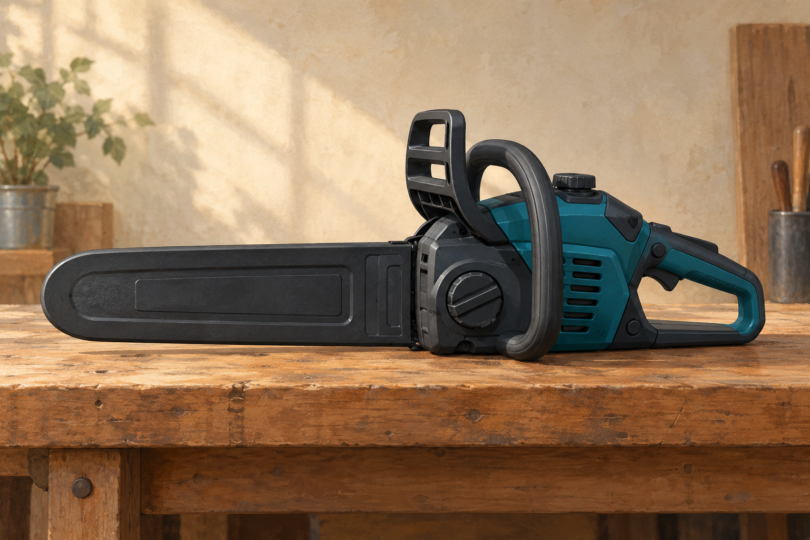
Image note: AI-generated generic editorial illustration of a stored chainsaw; it does not depict a tested model or demonstrate chainsaw operation.


