
Liquid contour makeup is easiest to choose when you separate three questions: how much color you want, what finish you prefer, and whether the shade creates a believable shadow on your skin. A popular shade that looks sculpted on one complexion can look orange, gray, or barely visible on another.
The three options below cover a radiant contour wand, a more pigmented bronzer-contour hybrid, and a matte concealer that the manufacturer also recommends for contouring. They are a source-based comparison of formulas and applicators, rather than a claim of hands-on wear testing. Each linked shade is a specific example, so check the shade name before ordering.
Liquid contour makeup at a glance
| Product and exact shade | Why consider it | Main trade-off |
|---|---|---|
| e.l.f. Halo Glow Contour Beauty Wand, Fair/Light | Buildable color with a radiant finish and cushion tip | Radiance may be unwanted when you prefer a matte shadow |
| e.l.f. Camo Liquid Bronzer & Contour, 7 Tan/Deep | Concentrated pigment with a natural-looking finish | The shade must suit both your skin depth and intended effect |
| NYX Can’t Stop Won’t Stop Contour Concealer, Warm Caramel | Full-coverage matte liquid with a wand applicator | A concealer shade can be too opaque or the wrong depth for contour |
1. e.l.f. Halo Glow Contour Beauty Wand, Fair/Light
This is the option to consider if you like a little luminosity alongside facial definition. e.l.f. describes its Halo Glow contour wand as a lightweight, buildable liquid with a cushion-tip applicator. The brand’s current site calls it Halo Glow Liquid Contour Wand; the verified Amazon listing retains the Contour Beauty Wand name.
The cushion dispenses product directly onto the face, making short dots more practical than drawing a thick stripe. Start with less than you think you need. The point is to leave room to blend without spreading color across the entire cheek.
The linked Fair/Light shade is a 10 mL single tube. It is a starting point for lighter complexions, not a universal match. Choose this format for a softly built-up look; choose a different finish if you want a fully matte result. A sponge tip also needs care: recap it promptly and avoid squeezing out excess product that will sit in the applicator.

e.l.f. Halo Glow Contour Beauty Wand, Fair/Light, 10 mL, 1 Tube
As an Amazon Associate we earn from qualifying purchases.
2. e.l.f. Camo Liquid Bronzer & Contour, 7 Tan/Deep
Camo Liquid Bronzer & Contour uses a rounded, grooved applicator and a higher-pigment formula. e.l.f. describes the finish as natural-looking and positions the range for both bronzing and contouring. That dual role makes shade choice especially important: a color that adds attractive warmth may not create the shadow you want.
The linked 7 Tan/Deep shade comes in a 0.13-fluid-ounce single tube. It is useful to examine when comparing deeper options, but the name alone cannot establish whether it is dark enough or cool enough for your complexion. Look at the blended swatch against your foundation shade before deciding.
For control, put a tiny amount on a clean mixing surface, pick it up with a brush, and tap onto the face. This is a practical way to avoid applying a full applicator’s load at once. Consider this formula when you want more pigment in a small amount; start especially sparingly if you are accustomed to sheer products.

3. NYX Can’t Stop Won’t Stop Contour Concealer, Warm Caramel
NYX’s Can’t Stop Won’t Stop range offers a matte, full-coverage alternative. The brand explicitly includes liquid contour among its uses. This makes it worth comparing if you already prefer an opaque concealer texture and want definition without Halo Glow’s radiant finish.
Warm Caramel is shade CSWSC15.7. Despite its name, NYX describes this particular shade as medium tan with a neutral undertone. It is distinct from Caramel and Warm Honey, so do not rely on a similar-looking product photograph or the family name when shopping.
Its suitability depends on contrast: if Warm Caramel matches your skin, it will conceal rather than visibly sculpt. If it is much darker, a small dab may already be more than you need. Blend one area before moving on. Full coverage is helpful for precision, but broad, heavy application can be harder to soften than a sheer wash.
How to choose a contour shade
Judge the blended color, not the stripe
A thick swatch shows the pigment’s maximum intensity. Your finished contour should usually be more diffuse. Compare the softened edge with the skin beside it, ideally in daylight, and check it with the foundation or skin tint you normally wear. The right match should still look intentional after blending.
Depth and undertone are separate decisions. A deeper shade is not automatically a better contour, and a gray-looking shade is not automatically flattering. e.l.f.’s shade guidance distinguishes cooler contour colors, intended to suggest shadow, from warmer bronzing colors. Use that as a starting point and adjust to the effect on your own complexion.
Choose the finish with your base makeup in mind
For a luminous skin tint, you might prefer the radiant Halo Glow approach. For more defined makeup, a pigmented hybrid or matte concealer may be easier to incorporate. These are styling choices rather than promises about how a formula will behave on every skin type. Foundation, moisturizer, application amount, and blending technique all affect the finished appearance.
A simple application routine
- Prepare a thin, even base. Let your usual skin-care layers settle before applying makeup. Use your normal foundation or skin tint if desired.
- Pick one area first. Start near the outer cheekbone with a small dot. There is no requirement to contour the cheeks, forehead, nose, and jaw in the same look.
- Blend at the edges. Use gentle tapping or short stippling motions. Keep most of the color where you placed it rather than dragging it far down the face.
- Check from a normal distance. Step back from a magnifying mirror. Add another small amount only where the first layer needs more definition.
- Finish selectively. Apply blush and any powder you normally use with a light hand. Avoid piling on powder simply to rescue too much liquid pigment.
Applying contour over foundation makes it easier to see exactly how much definition remains. Underpainting, with contour beneath a light foundation layer, is another option, but a high-coverage foundation may hide much of the effect. Experiment with a small area before changing your whole routine.
Fixing the most common problems
- A harsh stripe: soften its edge with the brush or sponge used for your base. Next time, start with smaller dots rather than a continuous line.
- Patchiness: reduce the amount and test the contour with your usual base on a small section. Do not assume a new primer is necessary.
- An orange or gray cast: reassess the shade before adding more. Extra blending cannot always correct an unsuitable undertone.
- Color disappearing: check whether the shade is close to your skin depth or whether the foundation applied afterward is covering it.
Keep the product and tools clean
The FDA’s cosmetics guidance recommends clean hands, following label directions, avoiding shared makeup, and keeping containers clean and closed. Discard products that develop changes in smell or color. Do not use a facial contour around the eyes unless its labeling permits that use. If a product causes irritation, stop using it and seek appropriate advice.
Frequently asked questions
Can I use a darker concealer as liquid contour?
Yes, when the formula is suitable and the shade produces the effect you want. NYX explicitly lists contouring as a use for Can’t Stop Won’t Stop. A concealer’s coverage can be much stronger than expected, so begin with a very small amount.
Do I need a special contour brush?
A clean brush or makeup sponge that can blend a small area is enough to start. A smaller brush gives more placement control, while a larger one diffuses color over a wider area. Avoid buying a whole brush set before trying a suitable tool you already own.
Which option makes the most sense?
Compare Halo Glow for radiance, Camo for concentrated pigment, and NYX for a matte, full-coverage approach. Then choose the actual shade independently. Matching the finish and undertone to your routine matters more than buying the same color someone else uses.
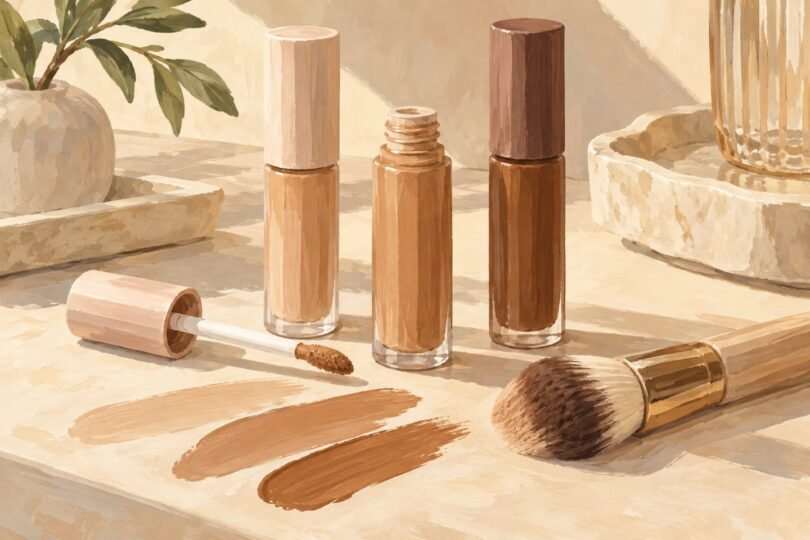
Image note: AI-generated editorial category illustration; not a photograph of a named or tested product.