
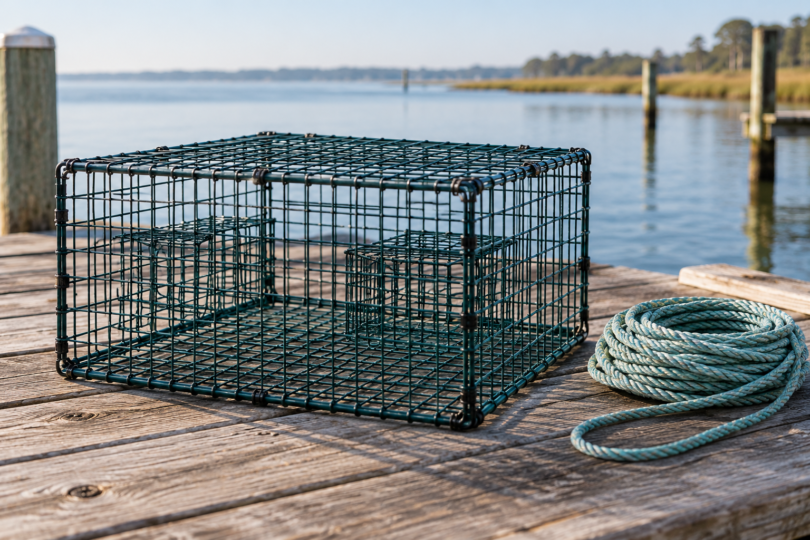

Our blue-crab trap shortlist covers three different needs: the Promar TR-555BC for a pot that folds flat, a Lee Fisher full-size pot with a specifically selected turtle-reduction option, and the Promar TR-701 for an actively retrieved pyramid-style trap where its dimensions are permitted. Choose the gear category allowed in your waters before choosing a product.
We compared manufacturer descriptions, exact product variants and state-agency guidance. We have not measured catch rates, tested corrosion resistance or used these traps on the water. “Best” here means a useful fit for a particular buying need, with local restrictions checked separately.
Three traps worth comparing
| Trap | Best fit in this comparison | Documented size | Important limitation |
|---|---|---|---|
| Promar TR-555BC | A pot-style trap that packs flat | 21 × 17 × 9 inches | Folding storage does not make it a legal manual trap |
| Lee Fisher Black Hex pot, 1¾ × 4¾-inch TD option | A full-size pot with the selected turtle-reduction opening | 24 × 24 × 19 inches | Choose the exact dropdown option; local pot rules still apply |
| Promar TR-701 Star Crab Trap | A compact pyramid-style alternative for active retrieval | 16 × 16 inches | Does not fit Maryland’s 20 × 15-inch manual-trap footprint |
Promar TR-555BC: our folding pot choice
The TR-555BC is a blue-crab pot with four swinging entrances and a frame that folds down for storage. Promar specifies coated-wire construction, three 2⅜-inch escape rings and a 9 × 9-inch tending door rigged with rot cord. Its 21 × 17 × 9-inch size is the practical attraction when a full-size pot would be awkward to transport. See the exact TR-555BC at Promar.
This is our first comparison for someone who has confirmed that pot-style gear is allowed and wants it to occupy less storage space between trips. Promar lists a bait-cage tether; that does not establish that a separate bait cage, retrieval line or buoy is included. Price the required rigging as part of the setup.
- Pros: Folding frame, documented escape-ring dimensions and a large access door give you concrete features to compare.
- Cons: The maker does not specify a turtle-reduction throat size on this page. Escape rings alone do not establish compliance with Florida’s separate entrance requirement.
Treat this as a pot, not as a manually closing drop trap merely because it folds. Its retaining doors and footprint differ from the manual-trap definition published by Maryland DNR. Check the rules for the actual gear type before deploying it.
Lee Fisher full-size pot: for a selected turtle-reduction option
The specific comparison here is Lee Fisher’s 24 × 24 × 19-inch Black Hex pot with the “TD (1-3/4 X 4-3/4)” option. The manufacturer describes 1½-inch hex mesh and offers several colors, wire finishes and entrance-device configurations on the same page. Select the complete size, color and TD option, rather than assuming that every photograph or dropdown choice represents the same package. Review the selected Lee Fisher configuration.
The larger footprint makes this a useful comparison if storage space is available and you prefer a full-size pot. The selected TD dimensions match the size illustrated in Maryland’s turtle-reduction guidance, but that is only one equipment requirement. It does not establish that you are entitled to place a pot at a particular shore, pier or dock.
- Pros: The maker offers an explicit turtle-reduction choice, letting you distinguish it from the standard pot and the separate 2 × 6-inch option.
- Cons: At 24 × 24 × 19 inches, it takes more space than the folding Promar. Confirm the full included rigging and all required escape features before purchase; do not treat the maker’s broad legality wording as a state-agency approval.
Promar TR-701: for an actively retrieved trap
The TR-701 is a coated-wire pyramid-style trap with draw-up cords and a fully collapsible design. Its 16 × 16-inch footprint makes it a different sort of purchase from a pot with retaining doors: shortlist it for an attended outing where you intend to work the retrieval line. Confirm that this design and its dimensions are permitted locally. See Promar’s TR-701.
For Maryland buyers, this particular 16 × 16-inch model is not our manual-trap recommendation: one side exceeds the 15-inch width in DNR’s maximum 20 × 15-inch base definition. Look for a correctly sized, manually closing model whose sides open when line tension is released. The word “collapsible” on a product page is not enough.
- Pros: Folds flat and includes draw-up cords, with a smaller footprint than either pot in this comparison.
- Cons: Requires attention to retrieval and local manual-trap dimensions. It should not be bought as a pot for an unattended soak.

Promar TR-701 Star Crab Trap, Black, 16 x 16 Inches
As an Amazon Associate we earn from qualifying purchases.
Choose the gear category before the brand
Ask your fisheries agency whether the proposed device is a crab pot, manually operated collapsible trap, ring net or another gear type. Maryland explicitly requires a qualifying manual trap to let crabs leave when the user is not applying closing tension. A pot that folds for transport can still retain crabs while resting on the bottom.
Keep three features separate when comparing pots. A turtle-reduction device restricts the entrance, an escape ring provides an exit opening, and a degradable panel is a different requirement again. Do not substitute one for the others or permanently defeat an escape feature when assembling or repairing a trap.
Think through the full trip: the space available in your vehicle, the route onto the dock or boat, and how you will retrieve the wet trap. Check the manufacturer’s assembly and rigging instructions before adding equipment. Inspect the frame, cords and closures before each outing, and replace damaged components with the specified parts.
Two state examples that change the buying decision
Maryland has separate pot requirements for recreational waterfront property owners, including registration. Its turtle-reduction guidance calls for a device at every lower-chamber entrance and illustrates a 1¾ × 4¾-inch opening. Consult Maryland’s blue-crab rules and crab-pot requirements for your location and gear.
Florida FWC specifies rigid recreational pot throats no larger than 2 × 6 inches, at least three escape rings measuring 2⅜ inches or more, and a degradable panel larger than 3 × 6 inches. It also sets mesh, size, registration and marking requirements. Check the full Florida blue-crab rules, including regional trap closures, before choosing or using a pot. These examples do not establish rules for other states.
Check the current license or registration, season, permitted placement, trap count, harvest limits and any special-area rules for the exact waterbody. If the seller cannot document the required gear details, get an answer before buying. Neither a “blue crab” label nor a retailer’s “legal” claim settles the whole question.
Frequently asked questions
Which trap is easiest to pack away?
Both Promar options fold. Choose the TR-555BC if you need a pot-style trap, or compare the TR-701 for active retrieval where its size is permitted. Check the folded size with the seller if it must fit a particular storage compartment.
Is a folding crab pot the same as a collapsible manual trap?
No. Storage design and fishing mechanism are separate questions. Maryland’s manual-trap definition depends on dimensions and opening when manual closing tension stops; the Promar TR-555BC is a retaining pot.
Does an escape ring replace a turtle-reduction device?
No. The agencies describe distinct openings with different purposes and placement. Check each required feature against the exact pot and the rules for your waters.
Are these complete kits with rope and a buoy?
Do not assume that. Promar specifies draw-up cords for the TR-701 and a bait-cage tether for the TR-555BC. Confirm retrieval line, buoy, bait holder and any other required equipment separately for the offer you select.
Which trap will catch the most blue crabs?
We have no controlled catch data that establishes a winner. Choose a legal design you can transport, rig and retrieve properly. The feature comparison cannot predict your catch.
Our recommendation
Start with the Promar TR-555BC when a folding pot fits your permitted gear and storage needs. Compare the selected Lee Fisher full-size pot when you want its specific turtle-reduction option, or the Promar TR-701 for attended use where its footprint is allowed. Confirm the jurisdiction and complete configuration before buying.


