
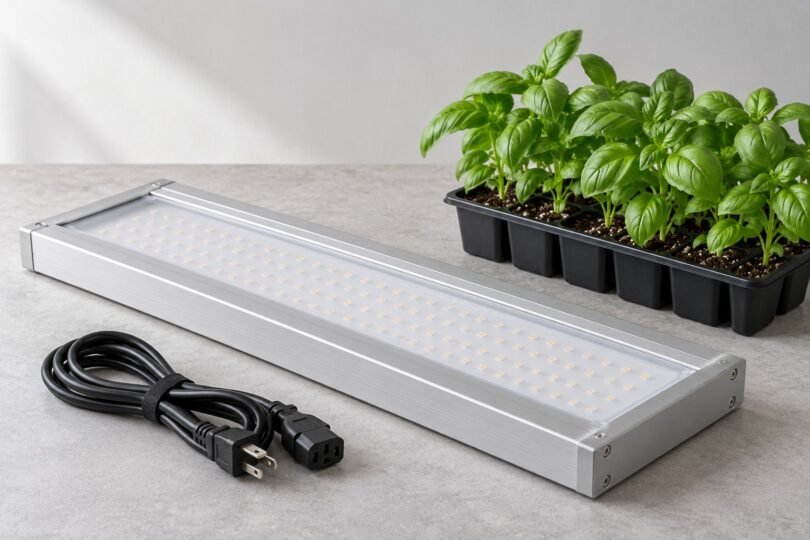

“Cree LED grow light” is not a complete product description. It can mean a finished fixture containing Cree LED components, an older COB-based lamp, or a listing that uses the name without identifying the actual LEDs. For indoor herbs, seedlings, and houseplants, choose by the documented complete fixture: its electrical input, spectrum, light distribution, mounting requirements, and suitability for the environment.
A recognizable LED maker is one useful detail. It does not tell you how much light reaches a seed tray, whether a driver is efficient, or whether the assembled light is safe around moisture. The most useful comparison starts with an exact fixture model and ends with measurements that match your growing area.
Cree components versus complete grow lights
Cree LED’s horticulture range includes component families such as XLamp XP-G3 and J Series LEDs. These are building blocks used by lighting manufacturers. They are not interchangeable with a ready-to-hang fixture that includes a driver, heat management, wiring, enclosure, and mounting hardware.
Also distinguish Cree LED from a Cree Lighting household or commercial luminaire listing. A similar brand name, white light, or a high lumen figure does not establish horticultural performance. Read the actual model documentation rather than searching for the word “Cree” anywhere in a marketplace description.
For a claimed Cree-equipped fixture, look for these details:
- The fixture maker, full model name, and revision or generation.
- The LED family and, where available, component order code or documented bill of materials.
- The driver model, intended input voltage, plug type, and whole-fixture input power.
- A spectral distribution and a PPF or PPFD report with measurement conditions.
- Installation instructions, environmental ratings, warranty coverage, and replacement support.
“Cree chips,” “COB technology,” or “full spectrum” without those details is not enough to establish a recommendation. A fixture containing other documented LEDs may be a better match than an unverified Cree claim.
What CXB3590 does and does not tell you
The Cree XLamp CXB3590 data sheet describes a chip-on-board LED array with a 30 mm optical source and 36 V-class and 72 V-class options. It documents color, electrical, and thermal characteristics under specified conditions. CXB3590 is an LED family designation, not the name of one finished grow light.
Cree also publishes a separate CXB3590 Pro9 data sheet. Do not silently treat a standard CXB3590 listing as Pro9, or transfer one bin’s performance to another. Color temperature, CRI, drive current, thermal design, and optics can differ between builds using the same broad family.
The component’s recognized status also does not certify the entire lamp. A finished assembly needs its own applicable safety evaluation and installation instructions. For an ordinary household purchase, choose a complete supported fixture rather than bare arrays, an undocumented kit, or a lamp requiring electrical modification.
A documented CXB3590 fixture example
Rapid LED’s Single 75W Plug and Play LED Grow Light is an identifiable manufacturer example. Its page lists one Cree CXB3590, a 160 mm pin heatsink, an ANGELINA extra-wide reflector, and a Mean Well XBG-100-48X driver. Listed choices include 3000 K/90 CRI or 3500 K/80 CRI, plus dimmable or non-dimmable configurations. Those options should be confirmed on the exact order.
Crucially, the specification says approximately 75 W from the LED. That is not an independently verified wall-input measurement for the complete fixture. Ask for whole-fixture consumption at the chosen output and input voltage before comparing operating costs. The driver model’s name is not a substitute for that measurement.
Its published PPFD illustration states a 12-inch measurement height inside a 2 × 2-foot grow tent, with a plotted area labeled 22 × 22 inches. That is a particular reflective test setting. It does not prove equivalent illumination across an open shelf, nor uniform coverage over the entire tent. The image does not establish all the details needed for a like-for-like test comparison, such as the instrument and selected LED/color configuration.
Consider this a documented small-space or supplemental-light candidate, not an independently tested winner. Confirm current configuration, full input-power figures, mounting instructions, and environmental rating directly with the maker. No marketplace ASIN is presented as a verified match for this configuration.
Read watts, PPF, PPFD, and efficacy correctly
Actual input watts describe electricity used by the complete light at a stated setting. “600 W equivalent,” a model number containing “1000,” or the sum of LED maximum ratings can describe something different. Compare wall input with wall input, including driver losses, rather than treating a marketing equivalent as consumption.
PPF, normally expressed in micromoles per second, describes emitted photosynthetic photon flux over a stated wavelength range. PPFD, in micromoles per square meter per second, describes photon flux arriving at a surface. PPF does not tell you where that light lands; a central PPFD peak does not describe the tray’s edges.
Photosynthetic photon efficacy, in micromoles per joule, relates photon output to electrical input. Check whether a quoted figure describes an LED component under laboratory conditions or the complete powered fixture. Those are different comparisons. The Luminus explanation of PPF, PPFD, and daily light integral gives helpful context for interpreting the metrics.
Lumens describe brightness weighted for human vision. They can be useful for room lighting but cannot replace a suitable plant-light measurement when comparing different spectra. Likewise, a white-light color temperature does not provide the entire spectral distribution.
Match coverage to the actual shelf or tray
Measure the usable growing area and the available height before shopping. A narrow shelf may benefit from a linear fixture that spreads light along the tray, while a compact lamp may suit a smaller cluster of plants. This is a layout choice, not a claim that one LED package is universally superior.
Ask for a PPFD map showing the test area, hanging distance, dimmer setting, supply conditions, and whether reflective walls were present. Look for average and minimum values as well as the brightest point. Maps taken at different heights or inside different enclosures should not be ranked as if they used the same method.
Daily light integral includes both intensity and duration, and window light also contributes. There is no single lighting schedule for every seedling, herb, and flowering houseplant. The University of Minnesota Extension’s indoor-lighting guide explains that plant needs and responses to day length differ. Use species-specific guidance and the fixture’s instructions rather than leaving a powerful lamp on continuously.
Electrical, moisture, and suspension checks
Indoor growing can place electrical equipment near irrigation, humidity, and elevated temperatures. Check the rating of the entire fixture and its power connections for the intended location. An LED coating, a weather-resistant component, or a driver rating alone does not make the whole setup suitable for wet use.
UL Solutions’ horticultural-lighting guidance addresses environmental exposure, ingress protection, wiring methods, and eye/skin exposure alongside safety evaluation of equipment and systems. Verify any claimed certification against the exact model; do not infer a finished product’s certification from the LED supplier’s name.
- Use the specified supply, cord, and grounding arrangement. Have a qualified electrician assess unsuitable outlets or installation requirements; do not modify wiring to make a fixture fit.
- Keep plugs and connections away from water and follow required electrical protection and local installation rules.
- Use the manufacturer’s mounting points and suitable load-rated supports. Never suspend a fixture by its electrical cord.
- Maintain specified clearance and ventilation. Keep leaves and combustible materials from contacting hot housings.
- Disconnect power before cleaning, adjustment, or servicing when the instructions require it. Avoid staring directly at bright emitters and follow any eye-protection guidance.
A practical buying decision
Choose the light with the clearest complete-fixture documentation for your plants and space. If the seller cannot identify the hardware, explain actual power consumption, or provide credible light-distribution and safety information, the Cree name alone is not a reason to buy it. For older or used fixtures, also check condition, driver availability, included hanging hardware, and the return terms before committing.


