

A useful cross stitch magnetic board keeps a printed chart steady and makes your current row easy to find. Choose the board around the size of the pattern you actually read: a compact 8-by-10-inch board for folded charts, a 12-by-18-inch board for larger pages, or a folding chart keeper when you want the stand and cover built in.
The shortlist below focuses on three identifiable products with clear differences. These are source-based recommendations using manufacturer descriptions and exact retail model checks, not a claim that we tested their holding strength or used them for a set number of stitching hours.
The short list
| Product | Best reason to choose it | Main limitation |
|---|---|---|
| Dritz 2008 Magnet Board & Ruler | Compact 8-by-10-inch board with a magnetic ruler | A full letter-size sheet extends beyond the board |
| Dritz 2007 Magnet Board Set | 12-by-18-inch surface for larger charts | More awkward to pack; stand sold separately |
| Knitter’s Pride Magma KP800112 | Fold-up holder with magnets and a supported reading position | Folded dimensions and total open dimensions are different |
1. Dritz 2008: a compact board for everyday charts
The Dritz 2008 is an 8-by-10-inch board supplied with a two-in-one magnetic ruler and three magnetic place markers. The manufacturer’s Dritz board listing identifies the small variant as item 2008; the Amazon listing uses that same model number. Its current product identifier is B0G612WSJB.

Dritz Magnet Board & Ruler, 8" x 10"
As an Amazon Associate we earn from qualifying purchases.
This is the sensible starting point if you work on a manageable section of a chart, fold a larger sheet to the current area, or want a board that slips alongside a small project. A ruler can give a clear horizontal reference while the other magnets keep the paper positioned.
The size tradeoff matters. US letter paper is 8.5 by 11 inches, so an unfolded sheet does not fit entirely within an 8-by-10-inch surface. Overhanging paper may be acceptable at home, but it is less convenient if you move the board frequently. Measure the printed grid, margins and symbol key before deciding it is large enough.
2. Dritz 2007: more room for large patterns
Choose the Dritz 2007 when your main frustration is constantly folding or moving a larger paper chart. Prym Americas specifies a 12-by-18-inch metal board with four magnetic strips and identifies the folding stand and magnetic magnifiers as separate accessories. The matching current Amazon listing is model 2007, ASIN B0FL79T889.
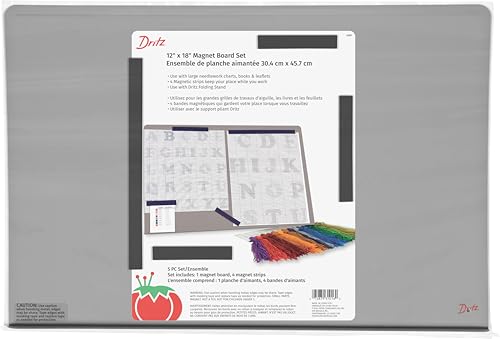
The extra area gives you more flexibility to position a chart and keep a nearby key visible. It can accommodate a letter-size sheet without the same edge overhang as the compact board. That does not mean every two-page spread or large-format pattern will fit: check the actual printed dimensions rather than the number of pages.
The downside is storage and placement. A larger board takes more table space and needs a bag wide enough to protect its edges. If you stitch in a chair with little nearby surface area, confirm where the board will rest before purchasing it. The bare board is not an integrated easel.
3. Knitter’s Pride Magma KP800112: a folding holder for travel
The Magma is worth considering if you want a chart holder that folds closed between sessions. KnitPro’s current Magma description explains the snap closure, inner pocket and ability to lie flat or fold into an upright position. The listed package includes three small magnets, one long magnet strip and a pen.

The linked Amazon product is the Knitter’s Pride-branded large model KP800112. Its description gives an approximately 10-by-12-inch folded size. The roughly 20-by-12-inch open measurement describes the whole opened holder, not a single upright reading panel. That distinction is important when comparing it with a flat 12-by-18-inch metal board.
Although marketed for knitting charts, the same paper-holding setup can be useful for cross stitch. Choose it for the folding format and convenient setup, especially if you pack your stitching away regularly. For a very wide chart you want to see all at once, a larger flat board may be easier.
Check model numbers when shopping older listings
LoRan names such as MB-8R and BB-1 still appear in searches and on older product pages. The current Dritz items above use model numbers 2008 and 2007. Similar dimensions do not establish that a different listing has the same packaging, accessories or seller offer.
Before ordering, compare the selected size, manufacturer’s item number and included pieces. A replacement magnet set is not a complete board, and a folding stand normally does not include a magnetic surface. Product photography sometimes shows a complete working setup even when accessories are sold individually.
How to choose the right board size
- Print a representative chart page. Use the enlargement you prefer for comfortable reading.
- Measure the visible working area. Include the symbol legend if you like keeping it alongside the chart.
- Allow room for magnets. A magnet placed over an important symbol or row number can create its own reading problem.
- Check the support position. A board that is comfortable flat on a table may be inconvenient on your lap.
- Check packed dimensions. Compare the closed holder or flat board with your actual project bag.
For a multi-page project, decide whether you want to display one page at a time or join pages temporarily. There is little benefit in buying a huge board if you normally stitch from a small working section. Conversely, a compact board is frustrating if you repeatedly need information hidden behind a fold.
A simple way to track your place
Secure the paper with magnets away from the active stitching area. Place a straight strip immediately above or below the row you are following, then use the same convention throughout the project. Consistency matters more than which side you choose.
When moving the strip, check a printed grid line or row number before stitching again. A row marker reduces the work of finding your place, but it does not automatically confirm that you counted correctly. For scattered stitches or color-by-color working, a small marker at the current section may be more useful than covering an entire row.
Before packing up, note your position in your own project notes or permitted working copy. Magnets can shift during travel. A closed chart keeper protects the paper, but it is sensible to recheck the marked position at the next session.
Stands, magnifiers and safety
A compatible stand can raise the chart into a more convenient reading position. Check its stated board compatibility and stability; do not assume any tablet stand will safely support a wide metal sheet. Buy a magnifier only if the symbols need enlargement after you have tried appropriate lighting and a larger printout.
Keep loose magnets and stitching needles away from children and pets, and account for them when packing the project. The CPSC warns that swallowed magnets can cause serious injury and advises immediate medical attention if swallowing is suspected. Follow any magnet precautions supplied with medical devices you use.
Which one makes the most sense?
For a small working chart, start with the Dritz 2008. For a larger flat display, choose the Dritz 2007. For a pack-away setup with a folding support, consider the Magma KP800112. The right choice is the one that fits both your chart and the place where you actually stitch.
Image note: Examples of magnetic chart boards and holders; pictured packages and accessories may differ from the selected options.