
A dual-band NMO antenna is a sensible choice only when its two operating bands match your radio and its mounting requirements match your vehicle. Start with the frequencies you actually use, the available overhead clearance and the complete cable path. The NMO connection alone does not establish any of those things.
For amateur use, compare antennas intended for the 2-meter and 70-centimeter bands. For a commercial or GMRS installation, check the specific channel frequencies and equipment requirements separately. A long product title listing several radio services is not a compatibility certificate. The models below illustrate different applications; the specifications are manufacturer figures, not results from comparative road tests.
Dual-band NMO antennas worth comparing
| Model | Frequency information | Published height and gain | Important fit check |
|---|---|---|---|
| Nagoya NMO-200A | BTECH lists optimal operating ranges of 140–150 MHz and 420–450 MHz | 38.4 inches; 3.0/5.5 dBi, VHF/UHF | Amateur-oriented tuning; NMO mount and feedline required separately |
| Nagoya NMO-200C | BTECH lists 150–170 MHz and 450–470 MHz, centered at 155/460 MHz | 38.4 inches; 3.0/5.5 dBi, VHF/UHF | Different tuning from the 200A; verify your intended service and installation |
| Diamond NR770HNMO | 2m/70cm; instruction-sheet VSWR plots cover 144–148 MHz and 440–450 MHz | Manufacturer-hosted catalog: 40.2 inches; 3.0/5.5 dBi | Radialless design in its instructions; verify exact revision and installed height |
The Nagoya dimensions and gain units come from BTECH’s antenna comparison chart. Operating windows come from the NMO-200A and NMO-200C product pages. These hardware ranges are not permission to transmit throughout them.
Nagoya NMO-200A: an amateur-oriented starting point
The 200A is the relevant version to investigate when your installation is for amateur VHF/UHF operation. BTECH specifies a 50-ohm impedance, a 200-watt maximum input rating and a lift-and-tilt feature. The package listing identifies the antenna itself, so budget for a suitable NMO base, feedline and any radio-end connector separately.
Its approximately 38-inch length deserves a real clearance measurement. Add the mount and vehicle height rather than comparing antenna length alone with a garage opening. BTECH’s documents use different nominal center-frequency labels, so use the stated operating windows as a starting point and confirm the exact frequencies and current supplied version before ordering.
Nagoya NMO-200C: different tuning, similar appearance
The 200C is aimed at a different frequency range, despite looking similar and sharing the 200A’s published height and gain. BTECH specifies 50 ohms and a 200-watt maximum input rating. That rating describes the antenna, not the power your radio service allows.
Choose it only after matching both intended operating frequencies to the published windows. Do not assume that a 200C is simply a better 200A, or that any radio bearing a familiar brand will work with it. The antenna-only package does not include the vehicle mounting system. For a single-service setup, also consider whether you actually need two bands.
Diamond NR770HNMO: check the suffix and clearance
Diamond’s catalog separates the NMO models from the similarly named UHF-connector versions. It lists NR770HNMO and black NR770HBNMO at 40.2 inches, with 3.0/5.5 dBi gain and a 200-watt maximum rating.
A separate Diamond operating sheet lists 38.2 inches. Treat that discrepancy as a reason to verify the supplied version and measure total installed height. Its plots support the frequency windows shown above; they are not a guarantee of the same SWR on your vehicle. The instructions describe a radialless design on both bands and say not to drive with the whip tilted.
Ground plane requirements are model-specific
NMO identifies a mounting interface, not a promise that an antenna works without a ground plane. Some designs rely on the mounting surface as part of the RF system. A plastic roof, isolated rack bracket and metal body panel are not interchangeable installation conditions.
Diamond’s compact NR72BNMO family makes the distinction especially clear. Its catalog specifies grounding, discourages magnet mounts and separates the side-mount NR72BNMO from the center-mount NR72BNMO-C. Both are listed at 13.8 inches with 2.15 dBi gain on each band. A shorter whip can solve clearance problems, but the mounting instructions still govern the choice.
For the Nagoya 200-series models, confirm the proposed ground-plane arrangement with BTECH rather than inferring it from antenna length or a wavelength label. The product-page and comparison-chart wavelength descriptions differ. For stationary use, BTECH offers the GPK-01 ground-plane kit, with an NMO antenna connection and SO-239 feedline connection; coax is separate. It is a mounting option, not a complete antenna station.
Check the whole connection from antenna to radio
Write down four items before buying: the antenna base connection, the mount, the cable specification and the connector on the radio. An NMO antenna normally attaches to an NMO mount. The opposite end of the cable may use a different connector.
For example, BTECH’s RB-50 magnetic mount supplies an NMO base and 18 feet of RG-58A/U cable ending in a PL-259 connector. That plug mates with an SO-239 socket. It does not directly establish compatibility with an SMA-equipped handheld or another socket type. Check the radio manual, connector gender and any adapter before purchase.
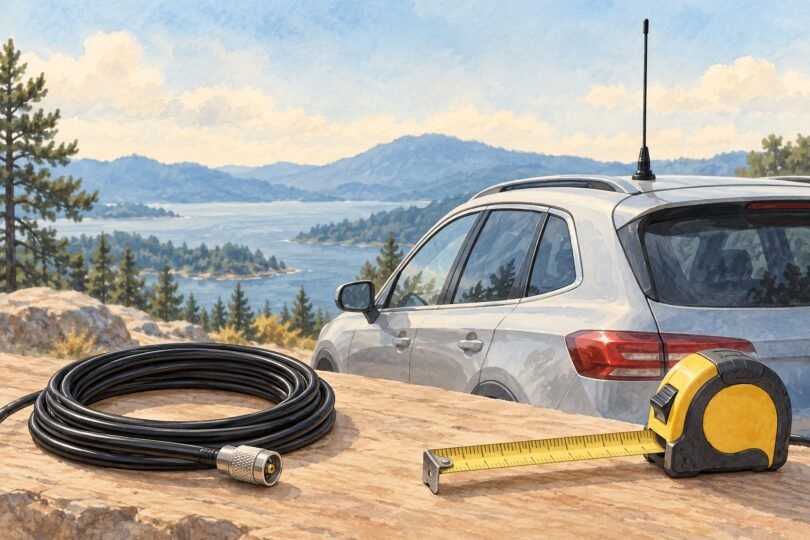
Choose the cable length for the actual route, allowing strain relief and normal door or hatch movement. Avoid pinched insulation, sharp bends and exposed joints where water can enter. A longer cable or extra adapter is not automatically an improvement. Match impedance and operating-frequency requirements across the complete system, and follow the radio and mount instructions for routing, grounding and weather protection.
What to verify before transmitting
- Check the exact antenna model and mounting location against the manufacturer’s instructions.
- Inspect the mount, cable and connectors for damage, looseness and water entry.
- Measure SWR on the frequencies you will use with suitable equipment; a factory-tuned label does not verify your installation.
- Resolve a poor match before normal transmitting, following the radio manufacturer’s limits and test procedure.
- Confirm overhead clearance and the mount’s mechanical suitability for that antenna.
Receiving a signal does not establish that the antenna is suitably matched for transmitting on that frequency, and it does not grant authority to transmit. In the United States, the FCC’s amateur station licensing rule and GMRS licensing rule are separate. Verify the rules and equipment requirements for your service before operating.
The most useful purchase is the antenna whose documented bands, mounting requirements and clearance fit your actual installation. Gain figures alone cannot promise a particular communication distance. Terrain, obstructions, antenna placement and the other station all affect the result.