
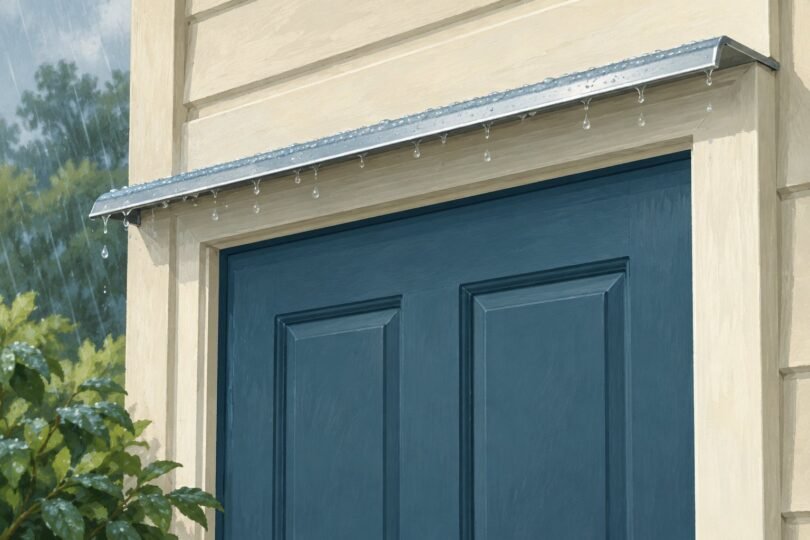

Choose an exterior door rain drip guard by where the water needs to be diverted. An overhead drip mounts above the opening; a door-bottom drip mounts near the base of the door. Their profiles and lengths are different, so a 36-inch bottom strip is not automatically a suitable head drip for a 36-inch doorway.
Three useful options are the Pemko 346 overhead rain drip, National Guard Products 16A drip strip and M-D 06247 door-base drip cap. This guide compares manufacturer dimensions and intended placement, not a hose test or a promise to cure every leak.
Match the profile to the location
- Above the opening: Pemko 346, with a 2.5-inch projection and a 5/8-inch overall height.
- When a taller mounting wall is useful: NGP 16A, with a 2.5-inch width and 1.5-inch wall.
- At the base of the door: M-D 06247, a 36-inch aluminum strip with a 3/4-inch width and 1.75-inch height.
1. Pemko 346: an overhead rain drip
The linked 346C52 is the 52-inch clear-anodized version; choose the length for your opening.

Pemko Aluminum Door Bottoms Overhead Rain Top Drip, Clear Anodized, 2-1/2”W x 52"L x 5/8”H - 346C52
As an Amazon Associate we earn from qualifying purchases.
Pemko identifies the 346 as an overhead aluminum rain drip with slotted mounting holes. Its profile is 2.5 inches wide and 5/8 inch high. The official guidance says to order it at least 4 inches longer than the door width.
That makes the length distinction important: for a 36-inch door, this guidance points to a minimum 40-inch strip, subject to the actual frame and installation details. Choose the correct finish and length rather than assuming every “346” listing is the same item.
Why choose it: A documented overhead profile with explicit width-overhang guidance.
Trade-off: It needs suitable space above the opening and an appropriate mounting surface. A projection strip cannot compensate for failed flashing behind the trim.
See Pemko’s 346 profile, finishes and instructions.
2. National Guard Products 16A: a taller mounting profile
This listing is the 40-inch 16A40; confirm that length suits your door and required overhang.

NGP lists its 16A as an anodized-aluminum drip strip made from 6063-T5 aluminum. The published profile is 2.5 inches wide with a 1.5-inch wall. It has slotted screw holes and supplied #6 x 3/4-inch stainless-steel screws.
The taller wall gives this strip a different mounting footprint from the low-height Pemko profile. Check the drawing against the flat area available on your frame, including any trim, closer or storm-door hardware.
Why choose it: A specified taller wall when that geometry suits the opening.
Trade-off: More mounting height is not automatically better. It can conflict with nearby trim or hardware, and the order length still needs to match the opening.
Review NGP 16A specifications and its dimensioned cut sheet.
3. M-D 06247: a door-base drip cap

M-D’s 06247 is a silver aluminum screw-on drip cap measuring 36 inches long, 3/4 inch wide and 1.75 inches high. The manufacturer explicitly places it at the base of the door. It includes screws and uses slotted holes for adjustment.
Choose it when you need to divert water running down the door near its bottom edge. Measure the door width and verify its travel over the threshold. The product can be cut to length according to the manufacturer’s instructions, but cutting may affect return eligibility.
Why choose it: A clearly specified door-base profile rather than a generic strip presented for every location.
Trade-off: A drip lip redirects water; it does not provide all the functions of a threshold seal, door sweep or complete sill system.
Check M-D 06247 dimensions and intended placement.
Measure these four things before ordering
- Required length: Measure the door or frame as the selected product’s instructions require. Overhead products can need extra width beyond the door.
- Projection: Ensure the lip will clear the moving door, storm door and nearby hardware.
- Mounting surface: Check that there is sound material for the specified fasteners and enough flat area for the profile.
- Water entry point: Look for the origin of the leak. Water entering through failed wall flashing, damaged seals or a poor threshold may need a different repair.
Installation cautions
Use the manufacturer’s instructions for fasteners, sealing and placement. Do not block drainage or weep openings, and do not modify a fire-rated or security door without confirming the permitted details. If water has softened the frame or wall, address the damage and source of the leak before attaching another strip.
Bottom line
Use an overhead profile such as Pemko 346 or NGP 16A when the head of the opening needs rain deflection. Use M-D 06247 for its intended door-base position. Correct location, profile and length matter more than a long list of nearly identical drip guards.
Image note: AI-generated conceptual rain-deflection profile, not a product-specific installation drawing.