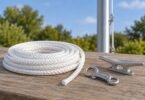
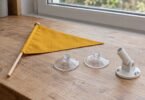
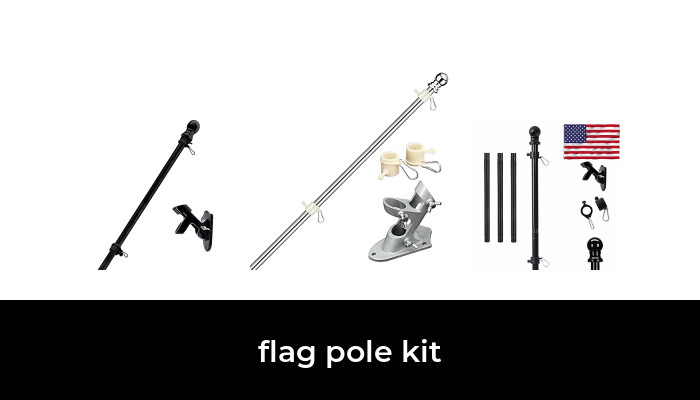
Choose flag fasteners by the way the flag attaches: snap hooks for a halyard rope, rotating rings for a grommeted flag on a stationary house pole, and the pole’s intended attachment for a sleeve-style banner. Those systems solve different problems. A strong clip will not prevent wrapping if the flag has no way to rotate around the pole.
For a measured 1-1/4-inch house pole, the silver Anley aluminum rotating-ring pair is worth considering. If you need fixed attachment points on a compatible 0.7–1.25-inch pole, Anley’s clamp-and-clip kit is another option. For a rope-operated flagpole, select properly sized halyard snaps instead of either of these pole-mounted products.
Match the fastener to your setup
- Flag with two grommets, raised by rope: attach the grommets to halyard snap hooks. Check rope diameter, hook-eye size, gate clearance, and the pole maker’s flag-size limits.
- Flag with two grommets, mounted directly to a stationary pole: use correctly sized rotating rings if wrapping is the problem.
- Fixed attachment on a compatible pole: a clamp-and-clip arrangement can provide adjustable mounting positions. It does not automatically provide free rotation.
- Flag with a sewn sleeve: use the sleeve and its intended retaining tab or attachment. A grommet clip cannot help if there is no suitable reinforced attachment point.
- Small garden flag on a horizontal arm: use the stand’s stopper or garden-flag retaining accessory, not a large halyard hook.
Two useful pole-mounted options
Anley 1.25-inch aluminum rotating rings, silver, two-pack
These rings are intended to let a grommeted flag move around its pole. The set includes two aluminum rings and carabiners. Anley’s manufacturer page distinguishes its ring sizes and lists the larger version for poles from 1 to 1.25 inches; the linked silver variant is identified as the 1.25-inch set.
Best fit: a measured, compatible house pole where a grommeted flag keeps winding around the shaft. Check the exact variant and how the rings slide onto your particular pole. A finial, bracket, coupling, or tapered section may affect installation.
Trade-off: rotating hardware needs enough clearance to move. Poor spacing, overtightening, dirt, or contact with a nearby wall can still stop rotation. Treat the anti-wrap description as the design’s purpose, not a guarantee that the flag will never tangle.

Anley 1.25" Aluminum Flagpole Mounting Rings Set - Anti Wrap 360° Rotatable Ring with Carabiners - Ideal for 1-1/4 Inch Diameter Flag Pole & Flag with 2 Grommets (Silver, Pack of 2)
As an Amazon Associate we earn from qualifying purchases.
Anley clamp-and-clip kit, four-pack, 0.7–1.25-inch range
The Anley clamp kit uses stainless-steel clamps and silicone anti-slip strips to create attachment points on poles within its stated diameter range. Clips allow a grommeted flag to be connected and removed without undoing the whole clamp each time.
Best fit: a setup that needs fixed mounting positions and has a pole surface suitable for clamping. Measure the shaft at both attachment points, particularly if it tapers.
Trade-off: this is not the same mechanism as a rotating ring. If the real complaint is a flag wrapping around a stationary pole, choose a system designed to rotate. Also check with the pole manufacturer before clamping thin-wall, coated, or specialty poles; do not assume more screw pressure is harmless.

For a rope flagpole, choose halyard snaps
Halyard snaps connect the rope to the reinforced holes along the flag’s heading. Nylon versions can reduce metal-on-pole noise and marking. Metal versions are available with different gates, eyes, swivels, and protective covers. Select the complete specification rather than using material alone as a strength rating.
The Annin hardware catalog shows why dimensions matter: its different nylon and brass snap designs are not all the same size, and some are paired with covers. The acceptable flag size depends on the specific hardware and flagpole system, not a blanket rule that every nylon hook is suitable only for one size of flag.
Check three openings: the rope must fit through the snap’s attachment eye, the open gate must clear the flag grommet, and the closed hook must leave the grommet room to move without prying against the gate. A bulky knot or stiff rope can make an apparently large eye awkward to use.
For a tall pole, an internal-halyard system, or a large flag, use the pole supplier’s recommended snaps, retainers, and counterweight arrangement. The small residential fasteners discussed here are not a substitute for a specified commercial hardware set.
Measure before ordering
- Pole diameter: measure the shaft where each ring or clamp will sit. Pole length and diameter are separate specifications.
- Attachment style: confirm grommets, sleeve, rope, or garden stand. Do not buy rings just because a listing says “flag clips.”
- Grommet spacing: measure center to center along the heading and check that both mounts can be positioned accordingly.
- Clearance: make sure clips can open, swivels can turn, and the flag will clear the building, ornament, and bracket.
- System limits: check the pole’s allowed flag size, material, number of flags, and weather guidance. Stronger clips do not increase the pole or bracket’s capacity.
Installation details that prevent common problems
Attaching snaps to a halyard
Follow the flagpole’s instructions and keep control of the rope so it cannot run through the top pulley. In the common loop method, a folded section of halyard passes through the snap’s eye, over the body of the snap, and is pulled snug. The attachment should be secure before the flag is raised.
Adjust the two snaps to the flag’s grommet spacing rather than stretching the heading to meet pre-set clips. Some pole kits use a different knot or assembly sequence, so the supplied instructions take precedence. Annin’s resources include instructions for several pole types and a snap-hook guide.
Installing rotating rings
Fit the rings in the orientation shown by their maker, then attach the flag and set the spacing. Annin’s spinning-fastener instructions specifically caution that excessive heading tension can prevent spinning. That is a useful troubleshooting check, although another brand’s mounting sequence may differ.
Test the motion by hand before leaving the flag up. Keep clamp screws and clips away from the rotating path. Tighten only as directed and avoid improvised shims unless the hardware supplier approves them.
What to check when a flag still tangles or slips
- Wrapping: verify that the rings actually rotate, have room to move, and are not pulled against each other by a taut heading.
- Rings sliding down: recheck pole diameter, surface compatibility, missing pads, and the specified tightening method.
- Clanging: inspect the halyard setup and consider compatible covered snaps or nylon hardware where the pole maker permits it.
- Torn fabric: inspect the grommets and reinforced heading. A stronger hook will not repair weakened cloth.
- Repeated breakage: reassess flag size, exposure, and the complete pole system rather than repeatedly buying heavier clips.
Care and buying advice
Inspect gates, screws, rope, rings, and flag headings whenever you change the flag and after rough weather. Replace cracked plastic, distorted hooks, damaged rope, or components that no longer close or rotate properly. Follow the pole maker’s guidance for taking flags down in severe conditions, and stay clear of overhead electrical lines when handling poles.
Buy by attachment type first, dimensions second, and material third. Rotating rings are the practical choice for wrapping on a compatible stationary house pole; clamp kits suit fixed attachment needs; halyard snaps belong on rope-operated systems. That short decision process is more useful than buying a large assortment of unrelated fasteners.
Image note: Original AI-generated editorial illustration; generic objects shown, not branded product photography.