
For an ordinary external flagpole, start with the rope diameter specified for its pulley and cleat, then choose a purpose-made outdoor halyard. Braided polyester is a practical option where low stretch matters, but there is no single diameter or material that fits every pole. The rope that raises the flag is part of a system: the pulley, clips, cleat and flag size all affect the choice.
If your pole accepts quarter-inch rope and needs a 50-foot length, Huouo’s solid-braid polyester halyard is an identifiable option. A matching-length kit with metal swivel clips can be useful when the attachment hardware also needs replacing. This guide compares those specific products and explains when a manufacturer-specified replacement is the better purchase. Recommendations are based on product documentation, not an outdoor endurance test.
Two flagpole rope options to compare
| Product | Verified package | Suitable shopping situation |
|---|---|---|
| Huouo solid-braid polyester halyard | 1/4-inch diameter, 50 feet, rope only | Your existing clips are usable and the measured rope specification matches |
| Huouo 50-foot rope and swivel-clip kit | White polyester rope with two approximately 3.5-inch nickel-plated clips | You need replacement clips too; confirm the kit rope diameter before ordering |
Huouo quarter-inch polyester rope for a simple replacement
The manufacturer’s rope-only page describes a 50-foot length of quarter-inch solid-braid polyester halyard, also designated number 8. It specifies low stretch and resistance to UV exposure and abrasion. The direct Amazon listing identifies Huouo as manufacturer and the selected 50-foot variant as ASIN B07PK981TC.

Huouo 1/4" Flagpole Rope - Solid Braid Polyester Flag Halyard Line Designed for Flag Pole (50 Feet)
As an Amazon Associate we earn from qualifying purchases.
This is worth considering when your pole already has sound clips, the pulley accepts quarter-inch line and fifty feet is sufficient for the complete route. It avoids buying an ornament, truck or cleat that you do not need.
The important qualification is fit. Huouo markets this length for poles up to 25 feet, but a height claim is not a substitute for checking the actual rope path and hardware. Inspect the replacement line when it arrives, and keep the packaging until you have confirmed its diameter, length and condition.
Huouo rope and clip kit when the hardware is worn
The Huouo kit pairs 50 feet of white braided polyester rope with two metal swivel clips approximately 3.5 inches long. Both its maker page and matching Amazon listing describe nickel-plated clips; the verified ASIN is B08L6KDGZV. This is a different package from the brand’s kit containing four small nylon clips.

Consider it if your current clips are corroded, difficult to open or otherwise due for replacement. Check that the clips pass through your flag’s grommets and work with the pole’s attachment arrangement. The accessible product text does not clearly specify this kit’s rope diameter, so confirm that measurement with the seller before buying. Do not transfer the rope-only product’s quarter-inch specification to a different package without checking.
Buying clips together with rope is convenient, but it is not automatically a better value. If your pole needs a different diameter or specialized fittings, order compatible parts separately.
Polyester, nylon and other rope materials
Concord American Flagpole’s halyard guidance describes purpose-made polyester, nylon and wire-center lines. Its polyester offering emphasizes flexibility and abrasion resistance, while nylon offers greater elasticity and shock absorption. Those are material trade-offs, rather than proof that every rope sold under one fiber name performs equally.
Read the complete material description. A listing that loosely uses nylon, poly and polyester together deserves clarification. Also look for the construction and intended application: smooth, rounded braided halyard is designed to travel through flagpole pulleys. Garden twine or a generic craft cord may be convenient to buy without being an appropriate replacement.
Follow the pole manufacturer’s specified material when it provides one. For example, Annin’s external-halyard installation instructions describe polypropylene rope for that particular system. A general recommendation for polyester should not override the documented requirements of your equipment.
Choose diameter from the hardware
The pulley assembly at the top of a flagpole is often called the truck. Its permitted rope diameter matters as much as the height of the pole. A thicker line can bind or rub rather than providing a useful upgrade, and a cam cleat also needs a compatible rope size to grip properly.
Eder Flag lists maximum rope diameters by truck model, with different groups accepting quarter-inch, five-sixteenths-inch or three-eighths-inch halyard. This is a useful illustration of why a universal height-to-diameter chart is insufficient.
Find the pole or truck model in the original paperwork. If it is unknown, send the supplier photographs and the existing rope measurement. Worn or flattened rope can be difficult to measure accurately, so avoid treating one rough measurement as conclusive. Keep the original specification with your maintenance records once it is established.
How much rope do you need?
For a conventional external loop, Eder recommends a length around twice the flagpole’s height. That is a starting point for shopping, not permission to cut before checking the installation. Account for the actual route, how the ends are joined and the rope needed at the cleat.
When the existing line is the correct length and can be removed safely, measuring it is useful. If it was previously too short, or if you are changing the rigging, ask the pole supplier for the correct replacement length. Buy one continuous piece long enough for the intended system rather than planning extra joins to rescue a short order.
Internal halyards and wire-center rope
An internal system may use a cam cleat, a counterweight and a prepared rope assembly. Others use cable and a winch. These arrangements require model-specific parts; a coil of external flag rope is not automatically interchangeable.
Concord’s internal rope assemblies, for example, include fittings and a safety stop in addition to the line itself. Its wire-center halyard adds a cable inside a fiber shell. If security or an internal mechanism is the concern, identify the complete system before choosing a rope. Do not assume an advertised breaking strength or metal core authorizes lifting, climbing or supporting people.
Replacement and maintenance checks
Before removing an intact halyard, establish how the replacement will be routed. Losing the line over the top pulley can turn a straightforward job into one requiring professional access equipment. If the old rope has already broken, the pulley is jammed or the pole must be lowered, use a qualified flagpole installer. Keep all pole work clear of overhead electrical lines.
Inspect the line and attachment points regularly for fraying, cuts, unusual flattening and damaged clips. Repeated wear in one location suggests you should inspect the hardware too, rather than keep installing new rope. There is no reliable universal replacement interval for every climate, flag size and operating schedule.
Before ordering, confirm the rope material, diameter, continuous length, package contents and compatibility with your pole. For a matching quarter-inch external setup, the Huouo rope-only option is the simplest purchase. Choose a kit only when its rope and clips both fit. For internal or unfamiliar systems, the pole manufacturer’s specified replacement is the safer starting point.
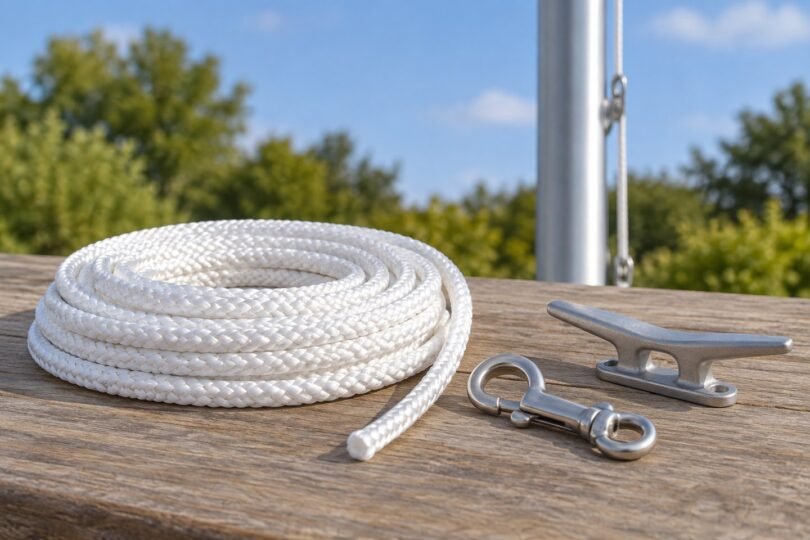
Image note: Original AI-generated editorial illustration; generic objects shown, not branded product photography.