
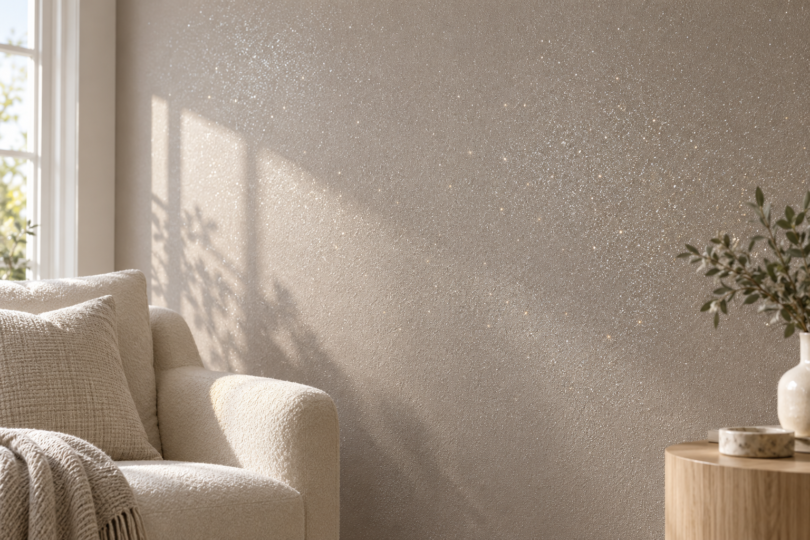

The best glitter paint for walls depends on whether you want to coat an existing color or mix sparkle into a new one. Rust-Oleum Glitter Interior Wall Paint in Iridescent Clear is our pick for a premixed glitter topcoat. Hemway Silver Fine Glitter Paint Additive suits a project using a compatible water-based wall paint. Neither is a one-coat, opaque colored wall paint.
We compared manufacturer instructions, safety documents and exact product identities. These recommendations weigh preparation, finish and buying requirements; we have not applied or durability-tested the products.
Best glitter paint for walls at a glance
| Product | Best fit | What you buy | Main limitation |
|---|---|---|---|
| Rust-Oleum Glitter Interior Wall Paint, Iridescent Clear | A ready-mixed glitter layer over a prepared colored wall | Current manufacturer SKU 323860: 28 fl oz | Clear topcoat; several thin coats and a suitable basecoat are needed |
| Hemway Silver Fine Glitter Paint Additive | Adding silver sparkle to compatible water-based wall paint | 100 g / 3.5 oz additive; paint purchased separately | Trial mixing and dry-surface buffing add work; no standalone coverage figure |
Rust-Oleum Iridescent Clear: best premixed wall topcoat
Choose this when you want glitter already dispersed in a liquid coating. Rust-Oleum describes a clear topcoat with glitter and a slightly textured finish. Iridescent Clear goes over a satin or other non-flat basecoat, so your underlying wall color remains part of the look. Premixed does not mean opaque or self-priming.
For bare drywall and other porous surfaces, Rust-Oleum recommends Zinsser Bulls Eye 1-2-3 white primer, followed by the appropriate colored basecoat. Let each dry according to its own instructions. The coating is for interiors, and the manufacturer excludes surfaces exposed to high humidity, so it is a poor choice for a persistently damp wall.
Build the finish with thin, even layers, stirring regularly to keep the glitter distributed. Rust-Oleum recommends a 3/8-inch nap roller and says full glitter coverage takes three to five coats. Its published yield is up to 30 square feet per quart; that is not a promise of a finished wall area from the current 28 fl oz container. Check the container label and allow for the required coats when buying.
The current manufacturer application guidance gives two hours to touch, two to four hours between additional coats, and seven days until fully dry at 77°F and 50% relative humidity. Cooler conditions need longer. It also says to wait 24 hours before applying painter’s tape and three to five days before hanging pictures. Follow the instructions supplied with your container if they differ.
Why choose it: no separate glitter-to-paint mixing ratio. Main tradeoff: the basecoat and repeated layers make this a multi-stage project. It is best approached as a decorative finish, with a sample area checked in the room’s actual lighting.
The current manufacturer product is 28 fl oz, SKU 323860. The Amazon listing we checked mixed a 28 fl oz selection with a 32 fl oz product photo, so use the manufacturer’s product page to confirm Iridescent Clear and the container size before choosing a retailer.
Hemway Silver Fine additive: best for choosing your base paint
Hemway’s Silver Fine version is a dry glitter additive sold in a 100 g / 3.5 oz pack. It does not supply the colored paint or a clear binder. Choose it if you want to keep control of the base paint and are willing to test the combination before committing to a whole wall.

Hemway Silver Fine Glitter Paint Additive, 100 g / 3.5 oz
As an Amazon Associate we earn from qualifying purchases.
Hemway’s compatibility guidance specifies water-based emulsion paints and advises against oil-based or solvent-based paint. Its product copy uses broader wording elsewhere, so do not assume every acrylic, varnish or lacquer will work. Confirm the exact base paint with its manufacturer and trial a small amount as Hemway recommends.
Hemway specifies 100 g of additive per one litre of paint. Use that metric quantity and the pack’s directions when planning supplies; a single pack is not intended for an entire gallon at that ratio. Apply the compatible paint by its own method, then use Hemway’s recommended buffing pads only once the painted surface has dried to reveal more sparkle.
The base paint determines surface preparation, primer requirements, coverage, recoating and full cure. An additive alone cannot establish those values. Test both adhesion and the finished appearance, including the buffing step, and check the sample under daylight and the room’s evening lighting before buying for a larger area.
Why choose it: you select the base paint’s color and finish. Main tradeoff: compatibility checks, mixing and buffing take more planning than a ready-mixed topcoat. This recommendation is for Silver Fine, not Hemway’s Microfine, Ultrafine or Chunky variants.
How to choose and use a glitter wall finish
Start with the coating type. An opaque wall paint supplies the background color; a transparent glitter topcoat adds sparkle over that color; a loose additive needs a compatible paint to hold it on the wall. Buying glitter intended for crafts or a small spray can is not the same as selecting a documented wall-coating system.
Budget for the complete system: primer where required, base paint, glitter product, application tools and any specified buffing pads. Make a sample before ordering enough for the room. A glitter effect changes with lighting, and a photograph cannot guarantee the sparkle you will see at home.
Read the current label and safety data for the glitter product, primer and base paint. Rust-Oleum’s SDS calls for adequate ventilation, avoiding vapors and mist, splash-protective eyewear and gloves for prolonged contact. Its SDS also says to avoid excess heat. Hemway’s additive SDS calls for adequate ventilation and limiting loose dust. Keep children and pets away from open materials, loose glitter and wet coatings; neither a “water-based” description nor a dry-to-touch surface establishes a universal safe re-entry time.
If preparation would disturb old paint that may contain lead, follow lead-safe guidance before scraping or sanding. Do not use glitter to cover unresolved dampness or assume it replaces necessary substrate repairs. For product-specific preparation and timing, consult Rust-Oleum’s application instructions and Hemway’s directions.
Frequently asked questions
Is premixed glitter paint an opaque wall paint?
Check the formulation rather than the name. Rust-Oleum’s Glitter Interior Wall Paint is a glitter-containing clear topcoat, and its Iridescent Clear version needs a suitable colored base underneath. Hemway’s additive needs a separately purchased compatible paint.
Can I put glitter into any paint?
No universal compatibility is established here. Hemway’s guidance recommends water-based emulsion and excludes oil-based or solvent-based paint. Check both manufacturers’ directions and test a small batch; do not substitute ordinary craft glitter for the specified additive.
How many coats will I need?
Rust-Oleum’s current instructions specify three to five thin coats for full glitter coverage. Hemway has no independent coat count because it is an additive: follow the chosen base paint’s requirements and assess a finished, buffed sample.
When can I use the room again?
Touch-dry, ready to recoat and fully dry are different stages. Rust-Oleum currently gives seven days to fully dry under its stated conditions; Hemway projects depend on the base paint. Follow the ventilation, curing and occupancy guidance for every coating in the system rather than using one fixed re-entry time.
Can I paint over the glitter later?
Rust-Oleum says its wall glitter can be primed and repainted. Sanding is not required for that process, although texture may remain unless further preparation is needed for a smoother finish. For an additive system, ask the base-paint manufacturer how to prepare it for repainting.


