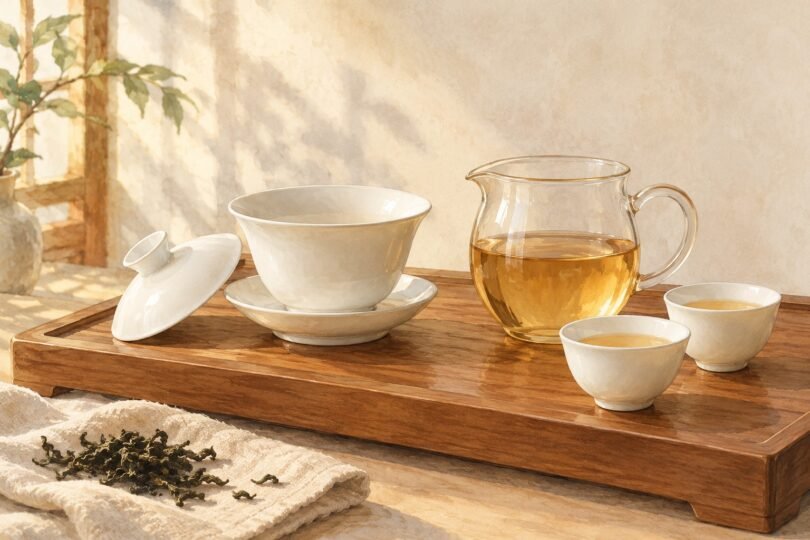

A useful gong fu tea set starts with a brewing vessel you can pour comfortably and cups that suit the amount of tea it makes. A large box of accessories can look impressive, but the important questions are simpler: are you brewing alone or sharing, do you prefer a gaiwan or a handled teapot, and how much liquid will the vessel actually deliver?
For a compact solo setup, consider Mei Leaf’s Gong Fu Solo. For a small teapot-and-cups travel set, look at TeaVivre’s Enamel Porcelain Travel Tea Set. If you already own suitable cups, a plain porcelain gaiwan lets you build a setup one piece at a time. The comparisons below use the sellers’ published specifications; they are not hands-on test results.
Quick choices for different tea sessions
- Solo tasting: Mei Leaf Gong Fu Solo, with one small gaiwan, one cup, a towel and a case.
- A handled brewing vessel: TeaVivre Enamel Porcelain Travel Tea Set, with a teapot, two cups and a storage bag.
- Build your own: Yunnan Sourcing White Porcelain Gaiwan, the 100 ml version, paired with cups you choose separately.
These choices serve different purposes. A single gaiwan is not a complete boxed set, and a two-cup travel set does not automatically include a tray, pitcher, kettle or tea.
Gong fu tea sets worth considering
Mei Leaf Gong Fu Solo: a minimal one-person setup
The Gong Fu Solo set lists a 60 ml white gaiwan, a 50 ml blue Tulip cup, a tea towel and a padded storage case. It is arranged for pouring directly into the cup rather than through a separate fairness pitcher.
Mei Leaf’s Tiny White Gaiwan specifications distinguish 60 ml overall capacity from 50 ml to the lid and identify the material as porcelain. That distinction helps explain why a small cup can suit a vessel with a larger headline number. Leaves still occupy space, and your chosen fill level matters.
Why choose it: fewer pieces to lay out, wash and pack, particularly when trying small quantities of tea. Consider first: it includes one drinking cup, so it is not a ready-made group-serving set. A small bowl also needs to suit your grip; miniature does not automatically mean easier to handle.
TeaVivre Enamel Porcelain Travel Tea Set: teapot and two cups
The Enamel Porcelain Travel Tea Set lists one porcelain teapot, two porcelain cups and a storage bag. The stated capacities are 130 ml for the teapot and 50 ml for each cup. It is an option for someone who wants a small teapot instead of controlling a gaiwan lid during the pour.
The two listed cup capacities total 100 ml. Do not assume that filling the teapot to its nominal maximum will produce exactly two comfortable cupfuls. The product information does not specify a separate working-fill measurement. Start conservatively and check your real output with cool water before brewing.
Why choose it: a coordinated, portable teapot-and-cups arrangement without a large accessory collection. Consider first: the listed contents do not include a fairness pitcher or draining tray. Decorative porcelain should also be handled and packed with care; a storage bag is not a promise against breakage.
Yunnan Sourcing White Porcelain Gaiwan, 100 ml: build around it
Yunnan Sourcing’s White Porcelain Gaiwan for Gong Fu Cha Brewing is a brewing vessel sold separately. Its specification says 100 ml measured to the bowl’s brim, with a stated tolerance of approximately 5 ml. This is not a promise of a 100 ml serving.
Why choose it: you can select your own cups and add a pitcher only if your routine calls for one. It is a sensible comparison point when a bundle includes pieces you already own. Consider first: account for the cost and size of those separate items, and allow room below the rim for safe pouring. Ask about replacement lids and shipping protection before buying if easy replacement matters to you.
Gaiwan or teapot?
A gaiwan is a lidded brewing bowl, commonly supplied with a saucer. Its open shape makes it straightforward to inspect and remove leaves. Pouring requires control of both bowl and lid, however. A teapot offers a handle and spout, which may feel more familiar, but the handle’s size, lid security and pouring angle still deserve attention.
Choose according to your hands and setting. At a desk, a stable arrangement with room to move hot vessels matters more than an elaborate presentation. For travel, consider how the lid, spout and cups are separated inside the case. A seller’s photo of nested pieces should not be treated as proof that every contact point is cushioned.
Match usable capacity to the cups
Nominal capacity can mean water to the rim, water to the lid or another measurement selected by the seller. Brewing output also changes with the quantity and shape of the leaves. Ask which measurement a listing uses rather than comparing the largest number on each box.
A practical home check is to fill the clean vessel with cool water to the level you intend to use, pour into your cup or pitcher, and measure the result. Repeat with your normal tea routine once you are comfortable handling the equipment. Leave headroom in both the receiving vessel and drinking cups.
For shared sessions, work backward from the small portions you want to serve. If two cups each need 35 ml for a comfortable pour, you need roughly 70 ml of brewed liquid for that round. This is serving arithmetic, not a universal recommendation for vessel size or leaf dose.
Materials and accessories that matter
For a first set used across several teas, plain glazed porcelain is a practical starting point. TeaVivre’s gaiwan guidance describes porcelain’s neutral brewing character. Glass makes the leaves visible, but check the maker’s temperature and cleaning instructions. A glass brewing vessel is not automatically a stovetop kettle.
If you want unglazed clay, ask the seller for specific material and production information. Color, a stamp or the words “purple clay” do not independently establish provenance or craftsmanship. There is no need to pay for an origin story you cannot verify.
- Fairness pitcher: useful for collecting a whole infusion before dividing it among cups. Choose enough working capacity for the full pour.
- Tray or catch bowl: useful for managing drips and discarded water; optional when your setup and pouring routine stay tidy.
- Strainer: helpful if you prefer to catch small leaf fragments; it is a preference, not a requirement for every tea.
- Towel and protective case: practical additions, provided the case fits each piece securely.
Start safely and adjust the tea, not just the equipment
Practice lifting and pouring with cool water before using hot water. Keep the setup stable, avoid overfilling and leave clear space for the pour. TeaVivre’s handling guide recommends an outward-flared rim and careful lid-gap control. If the bowl feels too hot or insecure, set it down and change your setup rather than trying to tolerate the heat.
Use the tea supplier’s instructions as your starting point for leaf quantity, water temperature and infusion time. A single ratio does not suit every oolong, green tea, black tea or pu-erh. Change one variable at a time, taste the result and drain the brewing vessel as appropriate for the method you are following. Let components cool before washing, follow their care instructions and dry everything before packing.
Common buying questions
Do I need a complete matching set?
No. A suitable brewing vessel and cup can be enough for a solo session. Buy extra pieces when they solve a real serving or cleanup problem.
Is a larger set better value?
Only if you will use the contents. Compare the brewing vessel, usable capacity, cup sizes and replacement options before considering the total piece count.
What should I check before ordering?
Confirm the exact bundle, capacities and materials, then check shipping costs, damage-reporting instructions and return conditions. For a beginner, a comfortable, straightforward set is a better starting point than a crowded tray of unfamiliar tools.