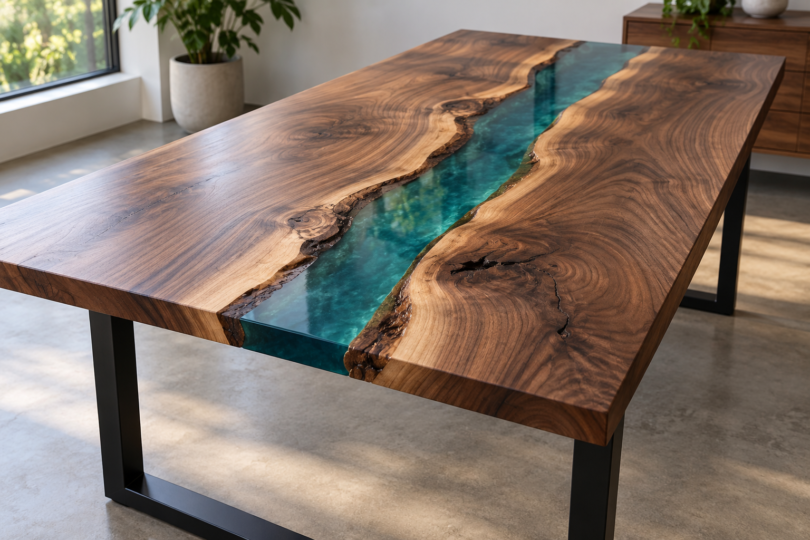

The best epoxy resin for a river table is a casting system whose depth, volume and temperature limits fit your actual channel. Our two picks are EcoPoxy FlowCast for 1/2–1 1/2-inch layers and WiseBond Deep Pour 2:1 for river pours up to 2 inches. Both are purpose-made casting resins; choose between them by the pour plan and curing schedule.
These recommendations compare documented applications and limitations. Before buying, measure the resin channel and check the instructions and safety data sheets for the exact resin and hardener supplied with your kit.
Best epoxy resins for river tables at a glance
| Resin | Best fit | River-table layer | Main buying consideration |
|---|---|---|---|
| EcoPoxy FlowCast | Projects with a planned layer volume and time for a slow cure | 1/2–1 1/2 inches; maximum recommended volume 30 L per layer without additional cooling | 68–77°F workspace and materials; small volumes cure more slowly |
| WiseBond Deep Pour 2:1 | A river channel requiring a layer up to 2 inches | 1/2–2 inches for river-table pours | Large pours need cooler conditions; verify the maker’s conflicting temperature guidance for your kit |
1. EcoPoxy FlowCast: best for planning by layer volume
FlowCast is our first choice when you want a clearly stated depth-and-volume envelope. EcoPoxy specifies 13–38 mm per layer, up to 30 L without additional cooling. It mixes at 2 parts resin to 1 part hardener by volume. The manufacturer recommends keeping the resin, mold and workspace at 20–25°C, or 68–77°F.
The tradeoff is patience. EcoPoxy’s reference river casting, about 14 L at 1 1/2 inches deep and 70°F, has an 8–12-hour working window, a three-day demolding time and a 7–14-day full cure. Those are reference conditions, not a promise for every table. Thin sections and small volumes can take longer; demolding also happens before full cure.
The selected 6 L FlowCast kit contains 4 L of Part A resin and 2 L of Part B hardener. Check that the listing says FlowCast: FlowCast SPR is a separate small-project formula. Plan a separate seal-coat and finishing step using the manufacturer’s guidance; this casting selection does not make a coating resin interchangeable with the river fill.

EcoPoxy FlowCast Deep Pour Epoxy, 6 L Kit
As an Amazon Associate we earn from qualifying purchases.
2. WiseBond Deep Pour 2:1: best for a 2-inch river layer
WiseBond Deep Pour is the option here for a river layer between 1/2 inch and 2 inches. The selected 1.5-gallon kit includes 1 gallon of A-resin and 1/2 gallon of B-hardener, mixed 2:1 by volume. Its deeper object-casting claims do not increase the 2-inch river-table limit.
Check the temperature guidance carefully. The dedicated mixing instructions specify components at 65–77°F, workspace air no warmer than 77°F, and cooler conditions below 75°F for large deep pours. The storefront also lists a warmer 77–85°F range. Confirm the correct instructions for your supplied kit with WiseBond before pouring if the label or other guidance conflicts; do not use the warmer storefront range to justify a large deep pour.
Allow for the full curing schedule. WiseBond’s instructions describe roughly 72 hours before sanding and shaping, seven days before light use, and continued hardening for up to 30 days. Temperature and the pour’s dimensions and mass affect those times. This formula is not intended for a normal 1/8-inch flood coat, so include a suitable finishing product in your project budget.

How to choose enough resin for your table
Calculate the channel volume before comparing kit prices. EcoPoxy’s river-table guide uses length × average width × depth in inches, divided by 61.024, to estimate liters; it recommends adding at least 5–10% for cracks, voids and holes. Irregular live edges make the average width important. A kit’s total yield is not automatically an appropriate amount to pour in one layer.
Choose a casting resin for the channel and a compatible coating or finish for the surface. Both manufacturers distinguish deep casting from thin coatings and recommend preparing or sealing the wood. If your channel exceeds the chosen resin’s layer limit, plan multiple pours using that system’s recoat instructions. Do not transfer cure times, mix ratios or depth limits from another formula.
For a useful cost comparison, include the total resin needed, seal coat, colorants, mold supplies, finishing materials and required protective equipment. Buy the exact formula and kit quantity your plan requires; a smaller bottle of fast-curing craft resin is not an equivalent deep-pour purchase.
Safety checks before buying and pouring
Uncured epoxy is not harmless. The resin components of these systems carry skin-irritation and allergic-skin-reaction warnings; the hardeners carry serious-eye-damage warnings. The manufacturer-linked US FlowCast Part A SDS also lists H341: “Suspected of causing genetic defects.” Both hardeners’ US SDSs warn that they are harmful if swallowed or in contact with skin. FlowCast hardener additionally carries a severe-skin-burn warning. Read both component SDSs, including their other health and environmental hazards: EcoPoxy links its US sheets on the FlowCast page, and WiseBond provides separate Deep Pour A and B sheets.
Set up the ventilation and protective equipment required by those documents before opening the containers. Use compatible chemical-resistant gloves, protective clothing and the specified eye/face protection. Respiratory protection depends on the exposure and ventilation assessment in the SDS; “low odor” or “zero VOC” is not permission to skip controls. NIOSH cautions that smell does not reliably indicate whether an exposure is safe.
Curing epoxy releases heat. Larger masses, deeper layers and warmer conditions can increase heat buildup, so follow the exact product’s limits and heat-management instructions. A slow-curing label does not make an oversized pour safe. Include the curing period in your workspace plan, and use the specified dust controls and protective equipment when sanding or cutting.
Frequently asked questions
Can I use ordinary tabletop epoxy for the river?
Choose by the formula’s casting instructions. A resin designed for a thin surface coating is not automatically suitable for filling a deep channel. FlowCast and WiseBond Deep Pour are casting selections; check a separate coating product’s instructions for the finishing layer.
Does a 2:1 ratio mean I can measure by weight or volume?
No. The 2:1 ratio here is by volume. FlowCast specifies 2.3:1 by mass, while WiseBond’s technical sheet lists 100:44 by weight. Use the method and ratio specified for the exact kit; do not treat those measurements as interchangeable.
Can I make a food-preparation surface with these resins?
Do not assume a furniture resin is suitable for cutting or preparing food. WiseBond’s instructions describe incidental food exposure only after a full 30-day cure and say it does not have FDA approval for direct, long-term food contact. Its storefront’s testing statement applies to correctly prepared clear epoxy under specified room-temperature conditions; adding colorant changes that qualification. WiseBond explicitly says not to cut on or prepare raw food on epoxy. Get written guidance for your intended contact and finish before using a resin surface with food.
Will clear river-table epoxy stay clear forever?
Do not buy on that promise. EcoPoxy says all epoxies yellow over time, that UV stabilizers eventually lose effectiveness, and that finished FlowCast projects should not be kept outdoors. Consider the room’s light exposure and the manufacturer’s finish recommendations when deciding between a clear and pigmented river.
Which of these two should I buy?
Choose FlowCast when its 1/2–1 1/2-inch layers, 30 L volume guidance and slow curing schedule suit your plan. Consider WiseBond Deep Pour when you need a river layer up to 2 inches and can meet its project-specific temperature and curing requirements. For either system, settle the pour plan and safety setup before ordering the kit.