
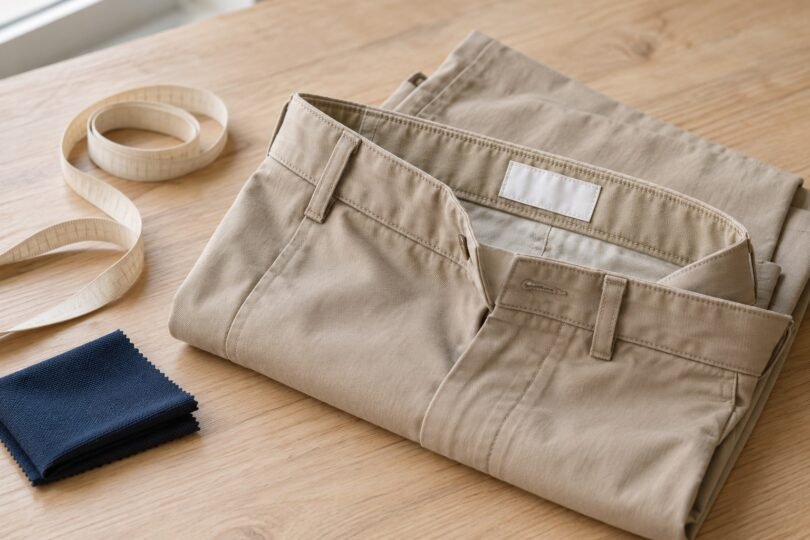

If the label in your favorite trousers says Haggar WPL 386, you have a useful clue to the company, but not enough information to reorder the same pants. The FTC’s registration record identifies WPL 386 with Haggar Clothing Co. It does not identify a particular collection, fit, fabric, waist size or inseam.
The practical next step is to find the garment’s separate style information and compare its construction with a named Haggar model. This guide explains what to photograph, what to measure and how to avoid buying a different pair simply because the seller includes the same WPL number.
What WPL 386 actually means
The FTC explains that WPL numbers were issued to companies under the Wool Products Labeling Act. Although it no longer issues new WPL numbers, existing numbers remain in use in the same way as registered identification numbers, or RNs. These identify the responsible business rather than an individual garment. See the FTC’s RN and WPL FAQ.
Consequently, two pants labels carrying WPL 386 can belong to different styles. The number alone does not establish that your trousers are Cool 18, Premium No Iron Khaki or another collection. It also does not prove that the fabric contains wool, reveal a manufacturing year or authenticate a secondhand listing. Read the actual fiber-content and care labels for garment-specific information.
Identify the pants you already own
- Photograph every label, front and back. Include the waistband branding, care label, size tag and any smaller tags tucked behind them. Copy letters as well as numbers. A style reference is more useful than the WPL number for finding a replacement.
- Record the collection and fit separately. A collection name describes a product family; classic, straight and slim describe different cuts. Neither is interchangeable with waist and inseam.
- Copy the fiber percentages. Write down the whole blend, not just the word “stretch.” A cotton blend and a polyester pant can look similar online while feeling different in use.
- Document the construction. Note flat or pleated front, cuffs or plain hems, waistband expansion panels, shirt-gripper strips and the front and back pocket shapes. Photograph details that matter to you.
- Check for alterations. A hemmed inseam, changed waist or tapered leg can explain why another pair with the same printed size fits differently.
If the identifying tag is unreadable, keep the best photographs and measurements together. Contact Haggar customer service with those details and ask whether the style can be identified or whether there is a comparable current option. Avoid treating a suggested alternative as an exact replacement unless the relevant style information agrees.
Two clearly identified Haggar styles to compare
These are comparison starting points, not a claim that either matches every WPL 386 garment. Both have their own style references. Choose by the features you need after identifying your original pair.
Premium No Iron Khaki HC10884: cotton-blend, classic-fit option
Haggar’s HC10884 product page specifies a classic fit, flat front, hidden expandable waistband and a blend of 61% cotton, 37% polyester and 2% spandex. The maker describes the waistband as expanding up to three inches and lists the pants as machine washable and no-iron.
This is a useful candidate if you want a cotton-blend flat-front khaki with added waist flexibility. It is a poor substitute for a pleated pair when pleats are part of the fit and appearance you want to retain. Treat the no-iron description as a maker feature, not a promise that the pants will never crease in storage or wear.

Haggar Premium No Iron Khaki HC10884, Classic Fit Flat Front, British Khaki, 40W x 30L
As an Amazon Associate we earn from qualifying purchases.
The linked Amazon variant is specifically British Khaki, 40W × 30L. Other sizes and colors are separate selections; confirm the full combination after opening the listing. The card is a purchase option for that identified variant, not a universal WPL 386 replacement.
Cool 18, style 41114529498: polyester flat-front option
The Haggar Cool 18 product page identifies this style as classic fit with a flat front, 100% polyester fabric and a hidden expandable waistband. Haggar lists moisture wicking, no-iron care and machine washability among its features.
Compare it if you are replacing a polyester pair or specifically want the maker’s moisture-wicking feature. Do not assume that Cool 18 and Cool 18 Pro are the same product, or that another fit within a similarly named collection has the same waistband and fabric. The exact style page and garment label are the useful reference points.
Fit: match more than the waist number
According to Haggar’s fit guide, classic fit gives more room through the seat and thigh and its widest leg opening. Straight/tailored fit runs straight through the seat and thigh. Slim fit is narrower through the thigh with a slightly tapered leg. These distinctions help explain why the same waist-and-length combination can feel different across styles.
Use your comfortable pair as a comparison tool. With the trousers laid flat and unstretched, record the waistband width, front rise, thigh width and leg-opening width. Measure the inseam along the inside seam from the crotch to the hem. These are garment measurements, so compare them with another garment measured the same way, rather than assuming they equal body-size-chart measurements.
For a secondhand purchase, ask the seller how the measurements were taken. A stretched waistband measurement can make a pair appear larger than it is at rest. A different front rise may also change where the waistband sits on your body. Buy the size that works without depending on the expansion panels being fully extended.
Before buying a replacement
- Check all variant selectors. Read collection, fit, front style, color, waist and inseam together. A product page can combine many variations, and its reviews may discuss several of them.
- Compare color names, then allow for uncertainty. Khaki, British Khaki and other named shades should not be assumed identical. Screen settings, lighting and fading in your older pair can affect the comparison.
- Read the care label for the selected style. Do not transfer washing, drying or ironing instructions from another Haggar pair solely because both carry WPL 386.
- Check returns before altering the pants. Try them standing and sitting, with the shoes and belt you intend to use. Keep the tags and packaging until you have checked the seller’s return conditions.
- Save the useful identifiers. Once a replacement works, photograph its tags and keep the full order description. That makes the next replacement search much more precise.
Common questions about the label
Can I search only for “Haggar WPL 386”?
You can, but expect broad results. Add the style code, collection, front construction and fit whenever you have them. A listing that repeats the WPL number without showing the other labels has not established an exact match.
Does WPL mean the trousers must be vintage or wool?
No. The FTC says older WPL numbers remain in use. The company identifier does not date your particular pair, and its fabric must be determined from the fiber-content label.
What if the exact style is no longer offered?
Prioritize the characteristics that made it work: room through the seat and thigh, rise, waistband construction, fabric blend and leg shape. Compare those with a clearly named alternative, and leave time to try it before a work trip or special event. An accurately chosen substitute is more useful than a listing that merely repeats the same company number.
This guide compares publicly documented specifications and label-identification information. It does not report hands-on wear tests or rank these styles by unverified comfort scores.


