
The best canned haggis for your meal depends on the recipe, the amount you can actually serve and the country where you are buying it. A Scottish tin containing a whole haggis in a casing is different from a U.S.-made product packed directly into a can, even when the brand name is the same.
For a first purchase, choose a clearly identified product with a readable ingredient panel, a stated can count and storage instructions. If you are buying in the United States, start with a seller that can document the exact product’s origin and supply it domestically. A Scottish-looking label or an overseas marketplace listing does not settle those questions.
Which type of canned haggis should you choose?
- For a whole haggis presentation: look for a product explicitly sold in a casing inside the tin. Check drained weight as well as net weight before planning portions.
- For a meat-free meal: choose the specifically labeled vegetarian or vegan recipe. The traditional and vegetarian versions of a brand are separate products.
- For an easy pantry meal: check that the exact can is shelf stable before opening, then compare the quantity, preparation method and delivered cost.
- For U.S. buyers: verify the U.S. formulation and label. Do not transfer the ingredient list or cooking directions from a similarly named British tin.
Three canned haggis labels worth understanding
These examples show the differences to check when shopping. The Stahly specifications below describe its Scottish products; the Grant’s example describes its UK listing. They are not a promise of U.S. delivery or interchangeable versions of one recipe.
| Product | Published package information | What matters when choosing |
|---|---|---|
| Stahly Traditional Scotch Haggis In A Skin | 410 g net; 232 g drained; made in Scotland | A whole haggis in the tin. Use drained weight when judging the amount of haggis served. |
| Stahly Vegetarian Haggis | 410 g net; 232 g drained; made in Scotland | The maker identifies this Scottish version as suitable for vegetarians and vegans; it also comes in a synthetic casing. |
| Grant’s Canned Premium Haggis | 392 g can; the maker’s shop offers six-can and twelve-can packs | Distinguish the weight of one tin from the number of tins in the order. This is a meat recipe containing oatmeal. |
Sources: Stahly Traditional Scotch Haggis, Stahly Vegetarian Haggis and Grant’s product information.
Stahly Traditional Scotch: check the drained weight
Stahly’s ingredient information describes a recipe combining lamb offal and beef suet with oatmeal, plus onion, water, pepper and salt. Its Scottish product page gives a minimum two-year shelf life and says refrigeration is unnecessary before opening. Follow the date and storage directions on the actual tin.
The 410 g net figure and 232 g drained figure are different measurements, not two pack sizes. If you need a particular amount of haggis for dinner, use the drained figure rather than assuming the larger number is all edible haggis. Choose the number of tins around the portion you intend to serve and your side dishes.
Stahly Vegetarian: a separate recipe
For the Scottish vegetarian version, the maker lists oatmeal with red lentils, kidney beans, mushrooms, turnip and onions, plus vegetable oil flake, water, pepper and salt. Its vegan designation applies to that named product. It does not establish that a different haggis, a sauce served alongside it or another country’s formulation has the same ingredients.
Stahly’s product information warns about gluten and does not guarantee freedom from nuts. Check the current label’s complete allergen statement.
Grant’s Premium: confirm the can count
Grant’s lists lamb lobes at 45% and oatmeal at 19%, accompanied by suet, onion, water, spices and salt. Its product page specifies 0.392 kg and offers six-pack or twelve-pack selections; its FAQ says direct orders start at six cans. A retailer selling one 392 g tin is therefore a different purchase quantity from the maker’s multipacks.
The UK retailer’s label information for Grant’s Premium Haggis identifies oats as an allergen, describes the product as cooked lamb lungs with oatmeal and spices, and gives the origin as the United Kingdom. The maker’s product photograph states that it is made in Scotland. Check those details against the label you receive, especially when a seller offers several sizes or markets.
Buying canned haggis in the United States
Stahly provides a particularly clear example of why country-specific details matter. Its North American information page describes U.S. production and says that the American product is packed directly into the can without a skin. It also says orders for the United States and Canada cannot ship from its Scottish operation. That page is useful for distinguishing the formats; confirm the present seller, pack size, ingredients and availability before ordering.
The U.S. restriction is more specific than saying every food called haggis is illegal. The current USDA meat-inspection regulation, 9 CFR 310.16, prohibits saving livestock lungs for human food. A lung-containing recipe and a U.S.-made alternative must not be treated as the same product.
Import requirements are a separate question. USDA APHIS guidance distinguishes traveler baggage from goods sent by mail, which it treats as commercial shipments. Travelers must declare agricultural products, and inspectors decide admissibility. Do not assume that a sealed tin or a retailer’s willingness to accept an order establishes permission to import that specific meat product.
How to compare value and serving size
- Identify the exact recipe. Traditional, vegetarian, whisky and meat-specific versions can differ in ingredients and preparation.
- Separate can size from order quantity. Record both the grams or ounces per can and the number of cans included.
- Check for drained weight. Where supplied, it is the more useful figure for comparing the portion left after the packing liquid is removed.
- Compare the delivered total. Divide the cost, including shipping, by the quantity you intend to use. Keep the weight basis consistent between products.
- Plan around your meal. A starter, a baked-potato filling and a main course need different amounts. A manufacturer’s serving suggestion is a guide, not a guarantee that a tin will feed your particular group.
Heating canned haggis
Follow the directions for the exact tin. Do not apply instructions for a chilled butcher’s haggis to a canned one, or casing instructions to a product packed loose. Remove the food from the metal can before microwaving it.
For its Scottish haggis, Stahly’s published microwave method removes both tin and skin, breaks the contents into a microwave-safe dish, then covers and heats them for about four minutes at 800 watts with occasional stirring. Its casing has metal clips and is not edible. Use the current label if its directions differ.
Grant’s UK label information gives a different microwave setting: 850 watts for four minutes in a covered microwave-safe dish, stirring halfway through, then stirring again and standing for one minute. It also permits gentle heating in a saucepan with occasional stirring. Food should be piping hot before serving. Those directions belong to that 392 g product, not every haggis brand or can size.
Storage before and after opening
A metal tin alone does not prove a food belongs in the pantry. USDA explains that some canned foods still require refrigeration. Check the label: shelf-stable unopened haggis, chilled haggis and frozen haggis need different handling.
Keep pantry cans in a cool, dry place and avoid bulging, leaking, badly rusted or deeply dented cans. Once opened, refrigerate the remaining food and follow the product’s use-within period. For example, Grant’s UK label specifies an airtight non-metallic container and use within two days. USDA’s general advice for opened low-acid canned foods, including canned meat, is three to four refrigerated days; the shorter product-specific instruction takes priority. See USDA’s shelf-stable food guidance.
Common questions
Is canned haggis the same as fresh haggis?
The name describes the dish, not one storage format. Buy and store the exact product according to its label. A shelf-stable can should not be confused with a chilled or frozen haggis, and some canned versions contain a casing while others do not.
Is canned haggis gluten free?
Do not assume so. A canned or vegetarian label does not establish gluten-free suitability. Check the exact product’s complete ingredient and allergen panel before buying.
What should I serve with it?
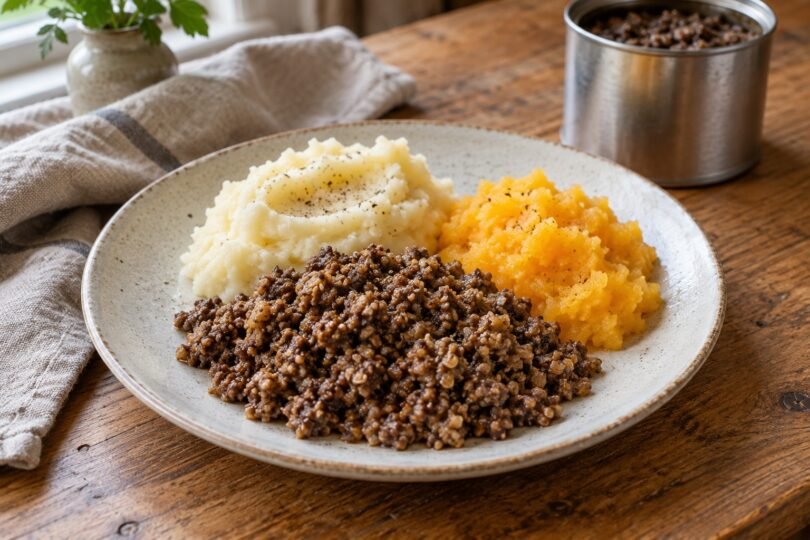
Mashed potatoes and mashed swede make a straightforward supper. For a smaller meal, serve the prepared haggis as a baked-potato filling. Check the ingredients of sauces and sides as carefully as the haggis when catering for dietary requirements.
Should I start with a multipack?
If you have never tried that exact recipe, a single tin can be a more practical first purchase when a seller offers it. Buy a larger pack when its quantity, storage life and delivered cost fit a meal you have planned.