A standard SMA male-to-male adapter joins two standard SMA female connections. Both ends of the adapter should have internal threads and a center pin. Check those two details before shopping: an RP-SMA male-to-male adapter has center sockets instead, despite its similar-looking threaded body.
For a simple connection, choose between a rigid barrel and a short coaxial jumper. A barrel minimizes extra cable, while a jumper gives you more freedom to position the equipment without loading a small antenna socket. Below are two verified general-purpose buying options, followed by the compatibility and specification checks that matter more than a “best adapter” ranking.
Identify all four SMA connector types
- SMA male: internal threads, center pin.
- SMA female: external threads, center socket.
- RP-SMA male: internal threads, center socket.
- RP-SMA female: external threads, center pin.
Amphenol’s connector documentation describes reverse polarity as a change to the contact arrangement. It does not mean that the threads screw in the opposite direction. A connector’s shell alone is therefore not enough to identify it.
If both existing ends have external threads and center sockets, a standard SMA male-to-male part is the connector configuration you are looking for. If either end has a center pin, stop and recheck the interface. Do not force two pins together or accept a connection that threads on but leaves two sockets facing each other.
Rigid coupler option: Superbat GP-KIT-AC-05

SUPERBAT SMA Male to Female 6inches RF Coax Cable & 5pcs Adapter Kit - SMA/SMA/RPSMA, All in one Convertor for WiFi/Ham Radio/GPS/3G 4G LTE Antennas and More
As an Amazon Associate we earn from qualifying purchases.
The Superbat GP-KIT-AC-05 is a 6-inch RG316 cable-and-adapter kit that includes one standard SMA male-to-male adapter. The manufacturer’s kit description also lists SMA female-to-female, SMA female-to-male, SMA female-to-RP-SMA male and SMA male-to-RP-SMA female adapters. The stated impedance is 50 ohms.
This makes sense if you need a male-to-male barrel and will also use the other fittings for low-stakes receiver or hobby connections. It is unnecessary to buy a whole assortment when you only need one precisely specified coupler. Keep the reverse-polarity pieces labeled so that they are not mistaken for ordinary SMA parts later.
The exact linked variant is the GP-KIT-AC-05 with 15cm/6-inch cable length. The 30cm/12-inch GP-KIT-AC-06 is a different variant. A single listing can show both, so confirm the selected option before ordering. The cable itself starts as male-to-female; the male-to-male connection is supplied by the separate adapter.
Limit: the checked product information does not provide a detailed frequency-by-frequency insertion-loss or return-loss specification. Treat it as a general-purpose kit, not a calibrated microwave adapter or an automatically suitable high-power transmitter accessory.
Flexible option: Superbat GP-AC-SMA-24
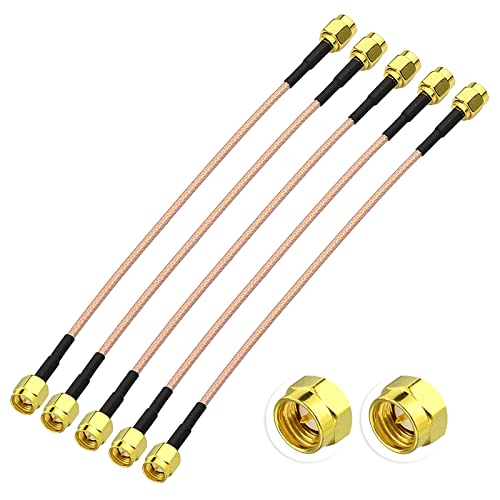
If a rigid adapter would place the connected devices at an awkward angle, the GP-AC-SMA-24 offers a short cable instead. Superbat specifies five 6-inch RG316 jumpers, each with standard SMA male connectors at both ends and 50-ohm impedance.
This is useful when connecting a small receiver or module to nearby equipment while leaving room to support the cable. The flexible section can reduce the need to use the socket as a lever, although the cable still needs strain relief. Avoid pulling it taut or suspending a heavy coax cable from the small SMA connector.
The trade-off is an extra length of coax and its associated loss. A cable assembly and a rigid barrel are not electrically identical just because their ends match. Pick the shortest practical length, and obtain measured performance information if losses at your operating frequency affect the application.
Choose the straight, 6-inch, five-pack variant. Other lengths, right-angle cables and similarly named listings should be evaluated separately. The brand’s product data directly links this model to the listed ASIN, avoiding a guess based on a similar product photo.
What to check beyond connector fit
Impedance
Both options above are specified as 50-ohm products. Match that to the rest of the RF system. The existence of an adapter between two connector families does not make it an impedance-matching device. A 75-ohm television coax installation is not automatically a suitable application for a 50-ohm SMA jumper.
Frequency range and loss
Look for a published maximum frequency and performance across the band you will use. Insertion loss tells you how much signal is lost through the part. Return loss or VSWR describes the quality of the impedance match. A broad list of words such as “GPS, Wi-Fi, LTE and radio” does not replace those specifications.
Manufacturer-rated adapters can differ substantially. For example, a Pasternack technical datasheet states separate frequency, VSWR and insertion-loss limits for a specific SMA adapter. Those limits belong to that exact part and cannot be transferred to another gold-colored coupler. For precision measurements or a critical link, buy against a proper datasheet and traceable part number.
Power and DC requirements
Before attaching anything to a transmitter, check the system’s power rating, operating frequency and any DC bias used for active antennas or amplifiers. Do not assume a passive adapter is an attenuator, DC blocker, surge protector or impedance transformer. A connector that physically fits can still expose connected equipment to unsuitable power or voltage.
Mechanical load and environment
A rigid barrel is appropriate only when the connected items can align without bending the ports. A short jumper is often easier to support when equipment sits at different angles. Neither of these products should be treated as weatherproof simply because it has threaded metal connectors. An outdoor installation needs appropriate components, sealing and protection specified for the complete system.
Connect it without damaging the equipment
- Turn equipment off before changing the connection, following its manufacturer’s procedure.
- Inspect both center contacts and threads for damage, dirt or loose metal. Do not use a bent pin or visibly damaged fitting.
- Align the parts straight and start the coupling nut gently by hand. Stop if it cross-threads or resists.
- Support the equipment and cable while tightening the coupling nut, rather than twisting the device body.
- Use the equipment manufacturer’s torque recommendation and the correct tool where specified. Do not apply a universal tightening value to every connector material or device.
Keysight’s connector-care guidance emphasizes inspection, careful alignment and turning the coupling nut rather than the attached device. A damaged inexpensive connector can damage the more expensive socket it is attached to.
Common buying mistakes
Buying RP-SMA because the name looks close: inspect the center contacts and match the exact polarity. Buying an F-type TV coupler: it is a different connector family. Buying a male-to-female extension: it will not join two female SMA ports without another appropriate fitting.
Also avoid stacking several adapters merely because you already own them. Each additional connection adds mechanical length and another possible fault point. When reception changes after installation, first inspect the mating interfaces, confirm the selected part and compare with a known-good connection.
Bottom line: confirm that you need two standard SMA male ends, then choose a rigid coupler or short flexible jumper. The Superbat kit is a practical assortment containing that coupler; the GP-AC-SMA-24 is the clearer choice for a flexible male-to-male connection. For demanding RF work, a documented frequency and power specification should decide the purchase.
Image note: Original AI-generated editorial illustration; generic objects shown, not branded product photography.