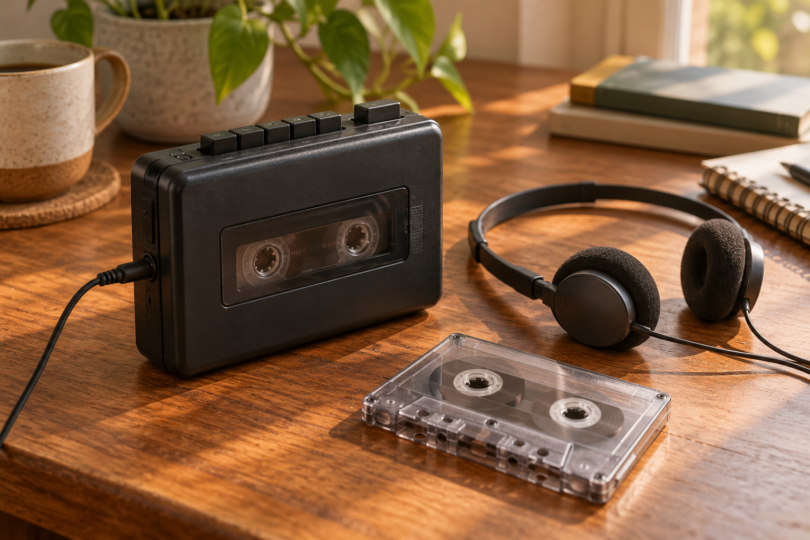

For a portable cassette player used with wired headphones, the FiiO CP13 is our focused playback pick. Choose the We Are Rewind WE-001 if Bluetooth output and recording mixtapes matter more. Choose the Sony CFD-S70 if you want built-in speakers, CD playback and tape recording in one carryable boombox. These three suit different jobs; none is ranked here from a listening test.
Check what “portable” means for your plans. The two personal players suit a headphone setup, while the Sony is a larger boombox that can run on batteries. Also separate playback from recording: a tape player need not record, and Bluetooth output does not by itself mean it can record a wireless source. Match the tape type, output and recording input to your intended use.
Best portable cassette players at a glance
| Player and exact selection | Best fit | Playback and recording | Output and power |
|---|---|---|---|
| FiiO CP13, Transparent | Simple wired-headphone listening | Playback only; manual rewind/fast-forward; no auto-reverse | 3.5 mm headphones; built-in rechargeable battery; USB-C charging |
| We Are Rewind WE-001, Amy black/yellow | Bluetooth listening and line-input recording | Stereo playback; records to Type I tape from a wired audio source | 3.5 mm headphones or compatible Bluetooth devices; built-in rechargeable battery |
| Sony CFD-S70, black, US power version | Room listening and CD/radio-to-tape recording | Type I tapes only; record from CD, radio or AUDIO IN | Built-in stereo speakers and headphone socket; 120 V AC or six C batteries |
1. FiiO CP13: best for focused wired listening
The selected CP13 has the transparent finish. Its transport gives you physical play, stop, rewind and fast-forward controls, with a 3.5 mm headphone output and a volume knob. FiiO deliberately omitted recording and auto-reverse. That makes it a straightforward choice when playing tapes is the goal and you already have wired headphones.
Pros: a dedicated playback layout and rechargeable power through USB-C. Cons: no Bluetooth, no recording, no auto-reverse and no Dolby noise reduction. FiiO says it can play Types I–IV but recommends Type I tapes. Those limits matter more than assuming a new player will reproduce every feature of an older deck.
FiiO’s power specifications rate playback at at least 13 hours under its stated test conditions; your tape, load and volume can change runtime. The headphone jack is the audio output and USB-C is the charging port. Its FAQ also warns that rewind or fast-forward buttons may not release at the tape end, so stop the transport manually.

FiiO CP13 cassette player, Transparent
As an Amazon Associate we earn from qualifying purchases.
2. We Are Rewind WE-001: best for Bluetooth and recording
The selected Amy version is black and yellow. The WE-001 combines stereo tape playback with a headphone socket, Bluetooth output and stereo recording through its wired 3.5 mm input. Choose it if wireless listening or making tapes from an audio source is central to the purchase. Use Type I cassettes for recording, as the manufacturer specifies.
Pros: Bluetooth output and line-input recording in one personal player. Cons: recording needs the appropriate wired source; the maker says a microphone requires a preamplifier to reach the line-input level. The maker also lists an in-ear-earbud compatibility exclusion, so check your exact Bluetooth headphones before buying. Do not assume every wireless device will pair.
The WE-001 FAQ describes automatic recording-level control, no Dolby system and a built-in battery that is not replaceable. It quotes up to ten hours of use and typically four to five hours for a full charge. The Amy retailer selection here is not the maker’s separate belt-clip bundle; verify accessories on the exact order rather than assuming a clip or blank tape is included.

3. Sony CFD-S70: best for speakers and multiple sources
The black CFD-S70 is the carryable-boombox option: built-in stereo speakers, a CD player, AM/FM radio, a cassette deck and a headphone socket. Its recording workflow covers CDs, radio and an external source connected to AUDIO IN. Choose it for a room, workbench or occasional move between locations rather than a pocket headphone setup.
Pros: speakers and several audio sources in one device, plus recording without a separate cassette recorder. Cons: Sony’s instructions limit both tape playback and recording to Type I cassettes, and portable power takes six C batteries. The selected US version uses 120 V AC; check the label before using it with another country’s mains supply.
The Sony operating instructions describe play, pause, stop/eject, fast-forward and rewind controls. Stop fast winding when the tape reaches the end instead of leaving the button engaged. Sony also instructs users to connect AC power for recording to avoid an unexpected power-related recording failure.

What to check before choosing a cassette player
Pick the output first: wired headphones, compatible Bluetooth headphones or speakers in the unit itself. Then decide whether you need to record and from which source. Playback support for a tape type does not imply recording support for that same type. In this shortlist, the CP13 does not record, the WE-001 records Type I tapes from line input, and Sony specifies Type I tapes for its deck.
Follow the player’s maintenance directions and inspect old tapes before playing them. We Are Rewind recommends cleaning the head, pinch roller and capstan and advises against C-120 tapes. Keep expectations realistic about tape noise: both the CP13 and WE-001 lack Dolby decoding. A feature list alone cannot establish which unit sounds best with your tapes.
Frequently asked questions
Can the FiiO CP13 record new tapes?
No. FiiO explicitly leaves out recording and auto-reverse. Choose the WE-001 for line-input recording or the Sony for recording from CD, radio or its external audio input.
Which player works with Bluetooth headphones?
The WE-001 provides Bluetooth output, subject to device compatibility. Its maker excludes in-ear earbuds in the product specifications. The CP13 has no Bluetooth and uses a wired 3.5 mm headphone output.
Can I use Type II or metal tapes in every player here?
No. Sony specifies Type I only for both playback and recording. FiiO says the CP13 can play Types I–IV but recommends Type I. We Are Rewind lists Types I–IV for playback and Type I only for recording.
Does USB-C on the CP13 transfer tapes to a computer?
Its documented USB-C port is for charging, not digital tape transfer. The audio leaves through the 3.5 mm headphone output. Digitizing that signal needs a suitable audio-input connection and recording software; do not buy it expecting a one-cable USB conversion feature.
Do I need to stop fast-forward or rewind manually?
For the CP13, FiiO says the button may remain engaged at the tape end. Sony likewise tells users to release its fast-wind button. Follow each player’s instructions and distinguish stopping the transport from automatically reversing to the other side.