
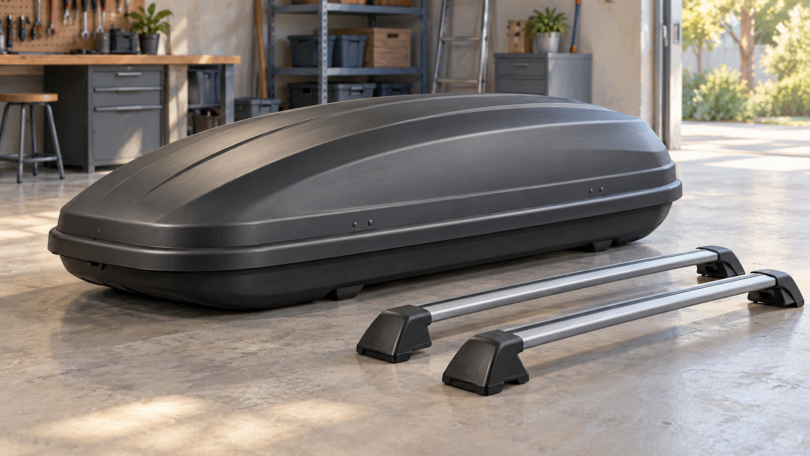

A hard-shell car top carrier should solve a packing problem without creating a fit problem. Start with the gear you need to move, then check the vehicle, rack and cargo box as one system. The three roof boxes below are useful candidates to compare, not universal recommendations for every car.
This is a specification-based shortlist, not a hands-on road test. The recommendations explain which published features may suit a particular trip; they do not claim measured noise, fuel economy, weather sealing or real-world durability.
Three hard-shell roof boxes worth comparing
Thule Force 3 L: a starting point for shorter travel gear
The US Force 3 L, model 645750, lists 16 cubic feet of capacity and exterior dimensions of 76.8 × 33.3 × 16.8 inches. Thule lists a 43-pound empty weight, a 165-pound box load capacity and a maximum ski length of 175 cm. Its PowerClick mounts provide a tightening indicator, and the box opens from either side. The textured, matte finish is another practical point of distinction. Thule specifications
Consider this model when your actual bags and shorter skis fit its usable space. Do not read the box load rating as the amount your vehicle can necessarily carry. The trade-off is straightforward: a shorter box may meet your needs without the length of an XL, but it is the wrong choice if your longest equipment exceeds the published limit. Thule specifications
Thule Motion 3 XL: a candidate for longer skis
The black-gloss US Motion 3 XL is model 639850. Thule lists 18 cubic feet, an 84.7 × 35 × 17-inch exterior and a maximum ski length of 200 cm. It has dual-side access, PowerClick mounting and a SlideLock closure. This is the candidate to investigate when the Force 3 L is too short for your equipment, provided the vehicle and rack can accommodate the longer box. Thule specifications
Resolve its weight before calculating payload: the US page says 51 pounds, but the linked Motion 3 instructions, document 5565335001_00, print 52.7 pounds for XL. Do not choose a convenient figure when the load is close to a limit. Confirm the exact unit with Thule. Thule specifications Motion instructions
Yakima SkyBox NX LG: a candidate for an uncluttered interior
Yakima’s US SkyBox NX LG is SKU 8007369. It offers 16 cubic feet and an exterior measuring 75.5 × 35 × 16 inches, with a listed maximum ski length of 175 cm. Its flattened interior floor, removable torque-limiting tool, two-sided opening and included SKS locks make it worth comparing if loading access and interior layout matter to you. Crossbar spread must be within its specified 24–36-inch range. Yakima specifications
There is a weight discrepancy here too: the product page lists 47 pounds, while Yakima’s linked hatch-clearance sheet lists 48 pounds. Obtain confirmation for the box you will use rather than treating either listing as permission to load to the last pound. Yakima specifications Yakima hatch chart
Choose around your packing list, not the largest capacity label
Make a trial packing list before ordering: soft bags, bedding, sports equipment and any rigid cases. Measure the longest item and the full height of awkward pieces, including handles. A capacity number is useful for narrowing the search, but it cannot tell you whether a particular suitcase will sit beneath a curved lid. If that fit decides the purchase, arrange a physical check or get dimensions confirmed for that exact item. This is a buying method, not a promise about any particular bag or box.
Treat extra space as a trade-off rather than an automatic upgrade. Ask where you will store the box between trips, how you will lift it into place, and whether you can reach its opening comfortably on your vehicle. A shortlist that passes those everyday checks is more useful than a long ranking of boxes you cannot safely install or conveniently use.
Check crossbars and mounting hardware first
Use a rack approved for your exact vehicle and follow both the vehicle and rack instructions. Yakima’s installation guidance specifically requires vehicle-authorized racks. Rails running front to rear are not a substitute for verifying the transverse bars and the box attachment. If the rack model or roof configuration is uncertain, resolve that before buying. Yakima instructions
For Force 3 L, the current instructions specify crossbar spacing from 21 7/8 to 36 5/8 inches. The clamp diagram also specifies a maximum bar width of 90 mm and bar heights of 18–30 mm. These are screening measurements, not a complete fit approval: follow the indicated bar profiles, clearance and adapter requirements. Force instructions
The Motion 3 manual shows 555–930 mm bar spacing, whereas Thule’s hatch sheet prints slightly different imperial endpoints for Motion 3 XL. Its clamp diagram has additional bar-shape and size requirements. Do not settle a borderline installation by mixing tables; have Thule confirm the applicable instructions for the exact rack and box. Motion instructions Thule hatch chart
Record the vehicle year, make, model and roof type, the rack brand and model, the measured bar spacing, and the box SKU. Keep that information together when seeking a fit check. A broad compatibility claim is not approval for an unidentified rack, and a clamp that appears to close is not enough evidence by itself.
Measure hatch clearance and total vehicle height
Thule’s hatch sheet measures from the center of the front crossbar to the point where the roof meets the hatch. It lists 50 9/16 inches for Force 3 L and 52 1/8 inches for Motion 3 XL, with the vehicle measurement needing to exceed the relevant value. Small differences appear in other current Thule documents. For a close measurement, seek clarification and check the hatch’s actual opening path instead of relying on a rounded number. Move bars only where the rack and vehicle instructions permit. Thule hatch chart
Yakima’s method is different: measure across the top of the crossbars from the front bar’s center to the edge of the open hatch. Its chart lists 47 inches for SkyBox NX LG. Follow that diagram rather than substituting Thule’s reference point. Yakima specifically says not to reposition BaseLine or Q-tower crossbars for this adjustment. Yakima hatch chart
Once fitted, measure the vehicle’s actual total height and keep it visible to the driver. Allow for the rack as well as the box; advertised box height alone is not a garage-clearance measurement. Thule warns that overhead clearance and the vehicle’s driving behavior change with roof equipment. Thule safety guidance
Calculate the dynamic roof load before packing
Use the vehicle’s dynamic roof limit, meaning the limit while driving, not a parked or static rating. Total roof load includes the rack, empty box, all mounting accessories and the cargo. Subtract the complete rack, empty box and other roof equipment from the vehicle limit for a preliminary cargo allowance. Thule loading guide
Also satisfy every rack, mounting-system and box limit. Read what each limit includes: some apply to cargo alone, others to the combined assembly. Convert each applicable limit to a remaining cargo allowance on the same basis, then use the lowest. If a specification is missing or contradictory, do not calculate a maximum payload until it is resolved. Thule loading guide
For illustration: a verified 165-pound dynamic roof allowance minus a 15-pound complete rack and a 45-pound empty box leaves 105 pounds. A lower applicable 90-pound cargo allowance would control. These hypothetical inputs do not specify a listed model’s approved payload. Thule loading guide
Yakima’s NX instructions illustrate box weight plus rack weight plus contents against a 165-pound combined ceiling unless otherwise specified. Do not copy that 165-pound number into a cargo-only allowance. Vehicle-specific requirements still apply. Yakima instructions
Load, secure and check the box before each trip
Use roof space primarily for relatively light, bulky items such as clothing and sleeping bags. Thule advises keeping particularly heavy belongings inside the vehicle to keep the center of gravity lower. This makes weight as important as volume: spare room inside the box is not an invitation to add dense gear. Thule packing advice
Thule’s packing guide recommends roughly one quarter of the load toward each end and half centrally. The Force 3 instructions illustrate restraining the load inside and leaving the lid able to close. Keep denser items central between the bars, and luggage clear of the closure and mounting mechanisms. Follow the exact model’s loading diagrams rather than forcing the lid shut over an oversized item. Thule packing guide; Force instructions
On the SkyBox NX, use the supplied torque-limiting tool as instructed, inspect clamp engagement, and test for movement on the bars. Verify both ends of the closed lid are secure. Recheck hardware before travel and after the first short stretch following installation. These checks supplement, rather than replace, the complete installation instructions. Yakima instructions
Drive to the conditions and the applicable limits, not to a presumed roof-box cruising speed. Thule sets a 130 km/h maximum in its safety instructions, but wind, traffic, road conditions and local limits can require less. Check the attachment, restrained load and locks during the journey, and do not attach extra baggage to the box exterior. The vehicle’s total permissible laden weight must also stay within its manufacturer’s limit. Thule safety guidance
Before committing to a purchase, confirm the exact SKU and revision, approved rack fit, usable cargo allowance, hatch travel and installed height. Then check the seller’s current delivery and return terms. This guide does not verify a retailer offer, price, stock status or an Amazon listing; those require a separate check for the exact product.
Frequently asked questions
Do hard-shell car top carriers fit every vehicle?
No. An approved vehicle rack, compatible mounts and adequate clearance are required. Roof-box compatibility must be checked for the actual vehicle and rack, not inferred from vehicle size or the word “universal.” Thule safety guidance
Can I fill a box up to its advertised weight rating?
Only if every applicable vehicle, rack and box limit still allows it after accounting for the complete roof-mounted assembly. An unknown or disputed empty-box weight is a reason to confirm the specification, not round it down. Thule loading guide
Which of these boxes accommodates longer skis?
Thule lists a 200 cm maximum for Motion 3 XL. Force 3 L and SkyBox NX LG list 175 cm. Check your actual equipment and the exact box variant before relying on those figures. Thule specifications Thule specifications Yakima specifications
Is the SkyBox NX LG listing different from the old NX 16 link?
The former NX 16 address now opens Yakima’s NX LG page for SKU 8007369. Verify the SKU and supplied instructions on the actual box; a redirected name is not proof that all production revisions are interchangeable. Yakima legacy listing
Can I use a garage or automatic car wash with a roof box?
Use a garage only after checking the fitted vehicle’s measured height against its clearance. Thule instructs owners to remove the box and rack before an automatic car wash; follow the applicable equipment instructions. Thule safety guidance


