
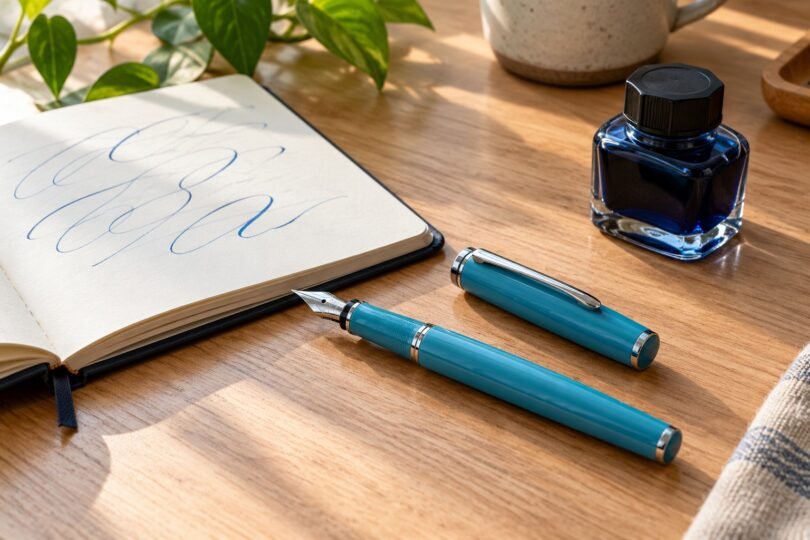

The Jinhao Shark fountain pen is worth considering if you want a playful, refillable pen and are happy to learn basic filling and cleaning. Start with one pen if this is your first fountain pen; buy a multipack only when you already know you want several. The important choice is the exact nib and filling arrangement, because listings under the Shark name do not all describe the same configuration.
This guide compares documented seller specifications and explains how to get started. It does not present hands-on writing tests or rank pens by unmeasured smoothness.
What is the Jinhao Shark?
The Shark is commonly identified as the Jinhao 993. Its distinctive cap resembles a shark’s head, with a dorsal fin instead of a conventional pocket clip. Goulet’s 993 overview describes a lightweight pen, a translucent triangular grip and a threaded cap. The fin can help stop the capped pen rolling across a desk.
That grip gives your fingers a defined position, but comfort remains personal. If you dislike shaped grips, try a single Shark before ordering a dozen. Also consider how you use a pen: a screw cap is less convenient for repeatedly jotting one-word notes than for a longer writing session.
Which Shark configuration should you choose?
One fine or extra-fine pen: the cautious first purchase
Frannie’s Pen Shop lists the Shark with fine and extra-fine choices and an included converter. Its selectors use 0.3 and 0.5 labels and list twelve body colors, including black, white, pink, green and two blues. Those are choices for an individual purchase, not a promise that twelve pens arrive together.
For small handwriting, compare the extra-fine option first. For ordinary notes, fine is a sensible starting point. Check the selected nib and color in the cart rather than relying on a photograph showing the whole range.
Transparent 993 with a medium #5 nib: a clearly specified alternative
Goulet’s transparent Jinhao 993, product code JIN-993-TRANS-5-M, is a single clear pen with a non-hooded steel nib in medium. The retailer specifies an included converter and no ink. It is a useful option to compare if you want a more exposed nib and a medium designation rather than fine or extra-fine.
The “#5” describes the nib format; it does not mean a 5 mm writing line. Nor does it make this pen identical to the hooded version described in older Shark guides.
Lanxivi’s twelve-pen Mako/Shark set: for several pens at once
The Amazon listing identified by ASIN B076D2GTYH uses the model name Jinhao Mako and the selected color label “Shark Fine.” Its title and description specify twelve assorted-color fine-nib pens, a plastic case, one converter per pen and ten cartridges: five black and five blue. Ten cartridges do not provide one for every pen simultaneously, so plan on bottled ink or additional confirmed-compatible refills if you want to fill all twelve.

Jinhao Mako/Shark fine-nib set: 12 assorted-color pens, 12 converters, case and 10 cartridges
As an Amazon Associate we earn from qualifying purchases.
The listing’s title and description include cartridges, although its shorter included-components field omits them. Confirm the package with the seller before ordering. Check the offer itself for availability and delivery details; a product listing is not a guarantee that the set can currently be purchased.
Nib appearance is not a measured line width
A hooded nib exposes less metal than an open nib. That appearance alone does not establish how narrow its line will be. Goulet’s older 993 overview describes a hooded extra-fine version, while its transparent product page specifies an open medium nib. Treat these as distinct configurations.
Fine, extra-fine and medium are useful starting labels, not universal measurements. A seller’s 0.3 or 0.5 notation is also not a writing test on your paper. Ink flow, paper and writing angle influence the result. Goulet’s nib guide explains why finer nibs suit smaller handwriting, while broader choices leave more room for ink effects. Choose for your handwriting before choosing a body color.
Cartridges and converters: check the specific version
This is the most important compatibility check. Goulet specifies short standard-international cartridges for its transparent medium 993. In contrast, the selected Lanxivi Amazon set explicitly specifies 3.4 mm cartridges and warns against 2.6 mm cartridges. Those statements must stay attached to their respective listings; neither establishes a universal refill size for every Shark sold elsewhere.
The simplest starting point is the converter supplied with your pen. Keep it with that pen. If you prefer cartridges, ask the seller to identify an exact compatible refill before buying extras. Do not force a cartridge or substitute a converter merely because its description says “universal.” A cartridge’s opening and the space inside the barrel both matter.
How to fill a Shark with its supplied converter
A converter is a refillable reservoir fitted behind the grip. For the twist-piston type, follow this sequence, based on Goldspot’s converter instructions:
- Protect the work surface, uncap the pen and unscrew the barrel from the grip.
- Make sure the supplied converter is securely seated. Turn its knob to move the piston toward the nib.
- Lower the nib and feed into bottled fountain-pen ink. Keep the filling opening submerged; dipping only the point can draw air.
- Turn the knob the other way to retract the piston and draw ink into the reservoir.
- Lift the pen out, gently wipe ink from the nib and grip with a soft cloth, and reattach the barrel.
Keep the nib clear of the bottle’s bottom and rim. If ink will not draw up, check the converter’s seating and immersion depth before trying again.
Choose suitable ink and paper
Use ink explicitly labeled for fountain pens. For a straightforward first fill, choose an ordinary dye-based fountain-pen ink and keep the bottle label for reference. Do not substitute traditional India ink or dip-pen calligraphy ink just because it comes in a similar bottle. Goldspot’s ink guide explains the clogging risk from unsuitable formulations.
Try a few lines on a spare page before using the pen for something important. If ink spreads into fuzzy edges or shows heavily through the sheet, compare a more fountain-pen-friendly paper. Changing the notebook can be more useful than immediately blaming or replacing the nib.
Cleaning, capping and everyday care
When changing inks or putting the pen away, remove the barrel and converter. Rinse the grip’s ink pathway with clean, cool water, then fill and empty the converter with water until it runs clear. Wick remaining water from the nib with a soft paper towel and allow the parts to dry. Goulet’s cartridge/converter cleaning guide shows the separate steps; Pilot’s cleaning advice cautions against hot water.
For a threaded Shark, unscrew the cap rather than pulling it off. Replace it between writing sessions and close it gently. Keep the pen away from excessive heat and direct sunlight. General precautions in Pilot’s fountain-pen care guide include avoiding solvents, excessive force and drops, and cleaning out ink before extended non-use.
If a clean, correctly filled pen still will not write, contact the seller before attempting nib bending, sanding or disassembly. For a beginner, the useful purchase is a correctly specified pen with compatible ink and clear support, whether that means one Shark or a set.


