
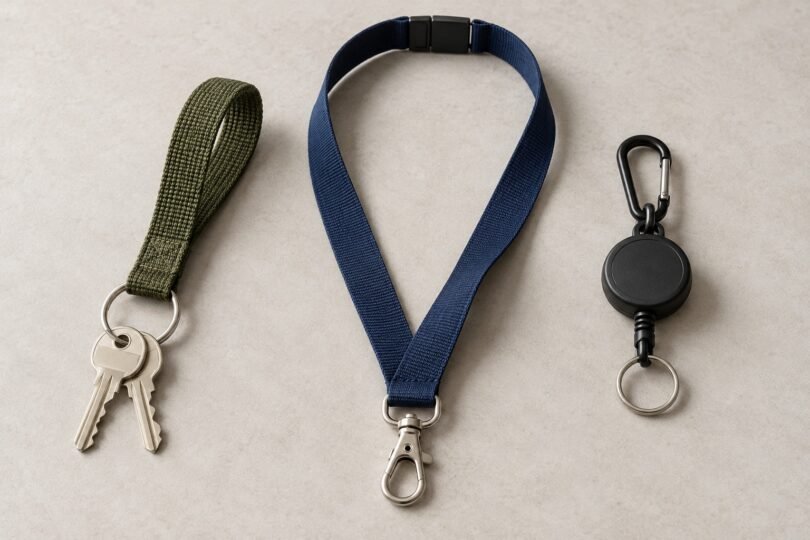

A good keychain lanyard makes your keys easier to carry and find without adding an awkward length of strap. For most everyday errands, a short wrist loop is a sensible starting point. A neck lanyard is useful when a badge needs to stay visible, while a retractable reel works well when keys must repeatedly reach a lock without being unclipped.
The important differences are the carrying position, release mechanism, attachment hardware and weight of the items you carry. A decorative strap, a breakaway badge lanyard and a heavy-duty key reel solve different problems. Choose the format first, then compare specific products.
Wrist, neck or retractable: which fits your day?
- Short wrist lanyard: useful for finding keys in a bag and temporarily freeing your fingers while opening a door. Check that the loop passes over your hand and does not catch on nearby objects.
- Neck lanyard: useful for visible identification and light essentials. Look for a clearly specified breakaway connection and follow the rules of the workplace or venue.
- Retractable key reel: useful for frequent access to locks or readers. Match the retraction rating to the total weight, not just the number of keys.
- Floating wrist strap: a specialized option for light valuables near water. Verify the stated flotation capacity and test your actual combination safely before relying on it.
If you only need to find a car key in a handbag, a long neck strap and badge holder may add unnecessary bulk. If your workplace issues an approved badge holder, keep that requirement separate from how you carry your personal keys.
Five options with clearly stated specifications
Chums Breakaway Wrist Lanyard: an adjustable rope loop
The Chums Breakaway Wrist Lanyard, SKU 82047100, uses a slider bead to adjust the loop. Chums specifies rope construction and a 6 lb breakaway connection. Its 16-inch figure is a cut length, not a promise of a 16-inch wearing circumference.
This is worth considering when you want an adjustable wrist tether rather than a flat decorative strap. Check that its attachment works with your key ring and that the adjusted loop fits your hand and wrist. The published release figure is a manufacturer specification, not a guarantee against entanglement or injury.
Vera Bradley Zip ID Pouch with Breakaway Lanyard: cards and keys together
The Rachel Ditsy premium-cotton version, SKU 5375422546, combines a 5-by-3-inch zip pouch with an ID window, key ring and badge clip. Vera Bradley lists a removable strap with an 18-inch maximum drop and an attached breakaway lanyard.
This is the more relevant format when you want a few cards and a key in one small setup. It is bulkier than a bare strap, and packing the pouch heavily defeats the appeal of light neck carry. Check the exact fabric and print: other versions can have different care instructions or details.
Chums 5MM Secure Entry Lanyard: primarily for workplace identification
The black Chums Secure Entry model 11701 includes a dual-sided plastic card holder, a vertical vinyl ID sleeve and a detachable side-release buckle. Chums lists a breakaway connection separately from that buckle, along with a 28-inch lanyard length and 10-inch drop length.
Consider it when badge display is the main task. It is not the same configuration as a simple key ring on a strap, so check the attachment you need before adding keys. The detachable buckle helps remove the lower assembly deliberately; the breakaway connection serves a different purpose.
KEY-BAK SECURIT: a retractable alternative for frequent key access
The KEY-BAK SECURIT product page offers several retraction strengths and cord or chain configurations. The heavy-duty 48-inch cord version is rated for 8 oz of retraction force and uses a carabiner attachment and split ring. Select that specific configuration if those are the dimensions you want.
A reel can keep a key set attached while it reaches a nearby lock. The tradeoff is a heavier mechanism and a finite reach. Do not confuse the cord’s breaking strength with the weight the reel can retract, or assume that every SECURIT variant has the same cord length.
Chums Sportfloat Wrist Strap: for a limited load near water
The Chums Sportfloat Wrist Strap uses foam-filled neoprene and a removable clasp. Chums states a flotation capacity of up to 85 g, or 3 oz. This makes the weight of the complete key set, including its rings and accessories, especially important.
It is a specialized alternative to an ordinary fabric loop. Test flotation in shallow, controlled conditions with a secure backup before taking valuables onto open water. A floating strap does not waterproof an electronic key fob, and adding another key or accessory changes the load.
Breakaway and quick release are different features
A quick-release buckle lets you intentionally detach a lower section by pressing or operating a fastener. A breakaway connection is designed to separate under a pull. A lanyard may have one, both or neither. A plastic buckle in a product photograph is not enough to establish that it is breakaway.
Look for an explicit manufacturer description of the release feature. If the lanyard is for work, ask whether that exact design is permitted. Do not convert a wrist strap into a neck loop or knot a breakaway section closed to prevent it releasing. Never treat a keychain lanyard as fall protection, a lifting strap or a safety tether for a person.
Breakaway construction does not make trailing straps appropriate around moving machinery. The HSE’s machinery guidance warns about trailing cords and entanglement. Follow site procedures and use the required storage or badge arrangement. Choose age-appropriate products and follow school or childcare rules rather than assuming an adult lanyard is suitable for a child.
Measure the useful length, not just the listed length
Sellers use several measurements: total webbing length, folded loop length, neck drop, strap width and overall length including the clip. Those numbers are not interchangeable. An 18-inch drop describes a different dimension from 18 inches of material laid flat.
For a wrist loop, measure a comfortable existing strap and check the opening needed to pass over your hand. For neck carry, check where the loaded keys or badge will hang when you sit, bend and reach. For a reel, compare the distance from its intended mounting point to the locks or readers you use. Leave comfortable reach instead of planning to pull the cord to its limit every time.
Hardware matters as much as the fabric
A split ring is useful for keys that stay together. A swivel clip helps detach a whole group and lets it rotate, but its gate still needs to close fully. A carabiner can attach a reel to a suitable loop or bag anchor; an everyday accessory carabiner is not climbing equipment.
Look for intact stitching where the strap folds around its hardware. Check that a thick ring does not prevent the clip closing and that a small gate is usable with your fingers. Avoid building a long chain of clips and rings merely to make incompatible parts connect: every extra junction adds bulk and another part to check.
Weigh the actual load if a reel gives a retraction rating. Car fobs, access tokens, pocket tools and decorative charms can matter more than the key count. Carry rarely used keys separately if the everyday set feels heavy or repeatedly pulls a reel open.
Materials, cleaning and everyday comfort
Flat woven straps, round cord, cotton and neoprene feel different against the hand and clothing. Check the finished edges, width and hardware position rather than assuming a particular fiber guarantees comfort. A wide strap spreads contact over more area but also takes up more room in a pocket.
Follow the instructions for the exact product. The cited cotton Vera Bradley pouch has laundering directions; that does not mean a retractable reel or every printed strap can go in the washing machine. Remove keys and electronics first, and allow washable components to dry fully before reassembly.
A quick check before you keep it
- Confirm the selected color, material, strap length and pack quantity match the order.
- Attach your normal key set and check every ring, clip and stitched junction.
- Try the intended carrying position while sitting and reaching, away from hazards.
- For a reel, check smooth extension and controlled return with the actual load.
- Replace damaged hardware, fraying webbing or a malfunctioning release instead of relying on a makeshift repair.
For simple key carrying, keep the setup short and light. Choose a documented breakaway neck design when identification needs to be visible, or a correctly rated reel when repeated reach is the priority. The best choice is the one whose format and hardware match your routine.

