

The best kids’ socks with grips are the ones that fit closely enough for the grip pattern to stay under the foot. An oversized sock can twist, and a thick pair can crowd a shoe. Start with foot size, the floor or activity, and your child’s comfort preferences before choosing a multipack.
For everyday indoor wear, look for clearly described sole grips, a secure but comfortable cuff, and washing instructions you can follow. Two useful options are Burt’s Bees Baby’s cotton-blend crew socks and Hanes’ lightweight gripper ankle socks. They suit different sizes and fabric preferences; neither is a guarantee against slipping.
Two grip-sock options to compare
These are specification-based choices. We have not performed a traction test, wash test, or wear trial, so we do not rank them by grip strength, durability, or how reliably they stay on every child’s foot. Check the selected size, color, and pack before buying: socks that share a review page can still be different variants.
Burt’s Bees Baby Solid Crew Socks: cotton-blend option
Exact linked variant: Cloud Crew Socks, size 4–5T, six pairs.
Burt’s Bees Baby identifies the toddler crew style as TD31872, with sole grippers and a ribbed ankle band. Its manufacturer page offers 2–3T and 4–5T sizes; the linked Amazon variant is specifically 4–5T. The brand’s chart associates that size with a foot length of 6 to 6¾ inches, so measure before relying on the age label.
This is a sensible starting point if you prefer a cotton-rich blend and a plain white pack. The higher crew shape gives more coverage than a low-cut sock. Check the package’s fiber label because retail listings and the current brand page show different cotton percentages; we would not assume every production version has identical composition.
Trade-off: A six-pair pack provides fewer changes than the ten-pair Hanes option, and this particular link is unsuitable if your child needs a smaller size. There is no basis here to call it more slip-resistant than another brand.

Burt's Bees Baby TD31872 Solid Crew Socks, Cloud, 4-5T, 6 Pairs
As an Amazon Associate we earn from qualifying purchases.
Hanes 37T10 Gripper Ankle Socks: larger lightweight pack
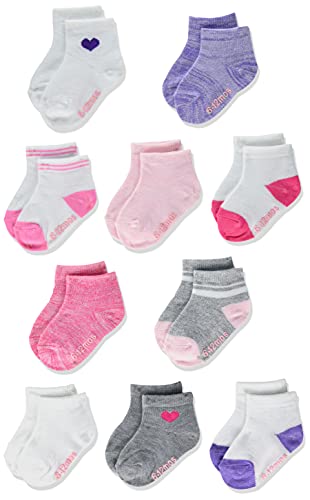
Exact linked variant: Pink/White/Purple/Grey assortment, size 12–24 months, ten pairs.
Hanes describes style 37T10 as lightweight quarter-length socks with gripper bottoms, ribbed cuffs, and its EZ Sort matching system. The manufacturer lists a fabric blend of 97% polyester, 2% spandex, and 1% other fibers, with ten pairs per pack.
This option makes sense when your priority is a bigger laundry rotation and a relatively low-bulk sock. The cuff sits above the ankle. Although the brand labels the assortment for girls, the relevant buying decisions are fit, color preference, and comfort.
Trade-off: This is a predominantly synthetic sock, so choose differently if cotton-rich fabric is your main requirement. The linked 12–24-month variant is not the same as 2–3T or 4–5T; do not order it simply because another size appears among the listing’s options.
How to choose the right size
Age bands are a starting point rather than a fit guarantee. Two children the same age can need different socks, and one brand’s toddler sizing need not match another’s. Use the manufacturer’s foot-length or shoe-size chart where available.
- Measure both feet. With your child comfortably standing if able, measure from heel to longest toe. Compare the larger measurement with the actual product chart.
- Check the heel position. It should sit at the heel rather than climb the ankle or pull beneath the arch.
- Look for loose fabric. Bunching under the toes or a heel that rotates sideways indicates the fit needs attention.
- Check toe and cuff comfort. Toes should have room to move without the sock pulling them together. Remove a pair that causes discomfort or persistent pressure marks.
- Recheck after washing. A pair that fit straight from the packet may feel different after laundering. Do not keep using it if the sole grips no longer sit beneath the foot.
Buying several sizes too large to allow for growth can defeat the purpose of grips. When between sizes, follow that brand’s advice and check the fit in person before committing to a large stock-up order.
Understand what the grips actually do
Some socks use scattered dots; others use lines, lettering, or a broader sole pattern. Product photos can help you see where the textured sections sit, but they do not establish which pattern performs best on your floor.
Also distinguish sole grips from a silicone strip inside a heel or cuff. An internal strip is designed to help keep the sock in place. It does not necessarily provide traction against the floor. For this search, the bottom of the sock must be explicitly described or shown as grippy.
Keep floors dry and clear of toys, wipe up spills, and supervise younger children. A “non-slip” label should not encourage running on a polished floor or replace stair gates and other appropriate precautions. Stop using a pair for grippy indoor wear if its sole material peels, detaches, or wears smooth.
Home, daycare, shoes, and activity venues
- At home: Begin with a well-fitting pair and observe normal walking on your floor. Do not deliberately test a child on a slippery surface.
- At daycare: Ask whether socks, indoor shoes, or a specific type of footwear is required. A spare labeled pair can be more useful than an elaborate design.
- Inside shoes: Try the complete combination. Grip material and extra padding can change how a shoe feels; check that the sock lies flat without making the shoe tight.
- At trampoline parks or classes: Check the venue’s current rules before buying. Ordinary household grip socks may not satisfy a required branded-sock or footwear policy.
- Outdoors: Socks do not provide the protection of shoes. The American Academy of Pediatrics says children need shoes for protection once they begin walking outdoors.
Fabric, seams, and care matter too
Read the whole fiber label rather than assuming “cotton socks” means 100% cotton. Stretch fibers help with fit, but fabric preference is individual. If your child objects to toe seams or bulky grips, start with a small pack and check comfort rather than relying on broad “sensory-friendly” claims.
Follow the package’s care label. Hanes recommends cold-water washing for 37T10. Burt’s Bees Baby’s current care guidance specifies a cold gentle cycle and low tumble drying. Avoid assuming a general laundry routine is suitable for every grip material, and inspect the soles as you sort clean socks.
Compare value by usable pairs: divide the actual pack price by the number of pairs, then consider whether the size, thickness, and care requirements work for your household. A larger pack is useful only when the child can comfortably wear it.
The simplest buying decision
Choose the correct size first, then the fabric and cuff style your child tolerates. Burt’s Bees Baby is the cotton-blend crew option here; Hanes supplies a lightweight ten-pair ankle pack. If your child is outside the linked size ranges, use the same checklist to find a properly sized alternative rather than stretching the fit of either choice.
Image note: Existing category illustration retained from original article.