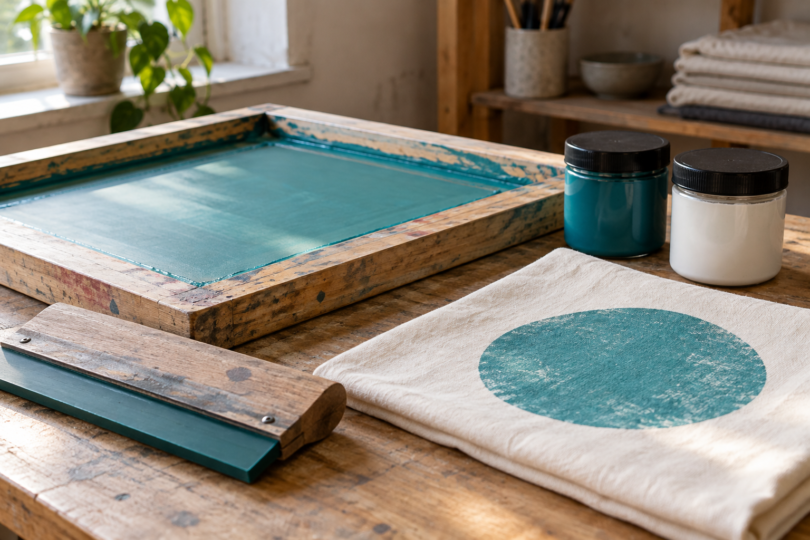

Speedball Flex Ebony is our fabric-first pick when you want an 8-fluid-ounce jar of black water-based screen-printing ink. Jacquard Professional Screen Ink Black is the more flexible starting point for a project that also involves paper, wood or other listed surfaces. Choose by the material you will print, then check the exact formula’s curing instructions.
These are recommendations based on product documentation and verified buying details. We have not run print, stretch or wash tests, so “best” describes the fit of each option for the stated job. There is no measured winner for opacity, softness or durability.
Two water-based inks at a glance
| Ink and selected jar | Best fit in this comparison | Main preparation check |
|---|---|---|
| Speedball Flex, Ebony, 8 fl oz, one jar | Fabric projects using a documented Flex-compatible material | Allow the print to dry before the formula’s required heat-setting step |
| Jacquard Professional Screen Ink, 117 Black, 4 fl oz, JSI1117 | Small mixed-surface projects, including fabric and paper | Test adhesion and washfastness; textile heat setting has its own instructions |
Speedball Flex Ebony: best for a fabric-focused project
Flex is Speedball’s water-based opaque fabric-ink line. Its documented materials include cotton, polyester, blends, linen, rayon and synthetic fibers. The selected Ebony version is black ink in one 8-fluid-ounce jar. It is a sensible choice for a printer concentrating on fabric rather than buying a separate formulation for several different surfaces.
The practical catch is curing. Speedball tells users to allow prints to dry overnight before heat setting, and its directions vary with the fabric. Read the current container instructions alongside the fabric’s heat limits before starting. Dry-to-the-touch ink is not a substitute for completing the specified cure.
Speedball explicitly advises against modifying Flex with water. Keep that restriction in mind when comparing tutorials or another brand’s instructions. Buy the color you need and keep any custom-color experiment within the manufacturer’s current guidance.

Speedball Flex Fabric Screen Printing Ink, Ebony, 8 fl oz, Single Jar
As an Amazon Associate we earn from qualifying purchases.
Jacquard Professional Screen Ink Black: best for mixed surfaces
Jacquard lists natural and synthetic fabric, paper, vinyl, wood, leather, metal and plastic among this ink’s surfaces. The selected manufacturer-store option is 117 Black in a 4-fluid-ounce jar, SKU JSI1117. That smaller container makes it a reasonable starting point for a sample project before committing to a larger quantity.
Its broad material list is a reason to consider it, not a guarantee of adhesion to every finish. Jacquard’s instructions call for testing the specific application and cleaning nonabsorbent surfaces before printing. A coated object or treated fabric still needs its own compatibility check.
Jacquard says the ink can self-cure, and its product page gives a 72-hour period. Its separate instructions recommend heat for maximum textile washfastness. Those statements do not mean that air drying and heat setting deliver identical results on every fabric. Follow the current label and test the intended washing routine before printing a full batch.
See the selected Jacquard 4 fl oz Black ink. The store uses a blue family photograph even for this black selection; check “117 Black,” the jar size and JSI1117 when ordering.
Check the color, substrate and cure before buying
Both choices here are black inks. If you need a light design on a dark garment, select an appropriate light or opaque color and verify that exact variant again. “Water-based” identifies a broad ink category; it does not establish the color, finish, opacity or suitable material by itself.
Start with a test piece of the actual fabric or surface. Assess the cured result for the requirements of your project before a production run. A jar that suits a cotton sample may still need different handling on a blend, coated textile or rigid surface.
Water-based still requires careful handling
For Flex, the manufacturer’s safety sheet calls for adequate ventilation and says mechanical or local exhaust ventilation may be needed. It recommends safety glasses with side shields when contact is likely and chemically protective gloves when skin contact may occur. Wash hands after handling and keep food and drink away from the work area.
Use the current safety data sheet and label for the exact ink and workplace. Jacquard makes its safety sheets available by request, so this comparison does not assign it the same PPE requirements as Flex. Obtain that information before use, particularly in a shared or production workspace. Do not infer that either wet ink is suitable for skin application from the words “water-based.”
Questions about water-based screen-printing ink
Which one should I choose for fabric?
Start with Flex when the fabric is on its compatibility list and you can complete its prescribed heat setting. Consider Jacquard when the same project also needs one of its other documented surfaces. Test the actual material whichever you choose.
Can I use the same curing schedule for both?
No. Flex specifies drying before heat setting; Jacquard describes self-curing and additional heat for maximum textile washfastness. Use each current formula’s instructions and the fabric’s heat tolerance.
Does water-based mean no protective equipment is needed?
No. Flex’s safety sheet includes ventilation, eye-protection and glove guidance. Check the exact product’s current safety sheet rather than transferring a “safe” claim from a finished garment or another ink.
How do I avoid buying the wrong jar?
Match the formula, color and volume. The selections here are Flex Ebony, 8 fl oz, and Jacquard 117 Black, 4 fl oz, JSI1117. A different color, larger jar or multi-color set is a different purchase.
Should I test before a full run?
Yes. Jacquard expressly calls for checking washfastness, adhesion and the needs of the application before production. A small sample also lets you judge whether the cured appearance and feel suit your own project.