
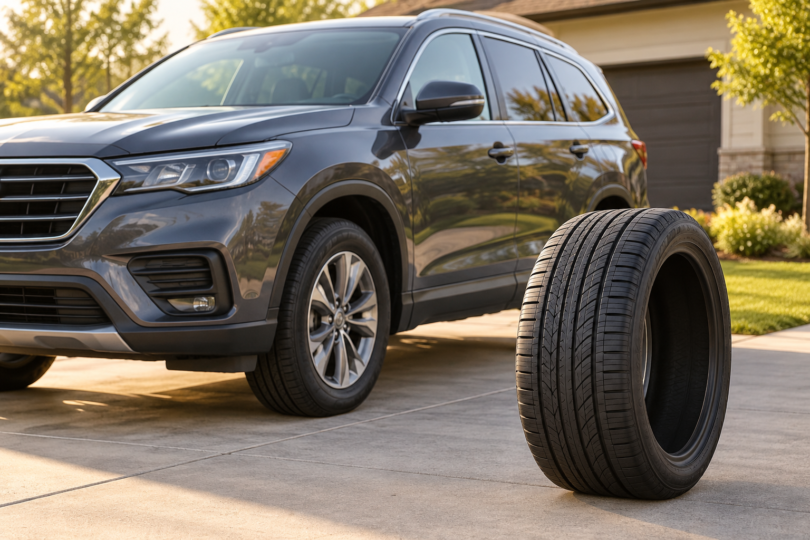

For a large SUV driven mainly on paved roads, our shortlist is the Michelin Defender LTX M/S2, Continental TerrainContact H/T and Bridgestone Alenza AS Ultra. The Michelin is the first candidate here when an installer confirms its 117T XL specification suits the vehicle; the Continental offers a documented 113T standard-load alternative; the Bridgestone is worth comparing when the required speed rating is H. These are conditional choices, because the correct size and service rating come before the brand.
The exact variants below all use 275/55R20 to make the differences easy to compare. That is an example shopping size, not a recommendation for every large SUV. Check your vehicle’s tire placard and owner’s manual for the approved size, construction, load requirement and speed rating. Different trims, wheel packages and axles may require different specifications.
The recommendations use current manufacturer specifications and documented product identities. We have not road-tested these tires or measured stopping distance, noise or wear. “Best” here means a useful fit for the stated buying priorities, with the final fitment confirmed for the actual vehicle.
The exact tires compared
| Tire and article | Exact example variant | Why shortlist it | Important distinction |
|---|---|---|---|
| Michelin Defender LTX M/S2, 04085 | 275/55R20 117T XL | On-road, durability-focused option in the higher load-index example | T speed rating; XL is not an LT designation |
| Continental TerrainContact H/T, 15571920000 | 275/55R20 113T SL, black sidewall | Highway/touring candidate when 113T SL meets the vehicle requirements | The 117H XL version is a different article |
| Bridgestone Alenza AS Ultra, 012475 | 275/55R20 113H, blackwall | A comfort-focused model to compare when an H-rated tire is required | Its 113 load index is lower than the Michelin example’s 117 |
The last number and letter are the service description: 117T and 113H are different specifications even though the size before them is identical. A higher load index does not automatically make one tire an approved replacement. Toyo’s technical guide explains that the required inflation pressure and the tire’s sizing standard also affect its usable load capacity. Confirm the complete match, especially when changing between standard load and XL.
1. Michelin Defender LTX M/S2: shortlist for an approved 117T XL fitment
Michelin positions the Defender LTX M/S2 as an all-season, on-road tire for pickups, SUVs, crossovers and vans, with an emphasis on tread life and comfort. The specific variant compared here is manufacturer article 04085, 275/55R20 117T XL. It is a sensible first quote for an owner who wants a road-focused tire and needs to investigate this extra-load specification.
Its advantage in this table is the higher documented load index, not a promise that it will carry more at whatever pressure you currently use. It still has a T speed rating. If the vehicle calls for H or a higher speed category, do not choose this exact T-rated variant merely because its load number is higher. Ask about the correct manufacturer-approved specification instead.
The linked Amazon item is article 04085, one 275/55R20 117T XL tire. The listing explicitly excludes the rim and says it is not a set. Its photograph shows a wheel for illustration, so the image should not be read as a wheel-and-tire package. Confirm the quantity and the full sidewall description before checkout.

Michelin Defender LTX M/S2 275/55R20 117T XL — One Tire, No Rim
As an Amazon Associate we earn from qualifying purchases.
2. Continental TerrainContact H/T: a documented 113T SL highway option
The TerrainContact H/T is Continental’s touring all-season choice for light trucks and full-size SUVs. The manufacturer describes its TractionPlus design as addressing traction, durability and road noise. That makes it relevant to a pavement-focused shortlist, but those design goals are not our own comparative braking or noise measurements.
For this comparison, use article 15571920000: 275/55R20 113T SL with a black sidewall. Continental’s current specification table also lists a 275/55R20 117H XL tire as article 15571930000. They share the model name and nominal size but differ in load index, speed rating and load range. An order should identify the article as well as the model.
The 113T SL variant belongs on the shortlist only when its complete load and speed specification is appropriate. It is not a substitute for an original-equipment requirement that it fails to meet. Compared with the Michelin example, this is a different load specification, not simply another brand of the same tire.
One Amazon listing we checked has a 113T title but contradictory generic fields stating load index 110 and a 2-pound capacity. Those fields do not match Continental’s article specifications, so we are linking the manufacturer’s information instead. Ask a tire dealer to quote the exact article and verify the sidewall on arrival; do not use that retailer’s conflicting load fields to make the fitment decision.
3. Bridgestone Alenza AS Ultra: compare the 113H comfort-focused option
Bridgestone describes the Alenza AS Ultra around road comfort, with QuietTrack technology intended to reduce tread-pattern noise. The exact example here is article 012475, 275/55R20 113H in blackwall. Its H rating is the main specification difference from the two T-rated examples above; it does not prove superior braking or ride quality.
The higher speed category does not cancel out the lower 113 load index compared with the Michelin’s 117. If your vehicle requires an XL tire or a higher load specification, this comparison is not permission to step down. The Bridgestone maker data we reviewed identifies 113H without an XL suffix; confirm the complete load designation and inflation requirements with the installer.
The manufacturer-owned Firestone retail page identifies the same 275/55R20 113H tire. Use it to obtain a quote for the required number of tires and installation. We have not qualified an exact Amazon listing for this size. Wheels in product photographs are illustrative; request a tire-only quote unless you separately want new wheels.
How to choose for your SUV’s actual load
Read the entire size, including any prefix. P-metric, no-prefix metric and LT-metric tires follow different load conventions. XL means extra load within the relevant passenger-tire standard; it does not turn a tire into an LT-metric design. The same width, aspect ratio and wheel diameter do not make those types interchangeable.
For the same approved tire type and specification, use the vehicle’s recommended cold pressures. If the replacement changes the type, size or load range, have the installer or manufacturer calculate the pressure needed to carry at least the original tire’s required load using the appropriate load-and-inflation tables. Do not automatically use the new tire’s sidewall maximum or copy another SUV owner’s pressure.
An LT tire is not automatically an upgrade for a family SUV. Toyo warns that an LT-metric replacement can need more inflation pressure than a same-size P-metric tire to carry an equivalent load, and that the resulting ride may be harsher. Passenger-type tires on SUVs also require the relevant light-truck load adjustment. These are reasons to have the fitment checked professionally, rather than relying on “heavy duty” or a ply-rating label.
Choose the specification for the vehicle’s intended loaded use, including passengers and cargo, while staying within its own loading limits. A tire with a higher number on its sidewall does not establish a higher vehicle payload or towing rating. The installer needs the original tire requirement and the vehicle’s placard information, not just the replacement tire’s maximum-load figure.
Comfort, weather and the real purchase cost
For ordinary road use, compare these tires only after eliminating incompatible specifications. Michelin’s stated emphasis is long wear and comfort; Continental presents a balanced touring design; Bridgestone highlights QuietTrack for tread-pattern noise. These give you useful models to quote, but there is no shared test in this guide that ranks their stopping distance, cabin noise or lifetime mileage.
All-season wording is not enough to choose a tire for regular ice or severe winter weather. Michelin explicitly says the Defender LTX M/S2 is not a dedicated winter tire and recommends dedicated winter tires for those conditions. If winter performance is central to your purchase, start a separate size-appropriate winter shortlist and verify the exact model’s markings and manufacturer guidance. This comparison makes no three-peak-mountain-snowflake claim for the selected variants.
Ask for the complete installed quote: correct tire article and quantity, mounting and balancing, valve or TPMS service as needed, disposal, taxes and any optional protection plan. Read the warranty for the exact tire and seller; a mileage warranty is not a promise of the distance your vehicle will achieve. The Michelin card is one tire, and the manufacturer links are model references, not four-tire bundles.
After installation, keep checking pressure. NHTSA recommends checking all tires, including the spare, at least monthly when cold, meaning the vehicle has not been driven for at least three hours. Follow the vehicle’s correct pressure guidance; TPMS is not a replacement for this routine check.
Frequently asked questions
Will 275/55R20 fit every large SUV?
No. It is the example size used here. Match the approved size and complete load/speed specification for your particular vehicle, trim, wheel package and axle. A model name such as Tahoe, Expedition or Yukon is not enough to establish fitment.
Can I replace a 117T tire with a 113H tire?
Do not treat that as an equivalent replacement. H is a higher speed category than T, but 113 is a lower load index than 117. The correct decision also depends on the tire standard, load range and inflation pressure; an installer must verify the replacement against the vehicle’s requirements.
Does XL mean the tire is for a light truck?
XL means extra load. It is distinct from an LT prefix, and its extra load capability depends on the applicable inflation table. Check the full tire designation instead of using either term as a general strength rating.
Do the product photos include a wheel?
A wheel shown in a tire photograph is not proof that it is included. The selected Michelin listing expressly sells one tire without a rim. Confirm tire quantity and wheel exclusion on any dealer quote before paying.
Which of these has the best snow traction?
This guide does not rank their snow traction. Manufacturer all-season descriptions and marketing tests are not a shared independent test of these exact variants. For regular severe winter use, choose a tire specifically suited to those conditions in a vehicle-approved size and service specification.


