
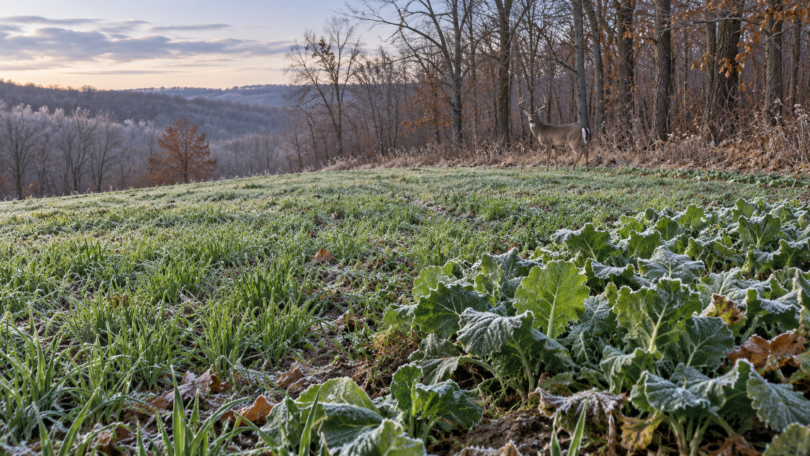

The best late-season food plot for deer starts with a crop that can establish on your land before you need it. Our shortlist is Winter-Greens for a brassica-focused plot, Tall Tine Tubers for turnip foliage and roots, Pure Attraction for an oat-and-brassica blend, and Wintergrazer 70 for cereal rye. These serve different planting plans; no seed bag guarantees deer visits.
Late-season forage is not the same as late planting. A winter plot may need to be sown in summer or early fall. If your normal planting window has passed, check local extension advice before buying. Mississippi guidance on November cereal-grain planting describes a southern climate; it is not permission to sow the same crop into frozen northern ground.
Four seed options at a glance
| Seed and checked package | Best fit | Main tradeoff |
|---|---|---|
| Whitetail Institute Winter-Greens, 3 lb / labeled 0.5 acre | A brassica-focused late-season planting | Needs advance soil preparation and the local planting window |
| Whitetail Institute Tall Tine Tubers, 3 lb / labeled 0.5 acre | A turnip-focused plot with foliage and underground roots | Not an instant source of mature tubers when planted late |
| Whitetail Institute Pure Attraction, 26 lb / labeled 0.5 acre | One packaged oat-and-brassica blend for fall into winter | Oat cold tolerance should not be treated as unlimited |
| Pennington Wintergrazer 70 Cereal Rye, 50 lb bag | A forage rye option where local timing still allows establishment | Coverage depends on the seeding method and rate; it is not ryegrass |
These are editorial choices based on seed identity, planting instructions and extension guidance. We have not grown side-by-side trial plots, measured attraction or assigned performance scores. Compare delivered cost for the area you can actually establish, including soil preparation.
1. Winter-Greens: for a planned brassica plot
Whitetail Institute Winter-Greens is an annual brassica blend with a small amount of Tall Tine Turnip. The checked 3 lb option is labeled for half an acre. It is a sensible first comparison for someone who wants a brassica-focused planting and has time to prepare the site.
The maker specifies medium to well-drained soil and a target soil pH of 6.5–7.0. Its instructions call for a laboratory soil test before deciding lime and fertilizer needs, a firm seedbed and surface broadcasting without covering the seed. Follow the actual product directions; cereal-grain planting depth is not interchangeable with these small seeds.
Choose Winter-Greens over Pure Attraction when your priority is the brassica component rather than an included oat crop. Choose Tall Tine Tubers when a turnip-focused planting is the clearer goal. The maker’s attraction and extreme-weather language is not a promise of results on your property.
2. Tall Tine Tubers: for turnip foliage and roots
Tall Tine Tubers centers on Whitetail Institute’s Tall Tine Turnip. The 3 lb package is labeled for half an acre, and the product is intended to provide leafy growth plus underground tubers. It belongs on the list for a landowner specifically planning that two-part crop.
Use the maker’s regional planting map rather than reading “late season” as “plant whenever hunting starts.” Its windows vary substantially by location. Northern forage guidance from Penn State likewise places July-to-early-August brassica sowing ahead of fall use. Allow establishment time; a late sowing cannot be assumed to produce useful roots on demand.
This is the more focused choice if turnips are what you want to plant. It is less useful as a last-minute decision driven only by a forecast frost. Confirm local suitability, drainage and the seed label before committing the whole plot.
3. Pure Attraction: an oat-and-brassica blend
Pure Attraction combines Whitetail Oats with the maker’s lettuce-type brassicas. The selected 26 lb option is labeled for half an acre; the page also offers smaller and multiple-bag options. Check the chosen size at checkout rather than assuming every listing covers the same area.
The blend suits a buyer who wants those two forage types in one product instead of selecting separate seed. Mississippi State describes oats generally as less cold tolerant than wheat and rye. That is a reason to check regional recommendations, not evidence that this particular blend will fail or survive a specified temperature.
Compare this with Winter-Greens by the crop mix and planting plan, not by bag weight alone. Half-acre labels on a 26 lb grain-containing blend and a 3 lb brassica product reflect different seed requirements; spreading either at an improvised rate is not a sound way to save money.
4. Wintergrazer 70: a cereal-rye option
Pennington Wintergrazer 70 Cereal Rye is a named forage rye sold in a 50 lb bag. Pennington includes wildlife food plots among its uses. Cereal rye is a small grain, distinct from lawn or annual ryegrass; make sure the seed label matches the crop you intend to plant.
This is the option to discuss with a local seed supplier or extension agent when you need a cereal grain and are checking whether a later sowing is still viable. Mississippi State supports cereal grains for some late southern plantings, but weather and browsing pressure can still limit growth.
Pennington lists 90–120 lb per acre drilled or 125–150 lb broadcast for forage use. At that broadcast rate, a 50 lb bag covers roughly one-third to two-fifths of an acre, not half an acre. These are product forage rates; ask for locally appropriate food-plot or mixture rates before combining seed.
What matters before you order
- Test the site: tell the soil laboratory which crops you plan to grow. Use its lime and fertilizer recommendations instead of adding amendments by guesswork. Drainage and soil suitability come before the brand on the bag.
- Match timing to climate: check your county guidance and the selected product’s regional instructions. Southern November advice and northern summer brassica advice describe different growing conditions. Neither gives a nationwide last planting date.
- Read the seed label: verify the named crop, bag size and rate for your planting method. Compare the total purchase for your measured area, not simply price per bag. Seed sold for planting is the appropriate purchase; grocery wheat berries and fertilizer are different products.
- Keep the habitat plan: food plots supplement the property’s existing vegetation and cover. Mississippi State stresses native habitat management as well as planted forage. A plot is not a substitute for the rest of that work.
- Check the land and current rules: confirm permission to plant and the wildlife rules for that property. Food plots, bait and supplemental feeding are not terms to treat as interchangeable; this guide is about growing forage and does not authorize adding grain piles, mineral blocks or feed.
Frequently asked questions
Which option would you choose first?
For an on-time, prepared brassica plot, start by comparing Winter-Greens. For turnip roots as a specific goal, compare Tall Tine Tubers. Pure Attraction adds oats; Wintergrazer 70 provides a cereal-rye route. Local conditions should decide which of those jobs makes sense.
Can I still plant after the normal fall window?
Sometimes, especially in milder southern conditions, but remaining growth matters more than the calendar label. Mississippi’s late-planting advice favors cereal grains and warns that late clover emergence can delay useful production until late winter or spring. Ask locally before buying seed for an urgent plot.
Is cereal rye the same as ryegrass?
No. The cereal rye discussed here is Secale cereale. Buy the intended forage seed and check its label; a ryegrass lawn mix is a different selection.
Do turnips guarantee deer will use the plot?
No guarantee is justified here. The turnip product describes foliage and roots, but a package description does not establish deer use on your site. Choose a locally suitable crop and assess the plot rather than relying on an attraction claim.
Should I buy fertilizer instead of seed?
No. Fertilizer supplies nutrients; it does not replace the chosen forage seed. Soil-test results determine whether amendments are needed, while crop, planting date, seedbed and seeding rate remain separate decisions.

