
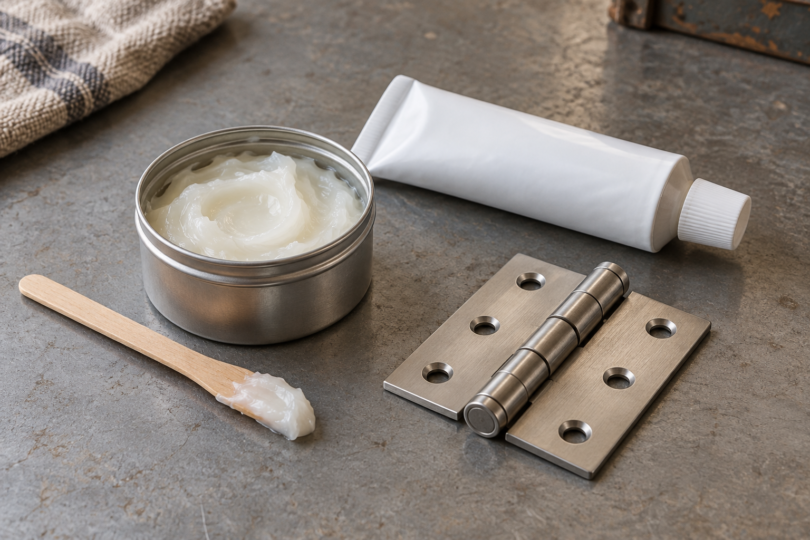

The best lithium grease is the one specified for the part you are lubricating. For ordinary hinges, latches and similar hardware, three useful options are Lucas 10533 White Lithium Grease for a conventional NLGI 2 squeeze-tube grease, Permatex 80345 for small applications that include manufacturer-approved metal-to-plastic contact, and WD-40 Specialist White Lithium Grease for spray access to suitable metal mechanisms.
These picks compare the manufacturers’ product information, technical sheets and safety data with the exact retail packages. They are recommendations based on documented applications and packaging, without claims of hands-on testing. The distinction that matters most is not the brand name: it is whether the equipment needs this grease chemistry, this consistency and this delivery method.
Best lithium grease options at a glance
| Product and selected package | Reason to choose it | Important limit |
|---|---|---|
| Lucas 10533 White Lithium Grease, one 8 oz squeeze tube | Conventional grease with a documented NLGI 2 grade; suitable listed uses include hinges, garage-door hardware and chassis lubrication | Lucas explicitly excludes wheel bearings |
| Permatex 80345 White Lithium Grease, one 1.5 oz tube | Small tube; manufacturer lists metal-to-metal and metal-to-plastic applications | That broad description does not establish compatibility with every plastic or rubber seal |
| WD-40 Specialist White Lithium Grease, one 10 oz Smart Straw aerosol | Spray access for suitable metal-to-metal mechanisms; published operating range of 0°F to 300°F | Extremely flammable aerosol; its operating range is not permission to spray hot equipment |
1. Lucas 10533: best when you need documented NLGI 2 grease

Lucas 10533 White Lithium Grease, 8 oz Squeeze Tube, One Tube
As an Amazon Associate we earn from qualifying purchases.
The Lucas product page and technical sheet identify this as white, lithium-thickened NLGI 2 grease. The selected 10533 package is an 8 oz squeeze tube. It is a sensible format for accessible hardware where you can place a small amount directly, rather than coating the surrounding area with spray.
Lucas lists household, automotive and industrial applications, including door hinges, garage doors, springs and chassis components. Its technical sheet also describes certain plain and antifriction bearings under moderate operating conditions. That does not make it a substitute for every bearing grease: the same manufacturer explicitly says it is not recommended for wheel bearings. Follow the equipment’s grease specification even when an application sounds similar.
Choose Lucas when your instructions actually call for a compatible NLGI 2 lithium grease and the listed application fits. Skip it when the job calls for a different consistency, a specific approval or wheel-bearing service. NLGI 2 describes consistency; it is not a quality ranking or a complete statement of load, speed or temperature suitability. The squeeze tube is also a different buying choice from a grease-gun cartridge.
2. Permatex 80345: best small tube for compatible mixed-material hardware

Permatex 80345 is the small 1.5 oz tube, not the company’s separate aerosol. Permatex lists metal-to-metal and metal-to-plastic uses, with examples including door hinges, hood and trunk latches and seat mechanisms. That makes it worth considering for a small maintenance job where the materials and equipment instructions permit this particular lubricant.
The useful distinction is the manufacturer’s explicit metal-to-plastic application statement. It is not a blanket approval for every polymer, elastomer, painted surface or seal. If the mechanism includes an unidentified plastic or rubber component, ask the equipment or component maker to confirm compatibility. A silent label is not evidence that a material is safe to lubricate with any white grease.
Buy this version for controlled placement from a compact tube. Do not transfer application directions from a spray can to it, or assume that a similarly named Permatex product has the same formulation and limits. We are not assigning the tube an NLGI grade or a numeric service-temperature range here. For a job that requires either, obtain current, product-specific confirmation before choosing it.
3. WD-40 Specialist: best spray format for suitable metal mechanisms

WD-40 Specialist White Lithium Grease sprays as a liquid and leaves a thicker lubricating coating. The selected package is one 10 oz can with the Smart Straw applicator, which offers a directed stream or wider spray. Manufacturer-listed metal-to-metal uses include hinges, latches, gears, sprockets and overhead tracks. This is a specific Specialist grease product, not an interchangeable description of other WD-40 sprays.
The technical sheet gives an operating range of 0°F to 300°F for the lubricant. The aerosol itself is classified as extremely flammable, with a pressurized container. Keep application away from heat, sparks, flames and other ignition sources, use adequate ventilation and follow the can’s directions. Let the equipment be in the condition specified for maintenance before spraying; an operating-temperature rating does not override application precautions.
Choose the aerosol when access makes a spray useful and you can control where it lands. A tube is easier to consider when adjacent surfaces must remain free of grease. WD-40’s documented emphasis here is metal-to-metal lubrication; do not extrapolate approval to plastics, rubber, electrical contacts, brake components or sealed bearings. Nor should you assume that an aerosol without a stated NLGI grade meets a machine’s NLGI 2 requirement.
How to choose the right lithium grease
Start with the equipment specification
“Lithium” names a thickener family, not a complete performance specification. Grease also contains a base oil and additives, and two lithium products can differ substantially. Look for the required grease type, NLGI consistency, viscosity or approval, temperature range and material compatibility in the equipment instructions. Match the whole requirement. An unspecified “multipurpose” label does not close a gap in the documentation.
Separate grease from the applicator
A squeeze tube lets you dispense grease onto an accessible point; an aerosol delivers a spray that leaves lubricant behind. The spray format can help with access but also creates an overspray and ignition-control problem. These three packages are not grease-gun cartridges. If your maintenance procedure uses a grease gun or a metered lubrication system, buy the specified grease in the packaging that system requires.
Check compatibility before adding anything
Do not top up an unknown grease simply because the replacement is also white or lithium based. Mobil’s lubricant-handling guidance explains that even greases with similar thickeners can be incompatible. Mixing can change consistency or cause oil separation. Follow an equipment-approved changeover procedure, or ask the lubricant supplier about the exact old and new products; improvising a blend is not a compatibility test.
Keep special applications separate
A hinge recommendation does not establish approval for a wheel bearing, brake slider, bicycle freehub, electric motor or food-contact mechanism. None of the selections here should be treated as universal grease for those jobs. Use the lubricant explicitly specified for the component. Keep grease away from brake friction surfaces, and do not put it on a part merely because that part squeaks.
Read the exact package label and current safety data before use. The relevant documents are the Lucas 10533 SDS, Permatex 80345 SDS and WD-40 Specialist SDS. Use their specified handling precautions, protection and ventilation, and follow the equipment’s maintenance instructions. “Household use” does not mean harmless; avoid unnecessary contact and keep lubricant out of drains and waterways.
Frequently asked questions
Is white lithium grease the same as lithium grease?
White lithium grease is one type within a broader family of lithium-thickened lubricants. Its color does not specify NLGI grade, base oil, additives or approvals. Compare the exact product’s technical data with your equipment requirements instead of using color as a compatibility guide.
Can I use lithium grease on plastic or rubber?
Only when the particular lubricant and component are compatible. Permatex 80345 lists metal-to-plastic applications, but that does not approve all plastics or rubber seals. Confirm the actual material and equipment requirements; do not extend one product’s claim to another grease.
Is lithium grease suitable for wheel bearings?
Some greases are formulated and approved for wheel-bearing service, but that cannot be inferred from the word lithium. Lucas specifically excludes wheel bearings for its White Lithium Grease. For a wheel bearing, select the grease required by the vehicle or bearing manufacturer, including its applicable approvals.
Can I mix a new lithium grease with the old grease?
Not without confirming compatibility between the exact products. Similar thickener names do not guarantee that their base oils and additive systems will work together. Use the equipment maker’s changeover instructions rather than adding a new grease to an unidentified existing lubricant.
Is aerosol white lithium grease better than a tube?
It depends on access and the required lubricant. A spray can reach some metal mechanisms conveniently; a tube supports direct placement. The aerosol also requires overspray, ventilation and ignition precautions. Compare the formulation and application approval first, then choose the delivery format.


