
For cruising on rough pavement, our comfort-first choice is the Orangatang Caguama in 85 mm, 77a blue, provided your board has enough clearance. The 80 mm, 80a orange Kegel is the middle option when you want a smaller diameter, while the 70 mm, 80a orange 4President is worth considering when fit and a lighter setup matter more than maximum wheel size.
This shortlist compares three actual wheel sets using Orangatang’s specifications and exact purchase variants. Keeping the manufacturer and urethane family consistent makes the differences in size, hardness and shape easier to assess. The recommendations are based on those documented features, not a riding test or a claim that one wheel makes damaged pavement safe. Choose around your deck and trucks before choosing around a diameter.
Three wheel sets for different cruising priorities
| Selected wheel set | Diameter / hardness | Width / contact patch | Shape and best fit |
|---|---|---|---|
| Orangatang Caguama, blue, four wheels without bearings | 85 mm / 77a | 58.5 mm / 56 mm | Rounded lips, offset hub; comfort-focused choice for a compatible large-wheel setup |
| Orangatang Kegel, orange, four wheels without bearings | 80 mm / 80a | 56 mm / 56 mm | Sharp lips, offset hub; middle-size option for cruising and carving |
| Orangatang 4President, orange, four wheels without bearings | 70 mm / 80a | 53 mm / 53 mm | Sharp lips, offset hub; smallest and lightest option here |
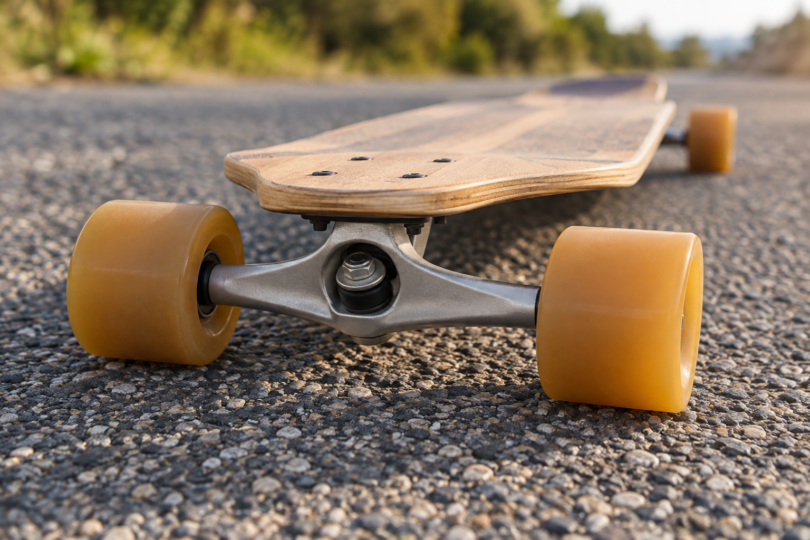
All three use Orangatang’s Happy Thane formula and a high-strength, high-stiffness urethane core, with an offset hub and a surface-skin finish. They are not identical wheels with different labels: their diameters, widths, lip profiles and published weights differ. These selected packages contain four wheels; bearings are a separate purchase unless you deliberately choose a different bundle.
1. Orangatang Caguama 85 mm, 77a: the comfort-first choice
The blue 77a Caguama wheels-only set combines the largest diameter and softest hardness in this comparison. Orangatang lists an 85 mm diameter, 58.5 mm overall width, 56 mm contact patch, rounded lips and an offset urethane core. Each wheel weighs a stated 270 g. The wide body should not be confused with a 58.5 mm contact patch; the published rolling contact width is smaller.
This is the first option we would assess for a board already designed around large cruising wheels. Its size and softer compound favor cushioning and rolling over ordinary pavement texture. The tradeoff is bulk: four listed wheel weights total approximately 1,080 g before bearings, and larger wheels generally require more effort to accelerate than smaller alternatives. That matters if your route includes repeated stops or you frequently carry the board.
Clearance is the decisive purchase check. An 85 mm wheel can rub a deck that accommodated a smaller set, especially as trucks turn and the deck flexes. A softer wheel is still capable of catching an obstacle, and rounded lips are not a promise of controlled sliding. Choose this set for its documented dimensions and comfort-oriented specification only after confirming the complete setup.
2. Orangatang Kegel 80 mm, 80a: the middle-size option
The orange 80a Kegel wheels-only set measures 80 mm in diameter and 56 mm across both overall width and contact patch. It has sharp lips, a surface-skin finish and an offset urethane core. The stated weight is 230 g per wheel, or approximately 920 g for four before bearings.
The Kegel is our middle choice for a rider comparing the 70 mm and 85 mm ends of this shortlist. It offers more diameter than the 4President while being smaller and lighter than the Caguama. Its sharp-lip shape suits a grip-oriented cruising or carving preference. The selected 80a compound is firmer than the Caguama’s selected 77a; this is a deliberate comparison of these variants, not a claim that every Kegel is harder than every Caguama.
Do not read “middle size” as universal fit. An 80 mm wheel can still require a suitable deck cutout, wheel well, truck arrangement or riser solution. If your current 70 mm wheels already have little clearance, buying the Kegel without checking the setup is a poor shortcut. Its 56 mm contact patch also deserves attention when considering lateral clearance around trucks and the deck.
3. Orangatang 4President 70 mm, 80a: for smaller-wheel setups

Orangatang 4President 70 mm Wheels, Orange 80a, Set of 4 Without Bearings
As an Amazon Associate we earn from qualifying purchases.
The selected 4President is the orange 80a version, sold as four wheels without bearings. Its diameter is 70 mm, with a 53 mm width and matching 53 mm contact patch. Sharp lips and an offset urethane core distinguish its shape; Orangatang lists a weight of 180 g per wheel, approximately 720 g for the set before bearings.
Choose it when you want the smallest wheel in this comparison and your board’s approved setup favors that size. The lower wheel mass and diameter are useful priorities for frequent starts, carrying the board and retaining a more compact setup. It is also the easiest of these three diameters to investigate when larger wheels would demand substantial changes, although 70 mm is not an automatic clearance guarantee.
The compromise is how much wheel you have available to deal with uneven pavement. If rough texture is the main problem and your board comfortably accommodates the Caguama, the 4President would not be our comfort-first pick. If the route is badly broken, however, changing to either larger option does not turn it into a suitable riding surface. Route choice can matter more than the purchase.
How to choose wheels for rough pavement
Diameter and softness solve different parts of the problem
Larger diameter generally helps a wheel negotiate pavement irregularities, while smaller wheels are lighter and quicker to accelerate. Durometer describes hardness: within Orangatang’s range, 77a is softer than 80a and emphasizes cushioning. These numbers are useful starting points, not a complete ride-quality score. Shape, urethane formulation, core construction, rider and board setup also affect the result.
The manufacturer’s wheel guide explains the size, hardness and lip-shape tradeoffs. For this shortlist, begin with the blue 77a Caguama if comfort dominates, then ask whether its size fits your board and routine. Choose an orange 80a alternative because its overall package suits the setup, rather than assuming a higher hardness number means a better wheel.
Check wheelbite before buying risers
Wheelbite is wheel-to-deck contact during turning. Fit depends on deck shape, truck geometry, bushings and rider-induced movement as well as nominal wheel diameter. As an illustration, changing from 70 mm to 85 mm adds 7.5 mm to the wheel radius. That reduces the available gap in a simple static comparison, but does not calculate the clearance of an assembled board as it leans and flexes.
Orangatang’s setup guidance says 80–85 mm wheels often need risers or wheel wells. Treat that as a reason to check, not a guaranteed riser prescription. Confirm compatibility with the deck and truck makers, including mounting arrangement, pad shape and hardware length. A conventional topmount riser solution should not be assumed appropriate for every drop-through or bracket system. A competent skate shop can assess the complete combination.
Have clearance assessed through the intended steering movement and loaded deck flex, rather than judging only a free-spinning wheel on an unloaded board. Recheck the setup after any wheel, truck or bushing change. Follow the board maker’s inspection guidance for axle nuts, bearings and mounting hardware, and use appropriate protective equipment. Stop using a setup that rubs or has damaged components; wheel choice cannot guarantee against a fall.
Compare the full set you will actually receive
Match model, diameter, color/durometer and bundle on the purchase page. Our selections are wheels-only sets of four. If reusing bearings, confirm their condition and fit, along with the required spacers and speed rings. Compare the total cost of the setup you need, including compatible hardware or bearings, rather than treating a wheel-set price as the entire upgrade.
Frequently asked questions
Are 70 mm wheels good for rough roads?
They can be a practical choice for a compatible compact setup, but the 70 mm 4President prioritizes smaller size over the Caguama’s larger diameter and softer selected compound. Consider the actual pavement and board clearance. No wheel in this guide makes potholes, loose debris or badly broken surfaces reliably rideable.
Should I choose 77a or 80a wheels?
Within these Orangatang options, 77a is softer and is our comfort-first starting point; 80a is firmer. Choose the complete wheel shape and size along with hardness. The recommendation here is specifically blue 77a Caguama versus orange 80a Kegel or 4President, not a universal rule for every brand.
Will 85 mm wheels need risers?
Possibly. Deck cutouts, wheel wells, trucks, bushings and mounting arrangement all affect clearance. Check the board manufacturer’s permitted setup and have wheelbite assessed under load. There is no single riser height that guarantees every longboard can use an 85 mm wheel.
Do these wheel sets include bearings?
The three variants selected here contain four wheels without bearings. Some purchase pages offer separate bearing bundles, so check the selected option before ordering. Reused bearings, spacers and speed rings must be suitable for the wheel and axle setup and in serviceable condition.
Can I use these wheels on an electric longboard?
Only with confirmed drivetrain compatibility. Orangatang identifies Kegel and Caguama as options for compatible electric setups, but the board or drive-system maker must confirm the pulley, adapter and clearance requirements. Do not assume that a 4President wheel or any similar-looking hub fits an existing electric drive.