
The right scooter battery charger is the replacement approved for the scooter’s exact model and battery system. Start with the original charger label and the manufacturer’s parts information. A connector that fits, a matching-looking voltage number or a long online compatibility list is not enough to establish a safe replacement.
The U.S. Consumer Product Safety Commission warns against chargers advertised as universal for e-scooters and other micromobility products unless they have been tested and approved for the specific device. An incompatible charger can cause a battery fire. Its replacement-charger guidance recommends contacting the device manufacturer when the supplied charger is missing.
Two model-specific chargers to identify
- Segway Ninebot official 42V, 1.7A charger: a documented option for the ES2 and ES4 discussed below. This is not a recommendation for every Ninebot scooter.
- Razor E100/E125/E150 24V, 600mA charger: a lead-acid charger listing naming those models, subject to the version and original-part confirmation described below.
These serve different scooters and battery systems. Choose by manufacturer approval for your machine, not by which charger has the larger current number. Owners of seated mobility scooters should use the separate manufacturer-identification route later in this guide.
Segway Ninebot official 42V, 1.7A charger
The selected Segway-Ninebot listing is for one black power adapter and AC power cord, manufacturer part 20.40.0004.20. Its stated output is 42V DC, 1.7A. The official ES-series manual specifies that charger output for the ES2 and ES4, with 100–240V AC input.

Segway Ninebot 20.40.0004.20 Official Charger, 42V 1.7A Black, One Adapter and AC Cord
As an Amazon Associate we earn from qualifying purchases.
The manual provides a useful example of why voltage labels need context: these scooters have a 36V nominal battery and a 42V charging specification. Those two numbers describe different things. That documented pairing does not establish compatibility with another brand’s 36V battery or another Segway model.
Before buying: confirm the exact scooter model, regional power cord and current manufacturer replacement recommendation. The listing title also names E22 and ES1L, but this guide’s manual cross-check is limited to ES2 and ES4. Check the individual model’s documentation before extending that recommendation. This is not the same product as a higher-current fast charger.
Razor E100/E125/E150 24V, 600mA charger
The selected listing identifies Razor as the brand and manufacturer and names the E100, E125 and E150. It specifies 24V, 600mA output, 100–120V AC input and a three-pin inline female connector, for lead-acid batteries only. The selected product image shows a Qili Power label bearing model QL-09002-B2400600H; the listing also gives the QL-09002B-B2400600H version of that designation.

Razor’s own parts store lists W13110050014 for the E100, E125 and E150, among its named applications, and provides a barcode-ID check. Use Razor’s official part page to identify your scooter version and confirm its current replacement. That page does not establish that every older Qili-labeled unit or Amazon offer is identical to the current part. Treat the card here as a specific listing to identify, and ask Razor to confirm it against your original label and scooter version before buying.
Before buying: match the original part and have Razor resolve any discrepancy. Do not extend this recommendation to an E90, a lithium conversion, or every Razor product with a similar socket. An aftermarket charger advertised as “for Razor” is not automatically the Razor-branded unit linked here. The regional input specification also matters if you are shopping outside North America.
For Pride and other seated mobility scooters
A seated mobility scooter needs its own identification process. Pride recommends having the scooter model name, serial number and charger type ready when contacting an authorized provider. Its charger-identification guide shows why a brand-wide recommendation is unreliable: different scooters, and sometimes different battery options within a model, use different chargers.
For example, Pride’s lithium-battery guidance directs owners to their authorized provider for a replacement and prohibits substituting a different charger. A three-pin XLR connection alone does not establish the battery chemistry or approved charger. See Pride’s lithium-ion battery FAQ.
Ask the provider for the exact replacement part number for the scooter’s existing battery configuration. If the battery pack was changed, disclose that before ordering. This guide does not recommend a generic automotive charger or an unverified “fits most mobility scooters” adapter.
What to compare on the labels
- Device identity: record the complete scooter model and version, not just the brand.
- Approved charger identity: look for the manufacturer’s part number and any documented replacement or superseding number.
- Battery system: confirm the original chemistry and whether the installed pack is still the approved configuration.
- Electrical specification: compare the approved output voltage and current, plus the charger’s AC input requirements.
- Connector and cable: confirm the actual approved connector arrangement and regional mains lead. Do not use a tip adapter to force a mismatch.
Photograph the labels before contacting support. A clear image of the old charger’s label, scooter serial plate and charging port is more useful than a screenshot of a similar-looking online listing. If the label is missing or illegible, let the manufacturer identify the part from the scooter details.
Charging problems do not always mean a bad charger
If the scooter will not charge, avoid buying progressively more powerful adapters to see what happens. Follow the troubleshooting section for the exact model and describe the indicator lights and symptoms to support. A replacement charger is not a diagnosis of the battery, charging port or wiring.
Pride’s full-size scooter manual instructs owners to inspect the charger, wiring and connectors for damage and contact their provider if damage is found. It also warns against opening the charger case. Apply the relevant manufacturer’s instructions rather than attempting an improvised repair or charging a damaged system.
Safety checks before the next charge
For e-scooters and other micromobility products, CPSC advises being present during charging, avoiding charging while asleep, and disconnecting the charger when the cycle finishes. Follow the device manufacturer’s charging and storage instructions; do not copy a charging schedule from a different battery system.
There is also a specific CPSC stop-use warning for SafPow SPC-42020 and AMPOWSURE ASP-C10S42020 chargers. If your charger label matches either model, stop using it and follow that warning. Do not treat a long compatibility list or a claimed safety certification as approval to use a charger with an arbitrary scooter.
For an ES2 or ES4, begin with the documented Segway unit. For a Razor E100, E125 or E150, begin with the original-part and barcode check. For any other scooter, obtain its manufacturer-approved replacement number first. That gives you a meaningful product to compare and avoids guessing with the battery system.
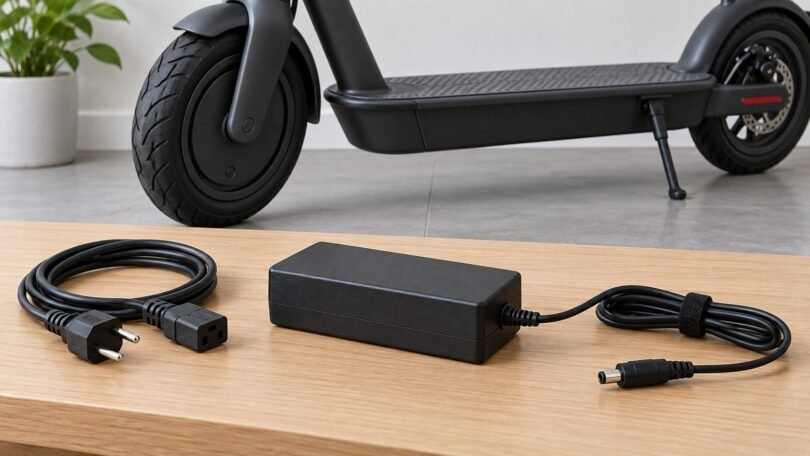
Image note: AI-generated editorial illustration; not a photograph of the named product.