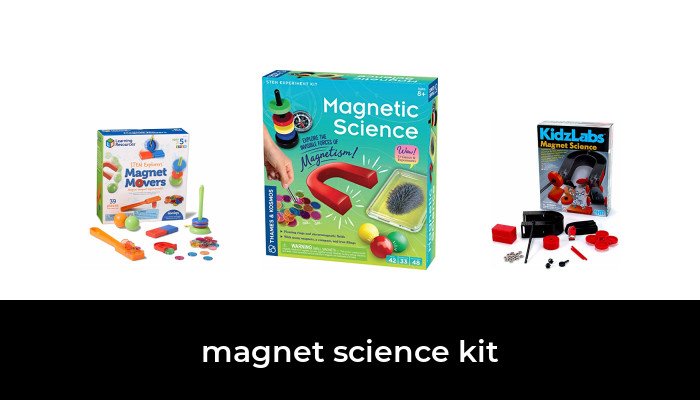

A useful magnet science kit should help a child ask questions, make predictions and see a result. The number of pieces matters less than clear instructions, a sensible mix of magnets and age-appropriate supervision. For an introduction, Learning Resources Magnet Movers offers short guided activities. For a child aged eight or older who wants a fuller sequence, Thames & Kosmos Magnetic Science covers poles, fields, compasses and electromagnetism.
Safety comes first: small magnets are a serious ingestion hazard. These kits are for supervised activities, and their parts must be kept away from younger children and anyone who puts objects in their mouth. If a magnet may have been swallowed, seek immediate medical attention.
Two magnet kits for different stages
Learning Resources STEM Explorers Magnet Movers: an introductory set

Learning Resources STEM Explorers Magnet Movers | Magnet Science Kit, STEM Activity Set, Physics Exploration Toy, Critical Thinking Activity, Hands-On Learning for Kids
As an Amazon Associate we earn from qualifying purchases.
The verified model is LER9295. Learning Resources lists it for ages five and up, with 39 pieces and 10 repeatable experiments. It includes a magnetic wand, bar and horseshoe magnets, a post with rings, two magnetic balls, string and colored counters with metal rings.
The useful feature is the variety of simple tools. A child can compare attraction and repulsion or investigate whether a magnet can act through a barrier. The short activities suit an adult and child working together without turning the session into a long assembly project.
Good fit: an early learner ready to follow instructions, with an adult managing the pieces and discussion. The small activity guide gives the session a starting point while leaving room to repeat a question in a different way.
Limits: the manufacturer’s five-plus label does not make it suitable for unsupervised play, younger siblings or children who mouth objects. Many pieces are counters rather than separate scientific instruments, so “39 pieces” does not mean 39 experiments. Follow the package warnings and the manufacturer’s activity guide.
Thames & Kosmos Magnetic Science: a fuller guided course
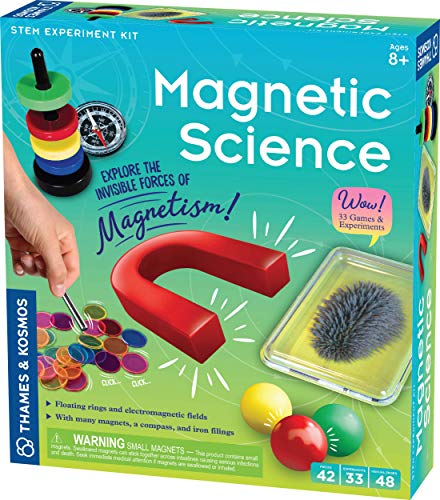
The verified model is 665050, for ages eight and older. The manufacturer’s individual-kit specifications list 33 activities, 42 pieces and a 48-page manual. The affiliate option above is one kit; the linked manufacturer reference also describes a separate classroom bundle.
The topics progress from magnetic attraction and poles to compasses, field patterns and an electromagnet. An enclosed iron-filings box lets a child observe a field pattern without needing to scatter loose filings. Keep that box sealed and use it exactly as directed.
Good fit: a child who enjoys working through instructions over several sessions and an adult who can help with setup, reading and cleanup. It offers more depth than a small magnetic sorting set.
Limits: this is still a small-parts kit with magnets, not an independent-play toy. The current downloadable manual specifies one 1.5-volt AA battery, supplied separately, for the electrical experiments. It says not to use rechargeable batteries, other battery arrangements or wall outlets. Follow the manual supplied with your exact kit, and disconnect the circuit after each experiment.
How to choose between them
- Start with readiness. Follow the minimum age and warnings, then consider whether the child can keep every piece away from their mouth and work alongside an adult.
- Match the activity style. Magnet Movers suits short observations and repeatable challenges. Magnetic Science gives an older learner a longer sequence with more explanation.
- Look at the instructions before buying. Check reading level, extra household materials, battery requirements and whether the adult can explain the steps comfortably.
- Plan the work surface. A clear, nonmetallic table makes many comparisons easier. Keep food and drinks elsewhere and use a tray to help account for small pieces.
- Plan storage. A closing container in a secure location is part of the setup, especially in a home with younger children or pets.
For a classroom, count how many children can actually use the key magnets at one time. A large counter count does not necessarily make a kit suitable for a whole group. Working in pairs with an adult-led demonstration may be more practical than several children reaching for the same small components.
What a good first session should teach
Some materials respond to magnets and others do not
Use the kit’s suggested objects and let the child predict which will move. The key is to compare materials, not to assume that anything shiny is magnetic. Learning Resources’ home activity guidance identifies iron, steel, nickel and cobalt as examples of materials magnets attract. Avoid sharp scraps or unidentified tiny metal objects.
Ask the child to describe what happened before supplying an explanation. “The magnet picked this up” is an observation. “All metals stick” is a claim that needs more checking. That distinction makes a simple kit useful for learning how science works.
Orientation changes the result
With the kit’s labeled magnets, compare what happens when the ends face in different directions. Matching poles repel and opposite poles attract. Teach the labels as north and south poles, rather than treating them as the positive and negative terminals of a battery.
Move the magnets gently. Letting them slam together adds no learning value and can damage pieces or pinch fingers. Use the positions and spacing illustrated in the kit instructions.
Distance matters
Choose one magnet and one suitable object, then compare the separation at which movement begins. Keep the object, surface and starting position consistent. A second test with a different barrier can introduce a new question, but change one thing at a time so the child can understand the result.
Record observations with a simple sentence or drawing. There is no need to force a precise numerical conclusion from an uneven tabletop or a hand-held ruler. The aim is to notice a pattern and think about how to make the next comparison fairer.
Magnet safety checklist for adults
The U.S. Consumer Product Safety Commission warns that swallowed magnets can attract one another inside the body and cause serious internal injuries. High-powered magnet risks extend beyond toddlers to older children and teens. Do not replace a kit’s parts with loose high-powered magnetic balls or novelty magnet sets.
- Read the full warnings and instructions before opening the activity with a child.
- Keep magnets away from mouths, noses and ears. Never use them to imitate piercings.
- Check parts before and after use. Stop if a magnet is missing, a housing is cracked or a component has broken.
- Keep the iron-filings display sealed. Do not improvise by opening it or adding loose filings.
- Keep the kit secured between sessions. An age label on the box does not stop a younger sibling from finding a loose part.
- Check the exact product against CPSC recall notices before use, especially when buying secondhand.
If you suspect ingestion, seek immediate medical attention. Do not wait to see whether the child develops pain or whether the magnet passes. Tell the medical team that a magnet may be involved, and bring the product information if it is readily available.
Common questions
Are more pieces better?
Only when the extra pieces make the intended activities easier. A kit with a clear manual and a few different magnet shapes can be more useful than a large bag of identical pieces. Compare the experiment list and tools rather than the biggest number on the box.
Can a magnet kit be used for a science-fair project?
It can provide tools for a simple investigation. Choose a question, make a prediction and repeat the same comparison under consistent conditions. Follow school requirements and the kit’s safety limits; copying an activity without explaining the question and evidence is not the same as designing an investigation.
Does “STEM” mean a magnet kit is safe for every child?
No. It describes an educational focus, not suitability for every age or a guarantee against ingestion. Look at the actual warnings, component sizes, supervision requirements and the child’s readiness.
Which kit is the better starting point?
Magnet Movers is the simpler introduction for a supervised child meeting its age and readiness requirements. Magnetic Science is the more detailed choice from age eight when the child wants experiments that connect magnets, fields and electricity. In either case, adult involvement and careful storage are part of using the kit.
Image note: Examples from the product category; pictured models and variants may differ from the options discussed.