
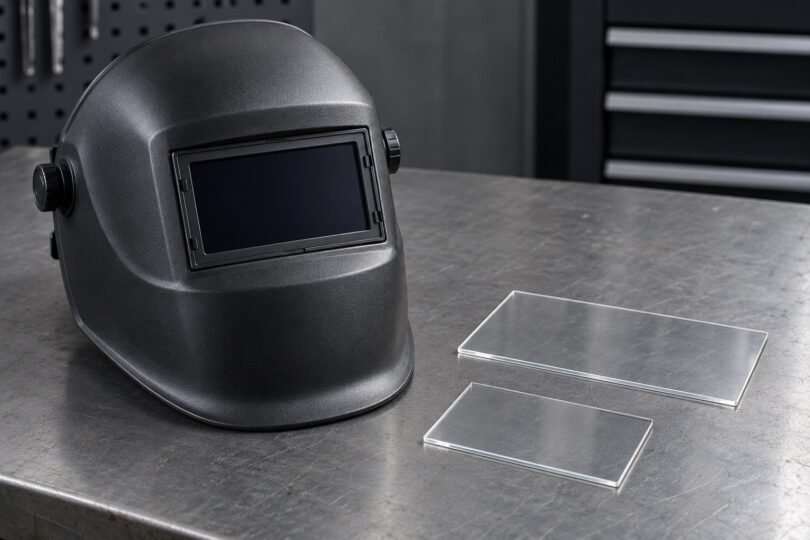

For a Miller welding helmet, the right replacement lens depends on two things: the exact helmet version and which component needs replacing. A clear outside cover, a clear inside cover, an auto-darkening filter and a magnifying insert do different jobs. Buying by the words “Miller lens” alone can leave you with a perfectly good part that does not belong in your helmet.
Start with the model and serial information on the helmet, find its parts diagram, and match the replacement number. For common Digital Elite and Digital Infinity cover lenses, the references below help narrow the search. They are not a universal compatibility list for every Miller helmet or generation.
First identify which kind of lens you need
- Outside or front cover: the replaceable clear plate on the outside of the lens assembly.
- Inside cover: the clear plate on the wearer-facing side of the filter.
- Auto-darkening filter, or ADF: the electronic lens assembly that changes its viewing shade during supported operations.
- Magnifying lens: an optional optical insert for closer viewing; it does not replace the required filter or protective covers.
A scratched clear plate and a filter that fails to darken call for different decisions. Do not assume an expensive ADF is needed before identifying the damaged component. Equally, a new clear cover cannot repair a malfunctioning electronic filter. Miller’s head-and-face protection guide distinguishes lens types and explains why shade coverage and helmet features must match the application.
Find the helmet version before the replacement part
Use Miller’s manuals and parts lookup, which supports model and serial-number searches. Locate the parts diagram that matches the helmet shell and lens assembly, not merely a similar graphic finish. Save the manual reference beside the replacement part number so the next order is easier.
Record three separate identifiers where available: the complete helmet model, the shell or assembly identification, and the ADF part number. “Digital Elite,” “Digital Infinity,” “Classic” and “T94” are not interchangeable descriptions. A shared brand name does not establish that a cover, holder or electronic cartridge fits.
For a used helmet, compare the actual components with the diagram. A previous owner may have changed a lens assembly or shell. If the labeling is unreadable, or the assembled parts do not match the manual, get Miller or an authorized distributor to identify it before buying or using replacements.
Four common Miller cover-lens references
216326: Digital Elite outside-cover reference
Miller 216326 is a front cover listed at 4-11/16 × 5-5/8 inches. Miller’s product page names MP-10, Elite, Digital Elite and Titanium helmet families. That family-level description is a starting point; verify the part in the diagram for your particular helmet.
Digital Elite manual OM-289749D lists standard black shell 216331 and quick-release black shell 241976. Both use outside cover 216326 and inside cover 216327, but their retention hardware differs. Follow the matching assembly diagram.
216327: Digital Elite inside-cover reference
Miller 216327 is the inside cover listed for those Digital Elite examples. Miller’s product page also names Elite, T94 and Titanium 9400/9400i families. Do not extend that description to an Infinity helmet simply because both are auto-darkening products.
Important size discrepancy: the Digital Elite manual lists 216327 as 4-1/4 × 2-1/2 inches, while Miller’s product-page title lists 4-3/16 × 2-1/2 inches. Match the OEM part number to the helmet diagram and have the supplier resolve any dimensional uncertainty. Do not order an unverified generic plate solely by one of those measurements.
271320: Digital Infinity outside-cover reference
Miller 271320 is the Infinity front-cover five-pack. Miller’s accessories catalog identifies the cover dimensions as 6 × 5-5/8 inches. This is a different part from the smaller 216326 outside cover discussed above.
For a concrete catalog example, the Digital Infinity list includes black shell 296786 with front cover 271320 and inside cover 271319. Confirm the same relationship in your helmet’s own documentation before ordering, particularly if the shell or filter has been replaced.
271319: Digital Infinity inside-cover reference
Miller 271319 is an Infinity inside-cover five-pack. The catalog gives its dimensions as 4-3/4 × 3-1/4 inches. It is the wearer-side cover, not the larger front plate, and not the ADF cartridge.
The Miller accessories catalog separates these covers from multiple Infinity electronic lens assemblies. The fact that different generations may share cover numbers does not establish that their electronic assemblies can be swapped.
Buying an auto-darkening replacement needs another check
Copy the complete ADF number from the relevant parts diagram and ask the supplier to verify any replacement or superseding number. Check whether the quoted item includes its required holder, gasket, battery trays or other associated components. A listing that says only “fits Miller helmets” does not provide enough information for this purchase.
Think about repair value as well as the cartridge price. Compare a verified replacement assembly plus any damaged shell or headgear parts against an appropriate complete helmet. Ask about the warranty that applies to the actual item being purchased. Neither an attractive discount nor an apparent physical fit establishes an approved combination.
If you want newer lens technology, ask specifically whether Miller supports that assembly in your existing shell. A replacement cover maintains the existing system; it does not add a newer ADF’s optical features, sensors or controls.
Shade selection is separate from cover-lens selection
A clear cover is not a welding filter. Shade selection depends on the process and operating conditions, including arc current and, where relevant, electrode size or material thickness. Use the applicable helmet manual and the OSHA filter-shade guidance, rather than choosing a universal shade number from a shopping article.
OSHA advises starting sufficiently dark and moving lighter only while staying at or above the required minimum protection. If the task requires a shade or operating capability the helmet does not provide, use suitable equipment for that task. Do not compensate for a scratched cover by reducing the shade below the minimum.
Wear the required primary eye protection beneath the helmet. OSHA’s eye-and-face protection guidance explains that a welding helmet is worn over safety spectacles or goggles. Also check the operating mode before welding; grind mode is not a welding setting.
When to stop using the helmet
If an ADF fails to darken, flickers unexpectedly or develops abnormal light and dark areas, stop welding or cutting and have it assessed. Do not test an uncertain filter by repeatedly striking an arc.
Follow the model’s instructions. For example, Digital Elite maintenance and troubleshooting covers battery and sensor checks and prohibits solvents, abrasive cleaners and immersing the lens assembly.
Both inside and outside covers must be installed as specified. Replace damaged covers; never modify a near-fitting plate or improvise retention hardware.
Keep the next replacement simple
Once the correct covers are confirmed, label the spare package with the helmet it belongs to. In a workshop with several helmet families, store front and inside covers separately so similar-looking plates are not mixed. Keep the invoice and original packaging with the part numbers visible, and reorder before the last usable spare is gone.
Final ordering checklist
- Confirm the helmet model, generation and matching parts diagram.
- Identify outside cover, inside cover, ADF or magnifier.
- Match the exact manufacturer part number and resolve conflicting dimensions.
- Confirm package quantity; a five-pack contains five covers, not necessarily a front-and-inside set.
- Check the seller’s return terms and keep the packaging until compatibility is confirmed.
For Digital Elite and Infinity owners, the four cover numbers above make a useful starting point. The final choice should always follow the documented helmet configuration. That is more dependable than buying a vaguely labeled “Miller replacement lens” and hoping it fits.


