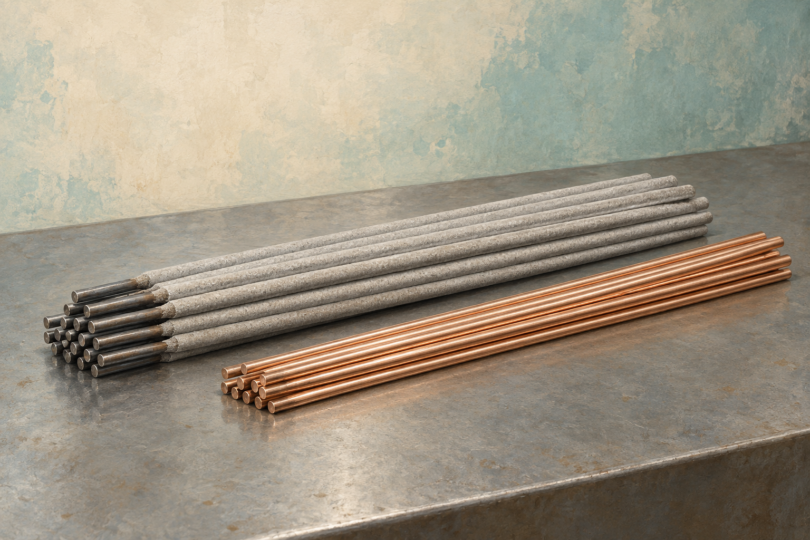

For thin mild steel with a stick welder, an E6013 electrode such as Lincoln Fleetweld 37 is a reasonable starting point to discuss with your welding supplier. If you are using TIG, you need a compatible bare filler rod, such as ER70S-2 for an appropriate mild-steel application, rather than a flux-coated stick electrode.
The phrase “thin metal” is not enough to specify a consumable. Identify the alloy, measured thickness, welding process, machine and joint before choosing a rod. Very thin sheet may be a poor match for the available stick-welding equipment, even if the electrode is marketed for sheet metal.
Research checked October 4, 2026 using manufacturer consumable information and welding-safety guidance. We have not performed weld tests or established a procedure for your material. This guide covers buying considerations for ordinary non-safety-critical work; structural, vehicle-safety, lifting and pressure-containing repairs need an appropriate qualified procedure and professional assessment.
First decide which kind of “rod” you need
| Process | Consumable example | Important distinction |
|---|---|---|
| Stick / SMAW | Lincoln Fleetweld 37, AWS E6013 | A flux-coated consumable electrode, subject to machine and material compatibility |
| TIG / GTAW | Lincoln ER70S-2 | A bare steel filler, used with suitable TIG equipment and shielding |
| MIG / GMAW | Process-specific compatible wire | Wire fed through a gun; neither of the rods above is a drop-in substitute |
These examples are not interchangeable. A product listing that loosely calls solder, brazing filler, plastic-welding staples or adhesive a “welding rod” may be describing a completely different joining process.
Fleetweld 37 E6013: a stick-electrode comparison
Lincoln’s retail electrode guide describes Fleetweld 37-RSP as an E6013 electrode for low-amperage sheet-metal work. It lists a 3/32-inch diameter, 12-inch length, one-pound tube under model ED033499, alongside other sizes and packages.
We would compare this family when you already have suitable stick equipment and the supplier confirms that it matches the known mild-steel job. The named package identifies an actual product; it is not a claim that 3/32 inch is right for every sheet thickness.
Limit: “low amperage” is a manufacturer application description, not a universal machine setting. Use the current data for the exact diameter and the welder’s instructions. A rod that can operate at a low current still cannot compensate for an unsuitable power source, poor fit-up or material too thin for the chosen process.
ER70S-2: a TIG filler for an appropriate steel job
Lincoln ER70S-2 is listed in the manufacturer’s TIG cut-length range, with sheet-metal work among its applications. It is a bare steel filler, not an E6013 stick electrode. The linked regional page establishes the product and classification, not US retail stock.
This is our comparison when you have compatible TIG equipment and a procedure that calls for ER70S-2 on the identified steel. Confirm the filler diameter, packaging and application with the supplier. The class name alone does not establish suitability for every alloy, joint or service condition.
Limit: do not use this mild-steel comparison as a recommendation for aluminum, stainless steel, cast iron or an unidentified plated part. Those materials require their own process and consumable decisions. A bare filler rod also does not replace the tungsten electrode used by the TIG torch.
When changing process matters more than changing rods
Miller’s sheet-metal guidance identifies burn-through, distortion and heat control as central concerns when welding thin material. It discusses MIG and TIG approaches for sheet metal.
That is why the buying decision should include whether your process and machine are appropriate at all. A different box of stick electrodes may not solve repeated burn-through on very thin sheet. Ask a qualified welding instructor or supplier to assess the material, equipment and intended result before buying more consumables.
This article does not supply a universal amperage, polarity or welding sequence. Those choices depend on the exact consumable, diameter, material, equipment and qualified instructions. A smooth-looking bead is not proof of adequate fusion or a safe repair.
Information to take to the supplier
- Material identity: the alloy or known steel grade, not just “metal.” Include any coating, plating or previous repair.
- Measured thickness: specify the actual measurement and units. A gauge number without the material can be ambiguous.
- Process and welder: give the machine model and the welding mode you intend to use.
- Joint and purpose: explain whether this is practice, a decorative item or a component whose failure could injure someone.
- Consumable details: verify classification, diameter, length, package size and the current technical and safety data.
For an important repair, the next step may be a professional welding service instead of a consumable purchase. Do not use a general buying guide to approve work on a chassis, suspension part, pressure vessel or load-bearing structure.
Safety comes before a test weld
OSHA’s welding-fume guidance explains that fumes depend on the process, base metal and coatings, among other factors. Working outdoors does not automatically provide adequate protection. Appropriate ventilation or fume extraction and an assessment of the material are essential.
Do not weld unidentified, coated or plated material until its hazards and preparation requirements have been assessed. A product description that mentions galvanized steel is not permission to ignore zinc fumes or other coatings. Never heat or weld a container that has held flammable material based on advice from a general shopping article.
Follow the equipment manual and obtain training in electrical, arc-radiation, burn and fire hazards. Use appropriate welding eye and skin protection, protect bystanders and remove combustible hazards. Ordinary blue-light glasses, casual work shirts, epoxy and soldering tools are not substitutes for the specified welding equipment or protective gear.
Buy and store the correct consumable
- Match the full classification and diameter on the package to the selected procedure.
- Do not infer compatibility from a similar brand name or a seller’s generic “all metals” claim.
- Keep packaging and batch information so the consumable can be identified later.
- Follow the manufacturer’s storage instructions; do not improvise oven-drying temperatures or reuse damaged consumables without guidance.
- Compare cost per usable quantity only after suitability has been established.
Frequently asked questions
Is E6013 always the best rod for thin metal?
No. It is one stick-electrode family to investigate for appropriate steel work. The alloy, thickness, machine and joint may require another consumable or another process.
Can I use a smaller rod and simply turn the welder down?
Do not choose settings by that rule alone. Stay within the exact consumable and machine guidance and obtain help if the process is unsuitable for the material.
Are TIG filler rods and stick electrodes the same?
No. They serve different processes and cannot be swapped merely because both are sold as rods.
Bottom line: compare Fleetweld 37 E6013 for suitable stick-welded mild steel and ER70S-2 only for a compatible TIG steel application. Identify the material and process first, and treat safety-critical work as a professional procedure decision.
Image note: AI-generated generic editorial illustration; it does not identify an alloy or diameter, set welding parameters or demonstrate a welding procedure.