
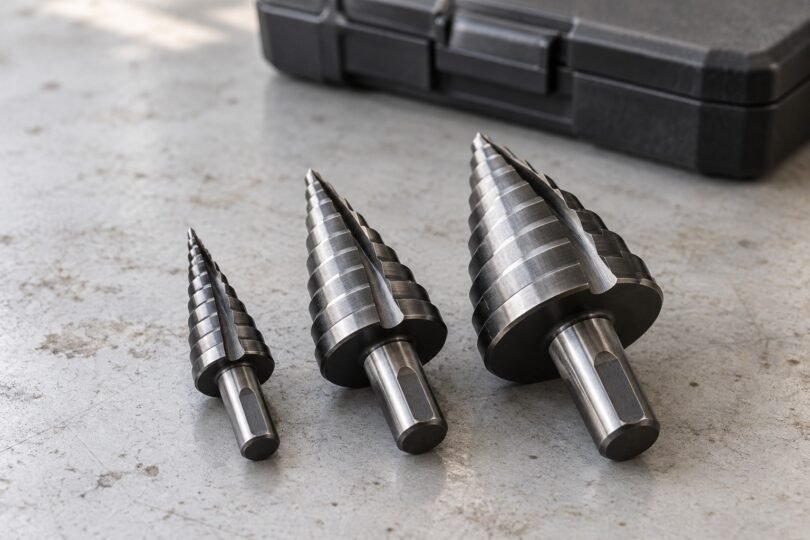

If you are searching for a Milwaukee Unibit set, the product category you want is a Milwaukee step drill bit set. IRWIN uses the UNIBIT name; Milwaukee sells its own JAM-FREE, SHOCKWAVE Impact Duty, and Cobalt step-bit families. The distinction matters when you compare model numbers, shanks, and included hole sizes.
For general mild-steel and plastic work with a drill/driver, start by comparing the 48-89-9221 three-piece set against the holes you need. If an impact driver is part of the plan, look specifically at the 48-89-9254 SHOCKWAVE set. For stainless-steel sheet within the manufacturer’s stated thickness recommendation, the 48-89-9291 Cobalt set deserves attention. These are different tool choices, not simply three price tiers of the same kit.
Three Milwaukee step-bit sets compared
48-89-9221: the general drill/driver starting point
Milwaukee’s 48-89-9221 set contains three black-oxide step bits and a carrying case:
- #1, 48-89-9201: 1/8–1/2 inch, in 1/32-inch increments.
- #2, 48-89-9202: 3/16–1/2 inch, in 1/16-inch increments.
- #4, 48-89-9204: 3/16–7/8 inch, in 1/16-inch increments.
The smaller bits overlap, so adding their step counts does not produce that many unique diameters. The practical attraction is the fine progression below 1/2 inch and coverage up to 7/8 inch. If your required hole is larger, this set needs a different companion bit or a different kit.
Milwaukee specifies three-flat shanks and cordless-drill use. Its current product presentation identifies mild steel and PVC applications. Choose it for those stated jobs after checking thickness and tool compatibility; do not transfer the impact-driver rating of SHOCKWAVE bits to this black-oxide set.
48-89-9254: the explicitly impact-compatible alternative
The 48-89-9254 SHOCKWAVE Impact Duty kit contains three step bits: #1 covering 1/8–1/2 inch, #2 covering 3/16–1/2 inch, and #4 covering 3/16–7/8 inch. Milwaukee specifies a 1/4-inch hex shank, impact-driver optimization, and drill/driver compatibility.
Its titanium aluminum nitride coating and dual spiral flute distinguish it from the black-oxide kit. The reason to choose it is the manufacturer’s explicit tool compatibility, rather than assuming a shiny coating automatically makes every bit impact-rated. It still stops at 7/8 inch and does not give a blanket approval for every metal or thickness.
Check the full 48-89-9254 number when buying. Milwaukee sells other three-piece SHOCKWAVE combinations with different bit selections, and a generic “three-piece step set” description is not enough to identify this one.

Milwaukee 48-89-9254 SHOCKWAVE Impact Duty 3-Piece Step Bit Set (#1, #2, #4)
As an Amazon Associate we earn from qualifying purchases.
48-89-9291: the cobalt option for stainless-steel sheet
The 48-89-9291 Cobalt kit contains these three bits:
- #1, 48-89-9281: 1/8–1/2 inch.
- #4, 48-89-9284: 3/16–7/8 inch.
- #9, 48-89-9289: 7/8 and 1-1/8 inch hole sizes.
The #9 is a two-size bit, not a complete sequence of every diameter between its endpoints. Milwaukee’s accessory catalog confirms the two hole sizes and lists a carrying case with this kit.
Milwaukee recommends the Cobalt family for material up to 14 gauge and specifies cordless-drill use with three-flat shanks. Its application guidance calls for low speed with cutting fluid in stainless steel and high speed in mild steel. Use the guidance for the exact bit and material; the cobalt construction does not establish an impact-driver rating.
Need a larger diameter? Read the actual kit contents
Milwaukee’s manufacturer catalog documents two other black-oxide combinations worth comparing:
- 48-89-9223, four bits plus case: #1 (1/8–1/2 inch), #4 (3/16–7/8 inch), #7 (7/8 inch), and #12 (7/8–1-3/8 inch).
- 48-89-9224, six bits plus case: #1 (1/8–1/2 inch), #4 (3/16–7/8 inch), #6 (3/8 and 1/2 inch), #7 (7/8 inch), #8 (1/2–1 inch), and #9 (7/8 and 1-1/8 inch).
The six-piece kit therefore does not reach as large a maximum diameter as the four-piece kit. This is why piece count makes a poor buying shortcut. The catalog establishes those combinations, but check the current seller’s exact model and included components before ordering. A range label also does not promise every fractional size within that range.
Match the shank to the tool
Hole diameter and shank diameter describe different parts of a step bit. For example, Milwaukee specifies a 1/4-inch shank for the black-oxide #1 and a 3/8-inch shank for the black-oxide #4. Three flats help a drill chuck grip; they are not the same interface as a 1/4-inch quick-change hex shank.
Check the chuck capacity and approved accessories for your drill. An adapter does not turn an ordinary drill bit into an impact-rated accessory. Likewise, an impact-compatible bit does not authorize hammer-drill mode or an impact wrench. Use the tool and operating mode specified for that exact accessory.
For tight spaces, compare the whole bit’s length and the working clearance beyond the sheet. The point and earlier steps project through before the final diameter is complete. A nearby cable, cabinet wall, or component behind the work can make an otherwise suitable bit a poor choice.
Material and thickness matter more than the coating color
A step bit enlarges a hole as progressively wider sections pass through the work. Check the material-thickness limit and usable step depth for the exact bit; total bit length is not the permitted sheet thickness. Thick stock can require another type of cutter even if the desired diameter appears on the step bit.
Do not apply the Cobalt family’s 14-gauge recommendation to every Milwaukee step bit. Likewise, a listing that says “metal” should not be read as approval for hardened steel, masonry, or any alloy you happen to have. Identify the material first, then match it to the manufacturer’s instructions.
For a precision fit, check the required finished diameter before buying. Grommets, fittings, and connectors may specify a mounting-hole size that differs from the nominal product size. Write down that actual dimension and find it in the bit’s size list. A kit that nearly reaches it is not a useful substitute.
A safer drilling checklist
Read your drill’s manual and the accessory instructions before beginning. Milwaukee’s drilling safety and application guidance emphasizes secure workholding, eye protection, appropriate accessories, and controlled pressure. Practical checks include:
- Disconnect power or remove the battery before fitting or changing the bit.
- Secure the workpiece with appropriate clamps and support it for breakthrough. Do not hold loose sheet metal in your hand.
- Check both sides of the drilling area for concealed wiring, pipes, and other obstructions.
- Wear the protective equipment required by the tool manual and keep loose clothing, hair, and hands away from rotating parts.
- Use the specified speed and compatible cutting fluid for the exact material. There is no single safe RPM for every bit, diameter, and metal.
- Stop at the intended step, allow the tool to stop before measuring, and handle chips or hot bits only after they are safe to touch.
If the setup chatters, binds, or stops cutting normally, stop and reassess workholding, tool choice, bit condition, and the material. More force is not a substitute for the correct combination.
Which set should you buy?
Choose by three answers: your largest required hole, your material and thickness, and the tool you will use. The 48-89-9221 is a logical starting comparison for common drill/driver jobs up to 7/8 inch. The 48-89-9254 is the clearly specified impact-driver choice with the same maximum size. The 48-89-9291 is the stainless-focused alternative with a different #1/#4/#9 combination. Buy the smallest verified combination that covers the actual job, rather than paying for a larger count of overlapping bits.

