
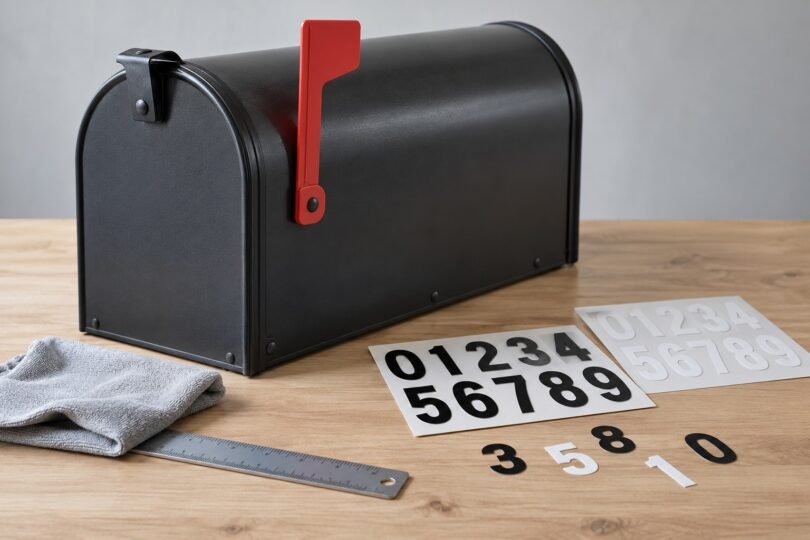

The best number stickers for a mailbox are easy to read from the carrier’s approach, sized for the available space and made for the mailbox’s outdoor surface. Before buying, count every repeated digit and decide how many sides you want to mark. A sheet containing 0–9 usually does not mean you get enough numbers for two complete addresses.
For a straightforward address without repeated digits, an individually cut reflective set is convenient. For several repeats or perfectly aligned lettering, a custom pre-spaced decal can be easier. Measure the usable flat area first, then choose a contrasting color and check the adhesive instructions.
Three useful mailbox-number options
| Option | Size and contents | Useful for | Check before buying |
|---|---|---|---|
| Mail Boss Reflective Designer Mailbox Address Numbers | 3-inch and 4-inch variants. One sheet contains 10 individually cut, self-adhesive reflective vinyl numbers: one each of 0–9. | Choosing individual digits and arranging them to suit the mailbox. | Every duplicate digit needs another sheet. Select the required height and enough sheets for all marked sides. |
| Hy-Ko MM-23N reflective number set | The manufacturer’s catalog lists 3-inch numbers on 3.25-inch panels and 24 characters per retail set. | Black numbers with a reflective background, especially where the mailbox color makes bare digits difficult to see. | The catalog does not itemize how many of each digit are included. Confirm those counts on the actual package; the catalog’s “Pack 10” is not the number of characters in one retail set. |
| Alphabet Signs custom reflective mailbox numbers | Custom 3-inch numbers supplied pre-spaced on a liner with transfer tape. | Repeated digits, consistent spacing and applying an address as a single arranged design. | Confirm the complete address width, chosen color and number of copies. Do not assume an order includes a matching decal for the other side. |
Mail Boss specifies reflective vinyl and the exact sheet contents. Hy-Ko’s number-and-letter catalog describes its packaged reflective numbers as weather resistant and intended for clean, dry, smooth surfaces. Alphabet Signs identifies the reflective material and supplies the lettering pre-spaced. These descriptions help narrow the choice; they are not a promise that a sticker will bond to every mailbox finish.
What USPS says about mailbox markings
For curbside mailboxes, Domestic Mail Manual section 508.3.2.7 says a box number, when used, must appear in contrasting, neat characters at least 1 inch high. It belongs on the side visible from the carrier’s usual approach, or on the door when boxes are grouped. The same section addresses house numbers assigned by local authorities and authorized for postal use.
The USPS mailbox installation guide also says to put the house or apartment number on the box, and to include the full street address if the mailbox is on a different street from the home.
Postal mailbox identification and local emergency-address requirements are separate checks. Ask your local addressing office or fire department about any required number height, placement or separate house sign. For grouped or managed mailboxes, confirm the permitted labeling arrangement with the property manager and local Post Office. Buying a sticker labeled “mailbox numbers” does not establish compliance with every local rule.
Choose character height, contrast and placement together
Measure the actual numbers, not just the backing panel. A 1-inch panel can contain a character shorter than 1 inch. Hy-Ko’s MM-23N is a useful example of the distinction: its catalog gives a 3-inch number height and a 3.25-inch panel height.
As a practical starting point, consider 3-inch numbers if the complete address fits comfortably. Try 4-inch numbers where there is enough room, especially when the box is farther from the viewing point. Larger characters are only helpful when the whole address remains visible and uncrowded. Make a paper layout before choosing the size.
- Dark mailbox: use a light numeral or a contrasting light panel behind dark numbers.
- Light mailbox: use dark numbers with clear separation from the surrounding finish.
- Reflective finish: assess it in daylight and when illuminated at night. It is not a self-lit number or a guarantee of a particular viewing distance.
- Placement: keep the complete address clear of the flag, door hardware, seams and decorative details. Check the view from the carrier’s direction before pressing the stickers down permanently.
Count repeated digits before you order
Make a short inventory for every surface you plan to label. For the example address 1214, one side needs two 1s, one 2 and one 4. Two sides need four 1s, two 2s and two 4s.
With a sheet containing one each of 0–9, that two-sided example needs four sheets because the digit 1 is the limiting number. Two sheets would supply 20 stickers in total, yet still leave the address incomplete. Mail Boss explicitly advises ordering additional sets for duplicate digits.
For mixed-size bundles, count each height separately. Three sheets of 3-inch digits and two sheets of 4-inch digits do not provide five matching copies of each number. With an assorted 24-piece kit, ask for the per-digit inventory rather than assuming it contains equal quantities. For a custom decal, specify the repeated digits exactly and order the required number of complete address copies.
Check the surface and outdoor suitability
“Vinyl” describes a material, not a universal adhesive. Verify that the selected decal is intended for exterior use and compatible with the mailbox’s finish. Smooth painted metal, textured plastic and rough powder coating present different surfaces. If compatibility is unclear, ask the decal maker before buying.
Prefer a smooth, sound area without peeling paint, rust or old adhesive. A suitable separate address plaque can provide a different mounting surface when the box itself is unsuitable, but its mounting must suit the mailbox and the location’s requirements.
Outdoor-life claims need context. 3M’s reflective graphic-film bulletin explains that performance depends on the substrate, preparation, surface texture, application method, sunlight exposure, environment and maintenance. Its specifications apply to its named film series; do not transfer that film’s service life or installation temperature to a different sticker kit.
Apply the numbers without wasting the set
- Lay out the address with the backing still on. Check spelling or digits, spacing, total width and clearance from moving parts.
- Prepare the surface as directed. Remove dirt and residue using a cleaner suitable for both the mailbox finish and decal. Let the surface dry completely. Do not assume a strong solvent is safe on plastic or painted finishes.
- Check the application conditions. Follow the decal maker’s air and surface temperature limits, pressure instructions and any waiting period before washing or weather exposure.
- Apply individual stickers or transfer lettering according to their instructions. Avoid touching the adhesive. Do not stretch digits to make them fit or repeatedly lift a product that is not designed for repositioning.
- Inspect the finished address. Check that every digit is upright, unobstructed and firmly attached, then view it from the normal approach.
Recheck the numbers when you maintain the mailbox. USPS specifically recommends replacing missing or faded house numbers during its suggested annual mailbox checkup. Replace lifting or illegible digits promptly, and keep spare matching numbers with the product details so the next repair is straightforward.


