
The right OBS Ford headlights depend on the truck’s exact year, model and installed front end. For a road-driven truck, start by matching the original lamp type and fixing worn housings, mounts or wiring. A higher lumen number or an LED halo does not establish that a replacement will fit or put a safe beam on the road.
This guide focuses on choosing parts for older F-Series trucks and full-size Broncos. Product examples illustrate different replacement types; they are not the results of a comparative road test.
Identify the truck before ordering headlights
“OBS,” short for old body style, is an informal description, not a Ford parts application. Record the model year from the vehicle identification information, the full model designation and whether the front end or lamps have been changed. A seller’s broad year range is only a starting point.
| Vehicle or body style | What to check |
|---|---|
| 1987–1991 F-Series or Bronco | Search the exact year and model. Do not substitute a 1992–1996 housing because both trucks are described as OBS. |
| 1992–1996 F-150 and full-size Bronco | These years appear together in many application lists, but verify the particular part, mounting points and package contents. |
| 1992–1997 F-250/F-350 applications | Check the detailed model and duty designation. A 1997 F-250 HD listing does not establish compatibility with a 1997 F-250 light-duty truck. |
| 1997 F-150 or later trucks | Use the catalog for that body and model. Do not extend an older F-150 application just because an F-350 listing runs longer. |
| Front-end conversions or aftermarket projectors | Identify the installed housing and its specified bulbs. The original vehicle’s bulb chart may no longer describe the equipment fitted. |
For example, ANZO’s 111184 application table lists 1992–1996 F-150, Bronco, F-250 and F-350, then 1997 F-250 HD and 1997–1998 F-350. Its title compresses those applications into a broader range. Read the table rather than treating that title as coverage for every F-Series truck.
Buy the part that solves the problem
- Replacement bulb: appropriate when the housing, reflector, connector and mounting system are sound and the bulb has failed. It does not replace the lens or reflector.
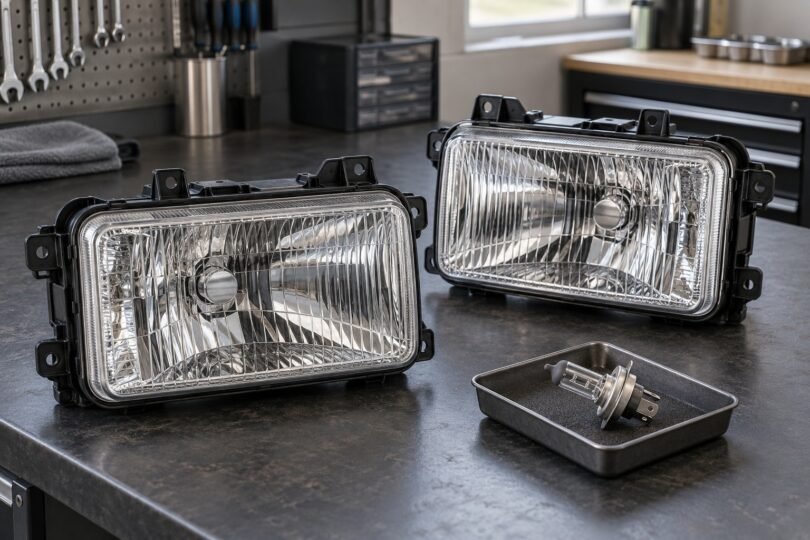
- Headlamp housing or assembly: check whether bulbs, sockets, retainers and adjusters are included. “Assembly” does not guarantee a ready-to-install kit.
- Front lighting set: a six-piece set can count headlights, parking lamps and corner lamps separately. It does not mean six headlamps, and trim bezels may be additional.
- Retainer, adjuster or headlight door: hardware and trim are separate purchases. A headlight door is not a light-producing assembly.
If a lamp is loose, cracked or leaking, address that fault before choosing a brighter bulb. If both beams are weak or the connector shows heat damage, have the electrical supply and grounds checked. A bulb upgrade cannot repair a damaged connector or an unstable mounting point.
Bulbs and assemblies: two different buying decisions
For a truck that still uses its specified 9007 halogen bulbs
The 1996 Ford F-Series owner’s guide, printed page 369, lists two 9007 headlamp bulbs. Use that as evidence for the manual’s application, not a guarantee for every truck called OBS.
SYLVANIA 9007 Basic, package 9007.BP2, is a two-bulb halogen pack. It is a straightforward replacement option when the installed housing and vehicle specifications call for 9007. The pack contains bulbs, not housings, corner lamps or mounting hardware. SYLVANIA describes this line as meeting DOT performance requirements; that claim applies to the intended bulb application.
For a change to projector-style assemblies
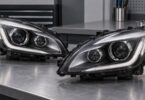
ANZO 111184 is a useful example of why the light-source specification matters. The current maker page identifies a clear lens, black housing, H7 halogen low beam and H1 halogen high beam. Its LED halo and parking-light features do not make its main beams LED, and the factory 9007 bulb is not the specified replacement for those projectors.
The manufacturer photo shows left and right units, while the title includes “1 PC.” Confirm the actual boxed quantity, included bulbs, connectors, hardware and installation instructions before ordering. Also confirm the exact assembly’s road-use certification and any separate wiring required for decorative features. This example is not a recommendation based on measured beam performance.
What DOT markings do and do not mean
For U.S. road use, the relevant federal equipment standard is FMVSS No. 108. It covers headlamp performance and marking requirements. The DOT symbol represents the manufacturer’s certification; NHTSA does not approve individual headlamp designs.
Look for the maker, part identification and applicable markings on the exact assembly. A mark on a corner lamp, a retailer’s “DOT approved” phrase or a photograph of another variant does not establish the headlamp’s compliance. Certification also does not verify that the part fits your truck or remains compliant after an unspecified bulb substitution.
NHTSA’s February 2024 LED interpretation distinguishes integral LED headlamps from replaceable-bulb headlamps and states that no LED replacement source was permitted in the latter at that time. The current federal standard still requires replaceable light sources to match their specified dimensions and electrical characteristics. Do not assume a plug-in LED advertised as “9007 compatible” is a lawful or optically suitable replacement for a halogen bulb. Vehicle modifications also involve state requirements; check the rules where the truck is registered.
Check installation details and aim
- Match the housing’s approved bulb type, electrical connector, retaining ring and mounting locations. Never force a similar-looking connector or modify bulb tabs to make an incorrect part fit.
- Confirm driver versus passenger side and count each included part. Budget separately for damaged adjusters, seals, retainers or trim.
- Read both the vehicle procedure and the replacement assembly’s instructions. Ford’s halogen-bulb guidance calls for avoiding contact with the glass and keeping contamination out of the open housing.
- After housing replacement, have the beam aim checked using the procedure appropriate to that lamp. Do not use a universal wall-measurement shortcut without confirming the lamp’s aiming requirements.
Ford’s 1996 lighting guidance identifies poor nighttime illumination, misplaced beams and repeated flashes from oncoming drivers as reasons to check alignment. Secure mounts, the correct light source and proper aim matter more than styling labels.
Questions to settle before checkout
Give the supplier the exact year, model, duty designation and installed lamp information. Ask for the precise part number, left/right quantity, bulb types and inclusions, connector details, aiming instructions and road-use documentation. If any of those answers are missing, resolve them before purchasing. That is a more reliable route to suitable OBS Ford headlights than choosing the largest “best” list or the highest advertised brightness.