A good PIV badge holder keeps your credential readable, secure and easy to remove for a computer’s contact reader. Start with your agency’s requirements: if you were issued a particular holder, ask the security office before replacing it. For example, GSA tells its cardholders to use the original issued holder when the card is not in use.
If a replacement is permitted, the important choice is whether you need RF shielding. The ID Stronghold DuoLite below is the shielding option. The GOVO T4 and Specialist ID kit are useful physical holders, but should not be substituted where an approved shielded sleeve is required. None of these recommendations establishes acceptance by your workplace.
Three PIV badge holders worth comparing
| Exact option | Best fit | What to check |
|---|---|---|
| ID Stronghold DuoLite vertical, black, one holder | Two cards and manufacturer-described RF shielding | Agency acceptance and the required operating frequency |
| GOVO T4 polycarbonate, black, metal clip, one holder | One to four cards with a pocket-clip option | Unshielded use must be allowed |
| Specialist ID SPID-9070 kit, black, one holder and lanyard | A top-loading multi-card holder with included breakaway lanyard | Card thickness, front visibility and permitted neckwear |
ID Stronghold DuoLite for a shielded two-card setup
The black vertical DuoLite holds two credit-card-size credentials back to back. ID Stronghold describes an open-face design that lets someone visually inspect a badge, a hook attachment for a lanyard or reel, and a way to present a card without completely removing it for a contactless read.
The manufacturer specifies shielding for 13.56 MHz and higher-frequency cards, and separately directs buyers with 125 kHz HID proximity cards to a different product. That distinction matters: do not assume the word RFID means every access technology is covered. Ask your security team which credential and shielding specification apply.
Trade-off: a shielded holder changes the tap-in workflow. You need to expose the card as the holder’s instructions require, then return it fully to the shielded position. For a contact reader, take the card out of the holder entirely. The linked option is one black holder without the separate lanyard-and-reel bundle.

ID Stronghold DuoLite Vertical RFID Blocking Badge Holder, Black, 2 Card Capacity, 1 Holder
As an Amazon Associate we earn from qualifying purchases.
GOVO T4 for a rigid holder with a metal clip
The GOVO T4 in black with its metal clip offers a different carrying arrangement. Its polycarbonate housing and transparent screen surround a spring-loaded system that holds one to four cards. GOVO lists a 1.4-ounce weight and a reinforced lanyard loop, so you can consider either the clip or an appropriate separate lanyard.
The maker describes this model as optimized for proximity access. Treat it as a physical card holder, rather than selecting it to meet an RF-blocking requirement. Its clear front is useful when you need the photograph visible while carrying other cards behind it.
Trade-off: the extra card capacity may encourage you to carry more than your badge program allows. Keep only the permitted credentials inside and check that the front card’s required details remain visible. This recommendation is for the original polycarbonate T4 with a clip, not the no-clip, aluminum, titanium or T6X versions.

Specialist ID SPID-9070 kit for an included breakaway lanyard
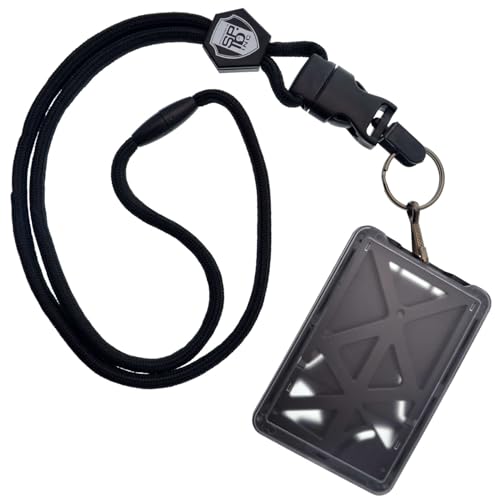
The Specialist ID vertical three-card kit combines a rigid top-loading holder with a breakaway neck lanyard, quick-release metal clip and key ring. The exact black single-kit listing identifies SPID-9070 and specifies room for three standard CR80 30-mil cards. A front window displays the leading badge, and rear thumb levers help slide the cards upward.
This is useful when your main frustration is removing a card for a reader while keeping the holder attached to a lanyard. A removable connection also gives you a way to detach the assembly without pulling the entire cord over your head.
Trade-off: capacity is based on standard card thickness. A thick clamshell access card, extra plastic sleeve or several added inserts can change the fit. The breakaway feature does not make neckwear appropriate for every job, and the kit should not be treated as a shielded holder. Confirm your workplace’s attachment rules first.
Check card dimensions rather than holder dimensions
A standard ID-1/CR80 card measures approximately 85.60 by 53.98 mm, or 3.370 by 2.125 inches, with a common nominal thickness of 0.76 mm, also called 30 mil. These are the card dimensions, not the outside dimensions of a case. Matica’s card-equipment specifications identify that format.
A listing that says a holder is four inches long does not tell you whether the inside channel accepts your card. Look for the insert size and supported thickness. If your badge is already inside an issued sleeve, do not assume a second holder will accommodate both. Avoid trimming, bending or otherwise modifying a credential to make it fit.
Match orientation and visibility to the badge
Choose portrait or landscape according to how the card must be displayed. Then look at the attachment point. A top slot, rear hook or pocket clip can change how the holder hangs, including whether it flips over or tilts when attached to your existing reel.
The card-loading opening and lanyard slot are separate features. A top-loading case may still use a rear attachment point. Check that a clip does not obstruct the opening you need for removal, especially if you insert the card into a computer several times a day.
Examine the visible window as carefully as the outer shape. Borders, frosted panels, stacked cards and accessory labels can obscure the photograph, name, expiration date or other details your workplace expects to see. Avoid adding decorative covers until you have confirmed that all required information remains visible.
Understand protection and reader access
A rigid shell can support the card and reduce everyday handling wear. That does not establish RF shielding. Similarly, an RFID-blocking claim does not establish waterproofing, protection against every attack or current government approval. Read the specification for the exact model instead of relying on words such as military, secure or tactical.
NIST’s PIV guidance describes both contact and contactless interfaces. With a contact reader, the card must be inserted so its contact pad can meet the reader. Remove it from its holder; do not force the holder, attached lanyard or additional sleeve into the slot. With contactless access, follow the issuer’s instructions and the holder’s intended exposure mechanism.
If a multi-card arrangement reads inconsistently, try the permitted credential alone according to your workplace’s procedure. Do not assume that a larger holder or more expensive reel will fix reader compatibility. Your security or IT team can distinguish a positioning issue from a damaged or expired credential.
A quick check before your first shift
- Confirm that a personal replacement holder and its carrying method are allowed.
- Insert only the supported number and thickness of cards.
- Verify that the credential’s required visual details are unobstructed.
- Practice removing the card over a desk so you can check retention without dropping it.
- Check that the loaded reel retracts normally and its connector closes securely.
- Try the approved reader workflow before relying on the new setup at an entrance.
GSA also advises against marking, punching holes in or bending its access cards, and against excessive heat or direct sunlight. A holder should let you follow those handling rules. If it needs you to alter the card, force its edges or leave it partly loose, choose a better-fitting arrangement or ask for an issuer-provided replacement.
Image note: Relevant existing category illustration retained.