
For legal-size poly file folders, check two things before anything else: the product must accept 8½ × 14-inch paper, and the folder body must actually be plastic. A paper hanging folder with a plastic label tab does not meet the same requirement. Neither does a letter-size envelope simply described as suitable for office documents.
Two verified choices cover different amounts of paperwork: Pendaflex 50993 translucent poly file jackets for modest project packets, and Smead 73550 poly file pockets for thicker files. Both are legal-size, open-top designs with enclosed sides. Choose between them primarily by expansion and how you retrieve the contents.
Quick comparison: a file jacket or a deeper pocket?
- Pendaflex 50993: five translucent assorted-color jackets, 1-inch expansion, straight tabs and a thumb-cut front. The more compact option for separating active document sets.
- Smead 73550: four assorted-color polypropylene pockets, 3½-inch expansion and a lowered front panel. The more spacious option for a growing project or multiple related packets.
These are not hanging folders and do not include the rods needed to suspend files from drawer rails. They are also different from conventional side-open file folders: the enclosed sides help retain loose sheets while you handle the file upright, but the open top remains a route for papers to slide out.
Pendaflex 50993: for slimmer legal-size packets
The Pendaflex 50993 package contains five legal-size poly jackets in assorted translucent colors. The construction encloses three sides, and the front has a thumb cut so you can reach the papers without opening a flap. The stated expansion is 1 inch. Eakes’ product specifications identify 8½ × 14-inch sheet compatibility and a 14¾ × 9½-inch jacket footprint.

Pendaflex 50993 Translucent Poly File Jackets, Legal Size, Assorted Colors, 5 Pack
As an Amazon Associate we earn from qualifying purchases.
This design makes sense when you want separate jackets for separate matters: one property project, one appliance’s paperwork, one client packet or one set of forms. The straight tab gives you a broad labeling edge, while translucency helps you recognize an inserted cover sheet. Use a readable label as well as a color; color alone becomes ambiguous as the filing system grows.
Trade-off: 1 inch of expansion is limited space. A file filled with stapled bundles, clips and folded attachments can become bulky sooner than a stack of flat sheets. Do not select the jacket solely from an advertised sheet count, because the thickness and arrangement of your paperwork determine whether it fits comfortably.
Check for 50993 at checkout. The related 50990 jacket is letter-size, so a listing that switches size or pack options can change the product you are buying. Baumann Paper’s model-specific listing corroborates the polypropylene construction, legal format and five-pack.
Smead 73550: for thicker legal-size files
Smead 73550 is a four-pack of legal-size polypropylene file pockets with 3½-inch expansion. Its deeper accordion sides suit a larger collection of related paperwork, and the drop-front panel makes the contents easier to reach from the front. Smead’s selected legal-size variant identifies the assortment and pack; Staples’ exact 73550 listing independently confirms the legal format and expansion.

The selected package includes blue, green, red and yellow pockets, one of each. It is a useful layout for grouping a substantial project under one label while keeping smaller internal document sets together. For example, a renovation file could contain separate clipped packets for quotations, product instructions and receipts.
Trade-off: the larger capacity consumes more drawer, shelf or bag depth when filled. It does not automatically make the documents easier to find. If you routinely leaf through a mixed pile, use labeled internal sections or split the collection across smaller files rather than treating extra capacity as a substitute for organization.
Verify 73550, not just the Smead brand and a four-color photograph. The same product family includes letter-size options that look much like the legal version. The correct paper format matters more than whether the product photograph has the colors you prefer.
Make sure “legal size” describes the paper that fits
US legal sheets are 8½ × 14 inches; US letter sheets are 8½ × 11 inches. A4 is another format, approximately 8¼ × 11¾ inches. An A4 or letter folder may accept some smaller documents from a legal-size file, but it cannot fully enclose an unfolded 14-inch sheet along that dimension.
Read both the sheet-size specification and the folder’s external dimensions. A folder must be larger than the paper it holds. Conversely, a package dimension is not necessarily the usable interior space: it may describe several folders stacked together or their shipping box. If the listing never states the supported sheet size, ask before ordering.
Also measure the destination. A legal-size folder can be correct for your paper and still be too wide for a letter-only drawer, desktop sorter or shoulder bag. Check opening width, usable height and depth with the file filled, including any tab that needs clearance.
Choose expansion from a real document stack
Gather the paperwork you expect to store and measure its thickness without compressing it. Include the bulky pieces you will actually keep: stapled reports, folded drawings, envelopes or divider sheets. Then allow sensible room for additions and easy removal. A product that fits only when forced is the wrong capacity.
A slimmer jacket is often easier to carry and assign to a single task. A deep pocket is more useful for keeping a substantial record together on a shelf or inside a suitably sized storage box. If your file will be inverted or tossed into luggage, select a legal-size design with a suitable closing flap or zipper instead; neither of these two products provides a fully closed carrying enclosure.
Water resistance, privacy and everyday use
Both product descriptions specify resistance to moisture or water, but an open-top folder is not a waterproof storage system. Keep it away from spills and wet bag compartments. Plastic construction also does not make the contents fireproof or provide a backup if the documents are lost.
Translucent jackets are useful for identification, but they are not a privacy barrier. Store sensitive papers where unauthorized people cannot access them, and avoid placing unnecessary personal details on exposed tabs. Test your chosen label on one folder before labeling the whole pack; an adhesive that works on paper may behave differently on a smooth plastic surface.
Which should you choose?
Choose the Pendaflex 50993 when five smaller legal-size jackets fit your workflow. Choose the Smead 73550 when four deeper pockets better match the size of your files. Before buying either, confirm the exact model, pack quantity, legal sheet compatibility and storage-space measurements. That short check prevents the most common mistake here: ordering an attractive plastic organizer that is three inches too short for the paper.
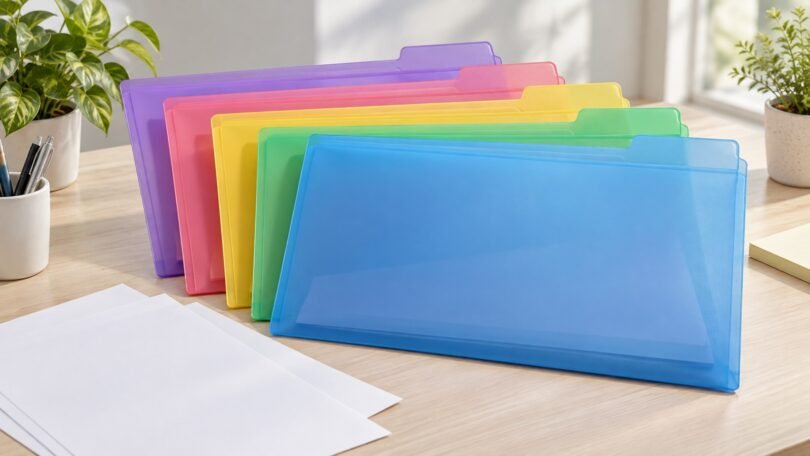
Image note: AI-generated editorial illustration; not a photograph of the named product.