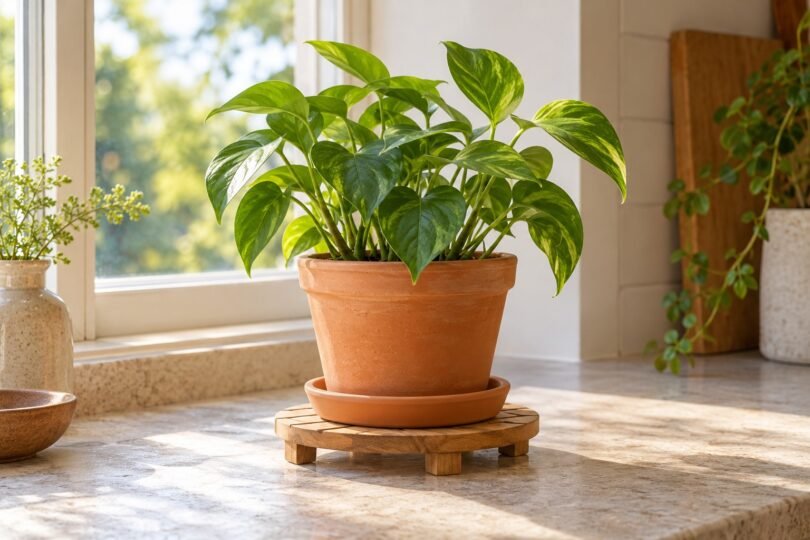

A plant trivet is useful when you want a pot or saucer raised slightly above a shelf, floor, or patio. Choose it by the base it must support and by where the water will go. For an indoor pot with drainage holes, start with a correctly sized saucer or other suitable catch container, then add a stable support if needed. An open trivet by itself will let water reach the surface below.
The most useful choices fall into a few different groups: low platforms, individual pot feet, decorative raised trivets, and saucers with built-in feet. A flat cork mat does another job again. The options below have manufacturer information you can check before buying. Use the measurements and setup notes to narrow the choice.
Choose the type that solves your problem
| If you need to… | Start with… | Check before buying |
|---|---|---|
| Raise a pot and its existing saucer a little | A low plant stand or trivet | Support contact points, footprint, and the combined loaded weight |
| Support the edges of an outdoor planter | Purpose-made pot feet | Required number and placement of feet, pot-base shape, and drainage clearance |
| Catch runoff beneath a pot | A saucer or catch tray | Usable inside dimensions, rim height, and a practical way to empty it |
| Add a thin layer beneath a dry saucer | A plant mat | Backing, care instructions, and compatibility with the furniture finish |
| Move a heavy planter regularly | A plant caddy | Wheel type, brakes, floor suitability, and load rating |
Plant trivets and related supports to consider
Bosmere Down Under Plant Stand, 12-inch: a low support for an existing tray
The 12-inch Clear Down Under Plant Stand is made from injection-molded plastic. Bosmere describes it as UV resistant and says its support arms can be shortened. Its catalog instructs users to put the stand beneath a potted-plant tray, which is an important distinction: the stand provides lift, while the tray handles runoff.
Bosmere publishes a support rating of up to 500 pounds for this stand. That is the maker’s rating, not a test result for your pot or floor. Confirm the fit and installation before using it with a heavy container. The 12-inch Terra Cotta version is a separate color choice; “terra cotta” describes its color, not a clay construction.
Choose it for: a discreet, low support beneath a compatible tray. Watch for: trimming too much material away or assuming the nominal diameter describes a solid, full-width platform.
ACHLA Cast Iron Leaf Trivets: a decorative, low raised option
ACHLA’s Cast Iron Leaf Trivets, model TWI-05-2, are sold as a pair. Each measures 8⅛ inches long, 6⅞ inches wide, and 1⅜ inches high. The manufacturer specifies cast iron with a black powder-coat finish and describes use beneath plants both indoors and on a deck.
The open leaf shape makes these worth considering when the support will remain visible. Measure the actual pot or saucer base: an irregular outline is not equivalent to a circular platform of the same longest dimension. The product page does not give a plant-load rating, so ask the maker before choosing it for a heavy planter.
Choose it for: a small display where the trivet is part of the decoration. Watch for: water passing through the openwork and a pot base that does not sit securely on the supporting sections.
Bosmere Pot Toes, 12-pack in Terra Cotta: separate feet for a planter
Bosmere Pot Toes in the Terra Cotta 12-pack are injection-molded plastic feet. The manufacturer describes a stackable design for leveling pots on sloping surfaces. This is a different arrangement from a single platform: the feet must be positioned to support the particular pot base.
A 12-pack means 12 individual feet, not 12 complete plant stands. Decide how many your planter needs using the maker’s instructions, and confirm the permitted arrangement for its loaded weight. Do not treat a broad product weight claim as a rating for each foot, or assume that stacking pieces increases the load capacity.
Choose it for: a planter whose base suits separate supports. Watch for: a foot covering a drainage hole, uneven contact, or a tall pot becoming less stable after it is raised.
Bosmere Down Under Plant Saucer, 12-inch Clear: a catch tray with feet
The 12-inch Clear Down Under Plant Saucer combines a tray with feet underneath. Bosmere specifies heavy-gauge plastic and a 12-inch diameter. It is the more relevant category when collecting runoff is the missing part of the setup.
The stated diameter does not tell you the exact usable inside base measurement. Check that your pot can sit flat inside the rim and that you can remove collected water. Bosmere’s page also discusses a 17-inch saucer that locks onto a 16-inch caddy; that compatibility should not be assumed for this 12-inch saucer.
Choose it for: a pot that needs both a catch tray and some separation from the surface. Watch for: cracks, overflowing water, or a pot that wedges against the sloping rim.
Measure the base, the support, and the whole setup
The diameter written on a flowerpot often is not the dimension resting on the trivet. Turn an empty pot over, or measure its base safely without lifting a heavy planted container. If a saucer will sit on the trivet, measure the saucer’s underside too. A broad upper rim can hide a much narrower contact area underneath.
- Measure the contact area. Record the pot-base diameter or its length and width. Note raised rings, feet, and drainage holes.
- Check the support layout. Look at where the platform’s bars or individual feet will meet the base. The pot should rest securely without rocking.
- Include everything in the weight. Account for the pot, plant, wet potting mix, tray, and any retained water. Compare that total with the exact product’s stated limit.
- Check the available space. Include projecting feet, the saucer rim, foliage, and access for watering. Added height can change the stability of a tall plant.
- Plan the first watering. Observe where drainage goes and whether you can empty the saucer without shifting an awkward load.
For example, a pot with a 10-inch top opening and a 7-inch base does not automatically need a 10-inch support. The decision depends on its base, the saucer beneath it, and the stand’s actual contact points. This is a measuring example, not a fit claim for any product above.
Cork mats and hot-pan trivets need a separate check
A flat mat can be useful under an already suitable saucer, but it does not create the same air gap as a raised stand and has no rim to contain runoff. For a size reference, MAT’s manufacturer specifications list the CM8 cork mat at 8 inches in diameter and 0.2 inches high. Those dimensions alone do not establish a water barrier, an outdoor-use rating, or a load limit.
Kitchen trivets also appear in plant searches. IKEA’s HEAT cork trivet, article 870.777.00, is described for hot pots and dishes and is listed by IKEA as a three-pack. That should not be confused with a reseller’s six-pack or treated as proof of plant-drainage performance. A heat rating answers a different question from whether a product will contain water or suit a floor finish.
Keep mats and the surface underneath clean and dry according to their care instructions. If the backing or finish compatibility is unclear, ask the manufacturer before placing it on valuable furniture. Neither a soft mat nor a raised stand is a guarantee against marks.
Use the saucer as part of your watering routine
Make sure drainage has somewhere suitable to go. On a balcony, that also means considering the area below you. University of Maryland Extension’s container guide discusses saucers for catching drained water, including above a neighbor’s balcony, and warns against leaving collected water standing.
After watering, empty excess water rather than leaving an ordinary houseplant pot sitting in it. University of Minnesota Extension gives the same practical advice. A plant support changes the space beneath a container; it does not correct blocked drainage or determine how often the plant needs watering.
During routine care, check the stand for cracks, bent sections, loose feet, or damaged coatings. Lift a manageable setup to inspect underneath instead of dragging it across the surface. Follow the product’s own care and outdoor-use instructions, especially if you plan to leave it exposed to rain or winter weather.
Common questions about plant trivets
Do I need a saucer and a trivet?
Sometimes. A saucer catches water; a raised trivet supports the pot or saucer above the surface. If your pot drains indoors, address runoff first. You may need only a saucer, or a saucer with feet, depending on the setup.
Can I use a plant trivet outdoors?
Only when the exact product is intended for that use. Check the maker’s information for the material, coating, and weather exposure. Outdoor suitability does not remove the need to check drainage, stability, and the surface beneath it.
Will a trivet stop water rings on wood?
It may provide separation, but an open support cannot catch runoff. Use a suitable catch container, remove spills promptly, and inspect underneath. Do not rely on a “floor protector” name as a promise that no damage can occur.
Is a plant caddy the same thing?
A caddy adds wheels for moving the planter. Choose one when mobility is the goal, and check its rating, brakes, and suitability for the route it will travel. A stationary trivet is simpler when the pot will stay in one place.