

If you mean a plastic garden-hose nozzle, start with the hose connection, spray control and intended water use. A plastic body can keep the tool light and avoid corrosion of the body itself, but the trigger, spring, seals and connector still need to suit the job. “Plastic nozzle” also describes bottle sprayers, caulking tips and industrial parts, which are not interchangeable with a hose nozzle.
For a simple trigger-operated hose attachment, the Seachoice 79601 is one identifiable option to compare. For use around salt water, Gilmour also publishes a dedicated polymer marine-nozzle specification. The practical buying checks below matter more than a long list of unrelated plastic fittings.
One clearly identified plastic hose nozzle
Seachoice 79601: a basic adjustable trigger nozzle
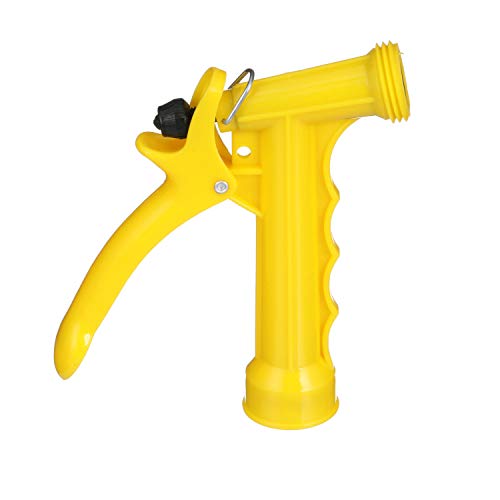
Seachoice 79601 Plastic Hose Nozzle, Yellow 5-1/2-Inch, 1 Nozzle
As an Amazon Associate we earn from qualifying purchases.
The selected Seachoice listing is a single yellow plastic hose nozzle, manufacturer part number 50-79601. Seachoice’s product page identifies model 79601 as a 5½-inch plastic nozzle with a stainless-steel return spring, adjustable spray, locking lever, threaded front and contoured handle.
Why compare it: the simple rear-trigger design lets you start and stop flow at the hose end, and the locking lever can hold the trigger during a sustained rinse. A threaded front can accept compatible accessories, but check the accessory’s connection rather than assuming every brush or fitting will attach.
What to check: the hose-end connection, the exact pack quantity and whether an adjustable stream suits your plants or cleaning task. The selected product is a basic nozzle, not a pressure-washer gun or a multi-pattern shower head. A narrow stream can be too forceful for tender seedlings, even when the body is lightweight.
Retail pack quantities can differ even when the model number is the same. This card links to one nozzle. Confirm that the order summary still identifies 79601 rather than Seachoice’s separate brass model.
What about a polymer nozzle for marine use?
Gilmour’s model 0474 marine-nozzle page describes a corrosion-resistant polymer body for use around salt water. It identifies item 804742-1001 and UPC 034411147474. Those identifiers are useful when comparing an actual retailer offer with the manufacturer’s specification.
Be careful with similarly named multipacks. A nozzle family name does not establish the precise package quantity, connection or included parts. Check the retailer’s selected option and manufacturer number together. Plastic construction alone is not proof of salt-water suitability, and a manufacturer’s marine-use statement should not be extended to chemical spraying or hot-water use.
Choose the right kind of plastic nozzle
- Garden-hose nozzle: connects to a hose and controls water flow for watering or rinsing. Look at the inlet thread or quick-connect fitting, spray control and pressure limits.
- Replacement bottle trigger: screws onto a spray bottle and uses a dip tube. It needs the correct bottle-neck specification, tube length and chemical compatibility.
- Squeeze-bottle tip: dispenses liquid through a narrow opening. The bottle’s thread and the liquid’s viscosity matter; this is not a hose fitting.
- Caulking nozzle: directs sealant from a matching cartridge or applicator. Its attachment and material compatibility differ from a watering nozzle.
- Industrial, welding or 3D-printing nozzle: must match the equipment’s part specification and operating conditions. Do not substitute a general plastic fitting.
If you are replacing a broken part, take a clear photograph of the original connection and note any molded model number before searching. The word “universal” is less useful than a matching part number and connection specification.
Hose fit: inspect both sides of the connection
Start with the hose end you actually have. A threaded nozzle will not attach directly to every quick-connect system, and an adapter adds another joint that must seal. Regional hose threads can differ even when listings use similar nominal sizes. Check the thread standard, not just the diameter printed in a marketplace title.
For a conventional washer-sealed hose fitting, inspect the washer inside the female connector. A missing, hardened or displaced washer can cause a leak even when the nozzle itself is sound. Replace it with the appropriate size rather than compensating by tightening harder.
Start the connection gently by hand. If it binds immediately or sits crooked, disconnect it and check for crossed or mismatched threads. Forcing a plastic fitting with pliers can damage it. Follow the manufacturer’s assembly guidance before using thread tape or sealant; a washer-sealed hose joint is different from a tapered pipe-thread joint.
Spray control and comfort
An adjustable stream is useful for moving between a light rinse and a more concentrated spray. A multi-pattern head may be more convenient when you regularly switch among delicate plants, larger containers and cleanup. Decide which patterns you need rather than paying attention only to the number printed on the dial.
Try to assess the grip with wet hands and, if relevant, work gloves. A rear trigger requires repeated squeezing unless a locking lever is engaged. A thumb-control or twist model may suit someone who finds that motion uncomfortable. Product dimensions cannot predict comfort for every hand.
For watering, begin with a low flow and adjust carefully. Aim at the soil where appropriate rather than blasting delicate foliage. For cleaning, test a small area first and avoid directing a concentrated jet at people, animals, electrical equipment or fragile surfaces.
Plastic does not mean suitable for every liquid or temperature
A polymer housing still contains other components, such as seals and springs. Their compatibility matters too. Unless the manufacturer explicitly approves it, do not assume a garden nozzle can handle hot water, disinfectants, solvents, fertilizers or pressure-washer output.
For a chemical sprayer, identify the exact liquid and concentration, then check the sprayer manufacturer’s compatibility guidance and the product’s label. “Chemical resistant” without a named material or application is not enough to establish a match. A replacement bottle trigger also needs the correct neck finish; a broad “28 mm” description may omit other dimensions that affect the seal.
Prevent avoidable leaks and damage
- Inspect before use. Look for cracks, a sticking trigger, worn washers and grit around the connection.
- Keep dirt out. Avoid dragging an open connector across soil before attaching it.
- Turn off the supply when finished. Release pressure according to the equipment’s instructions instead of relying indefinitely on the nozzle’s trigger seal.
- Drain before freezing conditions. Store the nozzle where trapped water will not freeze inside it.
- Replace damaged parts appropriately. Do not keep using a split body or improvise a repair that may fail under water pressure.
Bottom line
The Seachoice 79601 is a straightforward single plastic trigger nozzle to compare for ordinary hose-end rinsing. For a marine application, use an explicitly marine-rated specification such as Gilmour’s 0474 as your starting point, then verify the exact retail item. For bottles, sealants or machinery, search by the original connection and application instead. Correct fit, controllable flow and documented compatibility are the essential checks.
Image note: AI-generated editorial illustration; not a photograph of a named product or an installation/compatibility diagram.