
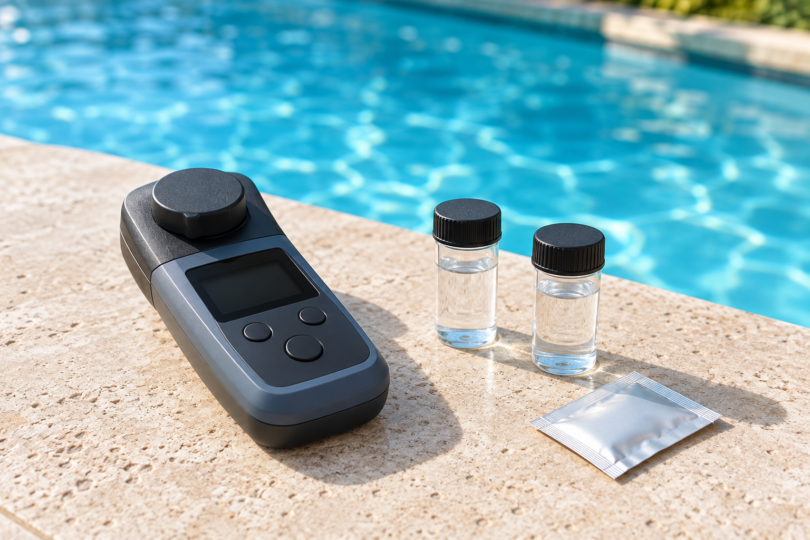

The best pool photometer for you depends on the tests you run and the reagent routine you will follow. Our two picks are the PoolLab 2.0 for flexible testing across three chambers and the LaMotte ColorQ 2x PRO 7, code 2086 for a kit that includes reagents for chlorine, pH, alkalinity, calcium hardness and cyanuric acid. Both provide a digital result after you prepare a water sample.
These are feature-based recommendations drawn from manufacturer instructions, rather than a hands-on performance ranking. Choose by the required measurement range, the exact reagents included and the amount of sample preparation you are comfortable doing.
Best pool photometers at a glance
| Photometer | Best fit | Routine test ranges | Reagents and main tradeoff |
|---|---|---|---|
| PoolLab 2.0 | Multiple tests with flexible chamber selection | Tablet chlorine: 0–6 mg/L; pH: 6.5–8.4; alkalinity: 0–200 mg/L as CaCO₃; CYA: 0–100 mg/L | Basic kit includes 70 tablets across five reagents; calcium-hardness liquids are an extra purchase. Some tests require the center chamber. |
| LaMotte ColorQ 2x PRO 7 (2086) | A supplied routine pool-testing kit with calcium hardness | Free/total chlorine: 0–10 ppm; pH: 6.5–8.5; alkalinity: 0–300 ppm; calcium hardness: 0–600 ppm; CYA: 0–150 ppm | Liquid chlorine and pH reagents plus tablets for alkalinity, hardness and CYA. Requires the correct tube and careful mixing. |
The figures above are manufacturer measurement ranges, not recommended water-balance targets or a claim that every point in a range has the same accuracy. Compare the range for your specific reagent method; PoolLab’s liquid chlorine method, for example, stops at 4 mg/L rather than the tablet method’s 6 mg/L. For PoolLab 2.0, the manual requires alkalinity of at least 50 mg/L for a correct pH measurement.
PoolLab 2.0: best for flexible multi-parameter testing
The PoolLab 2.0 has a replaceable triple cuvette and can run compatible tests in parallel. Its LabCOM connection adds Wi-Fi synchronization and reports, which may suit someone who wants a record of results over time. You can also run fewer than three tests in a session.
The standard kit’s 70 photometer tablets comprise 20 Phenol Red, 20 DPD No. 1, and 10 each of DPD No. 3, Alkalinity-M and CYA-Test. That is a mixed starter supply, not 70 complete five-test sets. DPD No. 1 and No. 3 are the tablet reagents for its free/total chlorine workflow; the manufacturer’s manual lists separate liquid reagents for the liquid method.
Check the chamber restrictions before assuming you can combine any three tests. The manufacturer reserves calcium hardness and CYA, among other methods, for the center chamber, and some methods must run alone. Calcium-hardness testing is supported over 0–500 mg/L as CaCO₃ with liquid reagents, but those liquids are absent from the listed basic-kit contents.
- Why choose it: flexible chamber selection, a replaceable cuvette and optional data synchronization offer useful room to expand your testing routine.
- Main drawback: the starter reagents cover a narrower set of tests than the instrument’s full menu, and the standard tablet chlorine method tops out at 6 mg/L. Budget for the exact extra reagents you need.
Use photometer-grade tablets for the specified method. The PoolLab manual warns that RAPID-grade tablets give incorrect results, and recommends a separate stirring rod for each chamber to prevent cross-contamination.
LaMotte ColorQ 2x PRO 7: best for an included routine test kit

LaMotte ColorQ 2x PRO 7 2086, Liquid and Tablet Kit
As an Amazon Associate we earn from qualifying purchases.
Choose the ColorQ 2x PRO 7, code 2086, if you want its routine test reagents together in a carrying case. The exact kit uses DPD liquids for chlorine and a liquid pH indicator, with instrument-grade tablets for alkalinity, calcium hardness and CYA. It also measures bromine using the chlorine reagent set.
The instructions identify DPD 1A and DPD 1B for free chlorine, followed by DPD 3 for total chlorine. The tablet refills are ALK 2X IG, CA HARD 2X IG and CYANURIC ACID IG. Match refills to code 2086: the all-tablet PRO 7 is a different kit, code 2087.
The 2086 instructions require the 0206 tube for CYA, rather than the 0205 tube used for several other tests. CYA preparation includes crushing the tablet, mixing and a two-minute wait, followed by reading without further mixing. This is a hands-on reagent workflow even though the result appears digitally.
- Why choose it: the supplied kit includes calcium-hardness reagents, and its listed chlorine, alkalinity and CYA ranges extend higher than PoolLab’s corresponding basic tablet methods.
- Main drawback: tubes, caps, reagent choice and reaction timing need attention. Bubbles, leftover reagent and scratched or stained tubes can compromise the procedure; a digital display does not remove those maintenance jobs.
LaMotte’s user guide documents chemical limits too. High sanitizer levels can bleach the DPD reaction; potassium monopersulfate can interfere with combined-chlorine results; and CYA readings depend on sample temperature. The guide identifies 70–80°F as the preferred sample range for that CYA reaction, with cold samples tending high and warm samples low. Follow the applicable interference instructions before acting on an unexpected result.
How to choose and use a pool photometer
- Buy a testing routine you can maintain. Check reagent refill codes and included quantities alongside the instrument. PoolLab’s basic pack has 10 CYA tablets; LaMotte lists 100 CYA tablets for code 2086. A larger refill supply matters only if it suits your testing needs.
- Keep range separate from resolution. A result displayed to decimal places is not a guarantee that the sample was prepared correctly. Use the exact tube, reagent mode and timing required by the manual, and investigate readings outside the method’s range.
- Check saltwater compatibility by parameter. PoolLab’s manufacturer lists several tests usable in salty water, including chlorine, pH and CYA, but says the instrument does not directly measure salt concentration. It describes pH corrections at high salt concentrations; salt testing requires a separate suitable method.
For residential pools, CDC guidance recommends pH 7.0–7.8 and at least 1 ppm free chlorine, increasing the chlorine minimum to 2 ppm when cyanuric acid or stabilized chlorine is used. These minimums are not a dosing recipe: follow the chemical label and applicable pool guidance when adjusting water.
CDC recommends checking chlorine and pH at least twice daily, and more often with heavier use. It also warns that chlorine above 10 ppm can bleach a DPD test and produce a falsely low or zero result. If a result is surprising after treatment, verify it using the manufacturer’s appropriate procedure before adding more chemicals.
Frequently asked questions
Is a pool photometer the same as a test strip?
No. These photometers use prepared samples and specified reagents, then give a digital reading. CDC discusses test strips as an alternative to a DPD test kit and considers them less accurate. Careful technique still matters with a photometer.
Which is the better choice for routine home-pool testing?
Choose PoolLab 2.0 if flexible parallel testing and its data tools appeal to you, and you are willing to buy additional reagents for tests such as calcium hardness. Choose ColorQ 2x PRO 7 code 2086 if you prefer its supplied mix of liquid and tablet reagents, including calcium hardness. Neither is a hands-off monitor.
Can I put any pool-testing tablet in either meter?
Use the exact reagent type and method specified for the instrument. PoolLab explicitly warns against RAPID-grade tablets. LaMotte’s 2086 and 2087 kits use different reagent arrangements, so a similar product name is not enough to identify the right refill.
Does a zero chlorine result mean I should add chlorine immediately?
An unexpected zero needs checking. CDC warns that a DPD test can bleach out above 10 ppm chlorine, while LaMotte also documents high-sanitizer interference. Follow the meter’s directions to verify the reading, especially after treatment, before deciding on a chemical adjustment.
Can these photometers test water without buying reagents?
The tests discussed here consume the manufacturer-specified reagents. The supplied tablets and liquids are a starting inventory, and the right refills are part of the ownership cost. Check both the reagent method and the kit code when you reorder.


