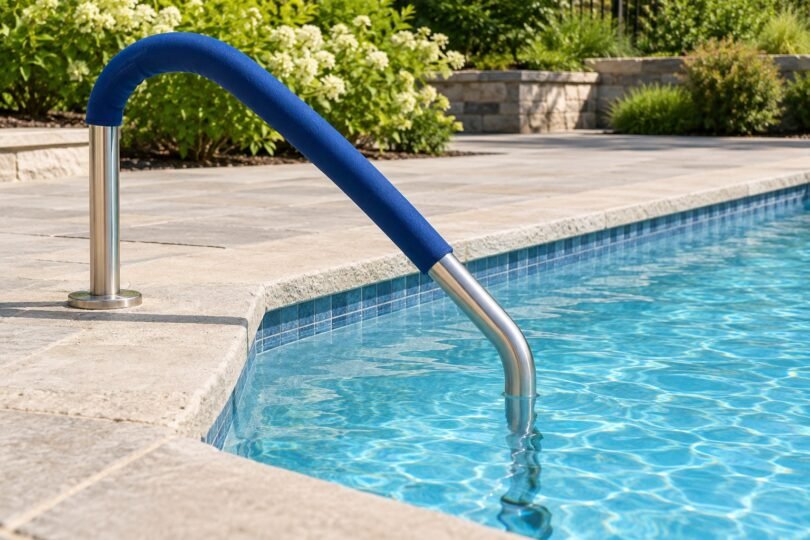

A pool rail sleeve should fit the handrail you already have: its outside diameter, curved grip length, surface finish, and the section that stays above water. Start with those measurements before choosing a color or comparing prices. A purpose-made cover can add cushioning and make a rail more comfortable to hold, but it cannot repair a loose handrail or guarantee protection from burns, slipping, or falls.
For a documented starting point, KoolGrips publishes both a product specification and a rail-fit guide. Use them to narrow the choice, then check the actual rail and the instructions supplied with the exact cover. A sleeve that appears similar in a photograph is not enough evidence of compatibility.
Make sure you are buying a grip cover
“Pool rail sleeve” can describe two different things. A fabric or neoprene cover wraps around the part your hand holds. An anchor sleeve is mounting hardware that receives a rail at the deck. This guide concerns the removable hand-grip cover. If the rail moves at its base, buying a fabric cover is not the repair.
Check the bare rail before concealing it. Look for looseness, sharp damage, deteriorated coatings, and corrosion around its connections. S.R.Smith’s rail-care guidance calls for regular inspection and cleaning of mounting hardware, including places where moisture can collect. Have questionable hardware or rail damage assessed by a pool-service professional before relying on the rail or fitting a sleeve.
Measure diameter and length separately
There are two independent dimensions to record. Diameter tells you whether the cover can wrap correctly around the tube. Length tells you how much of the hand-grip section it will cover. A four-foot sleeve does not describe the diameter it fits.
- Identify the rail. Find its manufacturer and model if possible. Photograph the complete shape, bends, brackets, and surface finish. Record whether it is a pool-entry rail, ladder rail, or spa rail.
- Measure the outside diameter. Measure across a round, straight section with calipers if available. If using a flexible tape around the tube, divide the circumference by approximately 3.14. A six-inch circumference is about a 1.91-inch diameter, so an approximate tape measurement still needs care at a stated fit limit.
- Measure the covered path. Follow the curve along the rail rather than measuring a straight line between its ends. Mark the intended endpoints without damaging the finish.
- Account for water clearance. For KoolGrips, start the lower endpoint four to six inches above the waterline. Measure back toward the deck; do not count submerged tubing as coverable length.
- Check each rail separately. Two sides may appear identical without having the same usable length. Confirm whether the purchase contains one cover or enough for both sides.
Keep the measurements together with a photo when asking the seller a fit question. “A standard pool rail” leaves too much room for misunderstanding. A rail that is oval, square, heavily coated, or interrupted by unusual supports needs specific confirmation rather than an assumption based on circumference.
A documented option: KoolGrips Pool Rail Comfort Covers
The manufacturer’s Pool Rail Comfort Covers specification lists a 1.625–1.900-inch rail-diameter range, lengths of 1, 2, 4, 6, 8, and 10 feet, and Royal Blue, Indian Teal, or Desert Tan colors. Confirm the selected length, color, quantity, and diameter range in the order summary. Those are separate choices, and a product page’s first photograph may show another selection.
The manufacturer’s rail-fit guide describes commercial-grade neoprene with a polyester-spandex fabric blend and a large number-10 zipper. It gives specific examples: a four-foot cover for the S.R.Smith P-Rail with a 1.625–1.9-inch diameter, and a six-foot cover for the Figure 4 rail at 1.9 inches. These examples are starting points for the named rails, not universal instructions for every similar-looking shape.
The same guide treats several designer rail shapes as measurement-dependent custom-cut applications. If your measured section falls between standard lengths, ask about the correct configuration before ordering. Do not buy an oversized cover with the intention of cutting through its zipper or folding excess material into the hand-grip area.
Compare covers by the details that affect use
Closure: A zip-on design wraps around an installed rail. With any alternative closure, ask how it is secured, how the ends are finished, and whether the cover is approved for your rail shape. The important question is whether it remains properly fitted in ordinary use without bunching or exposing an awkward edge.
Material compatibility: “Neoprene” identifies a material, not permission to use it on every rail finish or in every pool environment. Check the cover instructions for your bare stainless steel, powder-coated, or other coated rail. If neither manufacturer addresses the combination, request confirmation. The cover should also be removable for inspection and cleaning of the rail underneath.
Grip size: Think about the people using the steps. Added material changes the feel and overall size of the grip. Someone who already finds the rail difficult to grasp may need an assessment of the entry arrangement rather than a thicker cover chosen by appearance.
Heat claims: Treat comfort and insulation claims cautiously. A cover is not a guarantee that a sun-exposed handrail will remain safe to touch in every condition. Check the actual surface before use, and address shade or another entry option if the rail remains uncomfortable.
Maintenance and replacement: Choose a cover whose care instructions you can realistically follow. A low purchase price has little value if the sleeve is left dirty, becomes loose, or prevents inspection of the supporting rail.
Install only according to the exact cover’s instructions
KoolGrips recommends two people, wetting both the cover and rail, and keeping the cover above the water. Its warranty excludes installation in pool or spa water and using tools to force the zipper. Follow the full installation directions rather than stretching a poorly matched sleeve into place with pliers.
Work from a stable, dry position. Do not lean out over the pool or use the rail as an improvised work platform. If the shape or location makes installation awkward, ask a pool professional to handle it. After fitting, check the closure and inspect for loose sections, wrinkles, exposed fasteners, or interference with nearby equipment. If the sleeve rotates, slides, or changes the handhold in an uncomfortable way, stop and resolve the fit before use.
Follow the rail manufacturer’s safety directions too. A cover does not change the rail’s intended use, fix its anchors, or substitute for assistance when someone needs help entering or leaving the pool.
Care for the sleeve and the metal underneath
KoolGrips specifies hand cleaning with mild soap, rinsing, and air drying; it does not permit machine washing or tumble drying. It suggests maintenance every four to six weeks during hot weather or heavy use. Remove buildup sooner when needed, and inspect the stitching, closure, and fit during cleaning.
The rail needs its own maintenance schedule. S.R.Smith’s rail-maintenance sheet identifies saltwater, coastal, and indoor pools as more corrosive environments and calls for more frequent care. Follow the instructions for your rail’s finish. Do not assume a cleaner suitable for exposed metal is also suitable for a fabric sleeve, or that a covered section no longer needs inspection.
Before you place the order
- Match the exact rail diameter and measured curved coverage length.
- Confirm the selected color and whether the listing supplies one sleeve or a pair.
- Check closure type, material, finish compatibility, and above-water placement.
- Read the care directions and any return restrictions for opened or custom-cut covers.
- Resolve unexplained fit differences with the manufacturer before paying.
The best choice is the correctly fitted cover for a sound rail that you can keep clean and inspect. If the rail is damaged, unusually shaped, or difficult for its users to hold, address that underlying issue first.