
If you are looking for a seat belt adjuster for adults because the shoulder belt rubs your neck, start with the adjustments built into your vehicle. Check the owner’s manual, adjust the seat and shoulder anchor as directed, and ask the vehicle manufacturer or dealer for help if the fit is still wrong. A generic clip that moves the belt away from your neck is not automatically a safe solution.
The important distinction is between a factory adjustment, an aftermarket belt positioner and a vehicle-specific extender. They do different jobs. This guide explains those differences and the checks to make before buying anything.
What correct adult seat belt fit looks like
According to NHTSA’s seat belt guidance, the shoulder belt should cross the middle of your chest, away from your neck, while the lap belt sits across your hips rather than your stomach. Keep the shoulder belt in front of your body and over your shoulder. Never put it behind your back or under your arm to relieve irritation.
Check fit while sitting in the position you will actually use for the journey. A belt that looks acceptable while you lean sideways may sit differently when you return to the seatback. The goal is a usable seating position with the belt correctly routed, not simply moving the strap out of the way.
Seat belt adjuster, clip or extender: which is which?
- Factory shoulder-height adjuster: a built-in adjustment, often on the vehicle pillar, that changes the shoulder anchor’s height. Availability and operation depend on the vehicle and seating position.
- Aftermarket positioner: an added piece that redirects the shoulder belt, sometimes by joining it to the lap portion. This can change where restraint forces act.
- Comfort clip or sleeve: an accessory sold to reduce rubbing or belt tension. Its name does not establish that it is compatible with your restraint system.
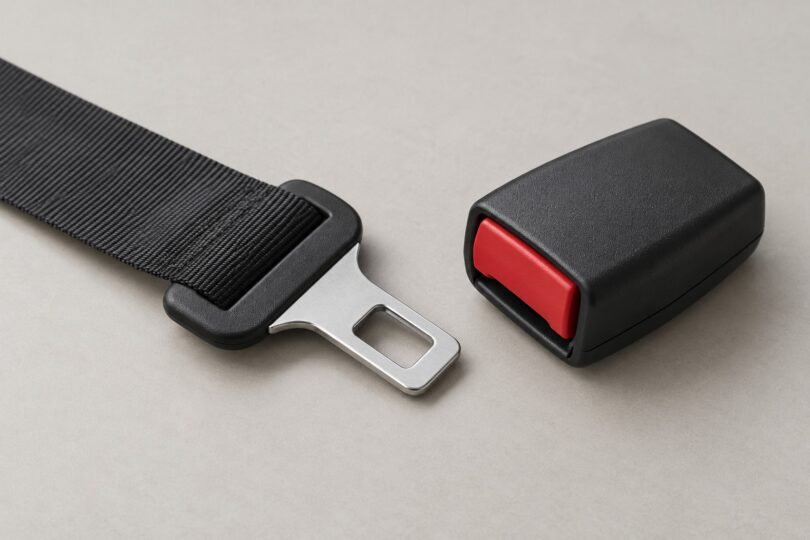
- Seat belt extender: an additional buckle-and-tongue assembly intended for a belt that is too short. It is not a general fix for shoulder-belt position.
“Fits a two-inch belt” describes a physical dimension. It does not answer whether an accessory is permitted by your vehicle manufacturer, whether it changes the lap-belt path or whether it interferes with the belt’s operation. Treat those as separate questions.
Try the vehicle’s own adjustments first
Park before making adjustments. Use your vehicle’s manual to set seat distance, seat height if available, and seatback angle. You still need to reach the controls properly. Honda’s 2025 Accord front-seat instructions, for example, call for a comfortable upright seatback and warn against placing a cushion between your back and the seatback. Excessive recline can leave the shoulder belt away from the chest and increase the risk of sliding beneath the belt in a crash.
If your seating position has a factory shoulder anchor adjustment, use it exactly as described in the manual. In the 2025 Accord’s fastening instructions, Honda describes four anchor-height settings and says to lower the anchor one level at a time if the belt contacts the neck. It also requires checking that the adjusted anchor is secure. That is a model-specific example, not a procedure for every car.
After adjusting, buckle up, remove twists and excess slack as the manual directs, and check both portions of the belt again. If a different driver uses the car, reassess the settings rather than assuming the previous position will suit you.
Why aftermarket positioners deserve caution
A softer material or a sturdy-looking metal clip does not demonstrate crash protection. In its 1994 interpretation on aftermarket belt positioning devices, NHTSA identified concerns about moving the lap-and-shoulder-belt intersection toward the abdomen, changing how an occupant moves in a crash, and introducing slack. Those changes can affect the protection provided by the restraint.
That document is historical agency guidance, not a current product test or approval list. More recent vehicle instructions also matter: Honda’s 2025 Accord Hybrid manual warns against attaching accessories to the seat belts, including devices intended to improve comfort or reposition the shoulder portion.
For that reason, this guide does not rank universal clips, recommend devices that add slack, or provide instructions for rerouting a belt with an aftermarket positioner. A claim that an accessory leaves safety “unaffected” needs more than a seller description or positive comfort review.
When a manufacturer-supplied extender may be appropriate
If the belt is genuinely too short, NHTSA advises contacting the vehicle manufacturer about an extender. Give the dealer the vehicle details and the exact seat where it is needed. Do not assume an extender that clicks into one buckle is suitable for another car or another seating position.
Ford’s 2016 Flex manual, for example, states that extensions are vehicle-specific, should be obtained through an authorized dealer and should be used only when the fully extended belt is too short. It warns against using an extension to change shoulder-belt fit and against using one with an inflatable belt.
Those restrictions illustrate why shopping by buckle shape alone is inadequate. Follow the instructions for your actual vehicle. An extender should not be purchased merely to bring the buckle closer to your hand or silence a reminder.
Questions to ask before buying an accessory
- What problem am I solving? Neck contact, insufficient belt length, difficulty reaching the buckle and a damaged belt are different problems.
- What does my manual allow? Check the restraint section for your model year and seating position, including any inflatable-belt restrictions.
- Can the dealer demonstrate the built-in settings? Ask about shoulder-anchor and seat adjustments before purchasing another part.
- Is there a manufacturer-specified part? Request the exact part number and application if an extender or other approved component is appropriate.
- What supports the seller’s safety claim? A universal-fit label, review score or material description does not establish suitability for your vehicle.
Be cautious about “NHTSA approved” advertising. NHTSA explains in its interpretation concerning an aftermarket belt accessory that it does not approve motor vehicles or vehicle equipment or endorse commercial products. Do not interpret a seller’s reference to the agency as a product recommendation.
If ordinary adjustments do not solve the problem
If your belt will not latch, retract or function as the manual describes, have the vehicle inspected. An accessory is not a repair for a faulty restraint. Honda’s fastening instructions say not to use a seating position with an inoperative belt and to have the dealer check it.
For ongoing fit or access difficulties related to limited mobility, seek an assessment rather than improvising. NHTSA’s adapted-vehicle guidance recommends working with experienced driver rehabilitation specialists and qualified equipment providers. Their assessment can consider seating, access to controls and appropriate equipment together. Passengers with special transportation needs can also benefit from specialist advice.
Bottom line: the best starting point for an adult seat belt fit problem is the vehicle’s own adjustments and manufacturer guidance. Buy a specific component only when it is appropriate for the problem, the vehicle and the seating position. Comfort matters, but the belt still needs to do its original job.