
The right drive tires for a semi-truck must match the approved size, load requirement, wheel configuration, and route. For a useful shortlist, compare the Michelin X Line Energy D+ for predominantly long-distance highway work, Michelin X Multi D+ for regional or urban duty, and Bridgestone M726 ELA for a deep-tread drive application on a compatible tandem-drive tractor.
These are route-based starting points. A tire selected for steady interstate mileage may not be the right answer for repeated tight turns, abrasive yards, or sustained on/off-road work. Have a commercial tire specialist confirm the exact size and specification before ordering.
Research disclosure: We reviewed current manufacturer product pages and technical guidance on October 4, 2026. We have not fleet-tested these tires, measured stopping distances, or compared fuel consumption. No mileage, fuel-saving, price, or stock result is promised.
Three representative drive tires compared
| Tire | Manufacturer application | Reason to shortlist | Important limitation |
|---|---|---|---|
| Michelin X Line Energy D+ | Long-distance heavy truck/tractor; dual drive | Highway-focused efficiency and casing program | Do not extrapolate advertised savings to your route |
| Michelin X Multi D+ | Regional and urban heavy truck/tractor applications | Regional-service design with open shoulders and siping | Regional designation does not establish severe off-road suitability |
| Bridgestone M726 ELA | Deep-drive applications on tandem-drive tractors | Deep-tread alternative for a documented drive-axle requirement | Confirm exact size, load capability, and service approval |
1. Michelin X Line Energy D+: start here for long-distance highway duty
Michelin identifies the X Line Energy D+ as a dual-drive tire for long-distance transport. Its product information emphasizes rolling resistance and a casing designed for retreading.
Why consider it: If your tractor spends most of its working life on highway routes, this is a relevant model to include in a fuel-and-tire-cost comparison. Ask the supplier to explain its suitability using your actual loads, routes, and replacement history.
Limits: Manufacturer comparisons use stated test conditions and particular sizes. They do not predict your fuel bill or guarantee a casing will qualify for future retreads. Do not treat a highway efficiency claim as proof that the tire is the best choice for abrasive yards or construction-site access.
2. Michelin X Multi D+: a regional-service candidate
The X Multi D+ is listed for regional and urban transport, including heavy trucks and tractors. Michelin documents open shoulders, full-depth siping, and scrub-resistant tread-compound features.
Why consider it: It deserves a look when your route involves more local deliveries, turns, and varied roads than a simple interstate run. Its intended application provides a useful starting point for a fleet that needs regional wear management alongside traction considerations.
Limits: Get an application recommendation if substantial time is spent on gravel, rough sites, or other severe surfaces. Also verify the exact product suffix: X Multi D+, X Multi Energy models, and other X Multi variants are different listings. A similar family name is not a sufficient substitute on the purchase order.
3. Bridgestone M726 ELA: compare it for a deep-drive requirement
Bridgestone describes the M726 ELA as a drive radial for deep-drive applications and tandem-drive axle tractors. The manufacturer highlights extra-deep tread and casing construction in its product information.
Why consider it: It is a useful alternative to quote when the tire specialist recommends a deep-tread drive product for your operation. Ask how that specification fits your existing wear pattern and planned removal point.
Limits: Deep tread alone does not establish the lowest operating cost or the right winter performance for your routes. Bridgestone’s published performance comparisons also include test qualifications. Use your own service records to judge value rather than treating a percentage in an advertisement as a fleet guarantee.
The specification checks to complete before purchase
Michelin’s commercial fitment guidance explains that size changes can affect wheels, clearance, dual spacing, loading, and inflation. Do not choose a different size simply because it is available at a lower quoted price.
- Approved size and wheels: Match the vehicle’s specified configuration and confirm the approved rim width, diameter, and clearances.
- Exact product: Put the model, size, load range or service description, and manufacturer product code on the quote. Check substitutions before accepting them.
- Loaded axle requirements: Supply representative operating weights and have the tire professional confirm capacity for the configuration, including dual ratings where applicable.
- Speed and route: Describe operating speeds, gradients, weather, highway percentage, delivery turns, and yard surfaces. Ask whether the selected tire is approved for that duty.
- Dual matching: Have existing and replacement tires assessed together. Matching nominal sidewall size does not settle every dimension and wear-compatibility question.
- Winter requirements: Ask the supplier to verify the exact tire’s markings and its suitability for the routes you run, along with the fleet’s traction-equipment requirements.
Pressure is part of the application, not a generic number
There is no universal pressure for every semi-truck drive tire. Michelin’s pressure guidance uses actual loading, size, single or dual configuration, and the appropriate load-and-inflation table. The maximum sidewall pressure should not automatically become the operating target.
Have the fleet or tire professional establish the correct cold-pressure specification and inspection program. Repeated pressure loss needs investigation. Tire mounting, demounting, and work on damaged or suspect commercial assemblies belong with trained commercial tire personnel; this guide does not provide service instructions.
Compare cost over a useful service period
Request an itemized quote that includes the specified tires, taxes and applicable fees, professional fitting, and any agreed casing credit. Ask about warranty conditions, inspection requirements, roadside-service coverage, and who handles a claim away from your home terminal.
For a meaningful comparison, record the fitted cost, miles to removal, reason for removal, service expenses, and realized casing value. Track fuel use separately with route and load context. A cheaper purchase can be good value, but only your operating records can show whether a different model lowers total cost.
Frequently asked questions
Can I choose by tread depth alone?
No. Start with fitment and service approval, then compare the tread design against your route and actual wear history. More tread is not a complete application recommendation.
Can I replace just one tire in a dual assembly?
Have a qualified commercial tire professional assess the pairing and the manufacturer’s matching limits. A new tire and a substantially worn mate should not be assumed compatible because their size labels match. Michelin’s truck tire service manual addresses matching and inflation within dual assemblies.
Should I consider retreads?
Include them in a supplier discussion when the casing passes professional inspection and the selected retread is approved for the intended position and service. The label “retreadable” describes a possibility, not a guarantee for every used casing.
Bottom line: Match X Line Energy D+ to a highway-focused discussion, X Multi D+ to regional-service needs, and M726 ELA to an appropriate deep-drive application. Buy the exact approved size and load specification, supported by a maintenance plan and a clear written quote.
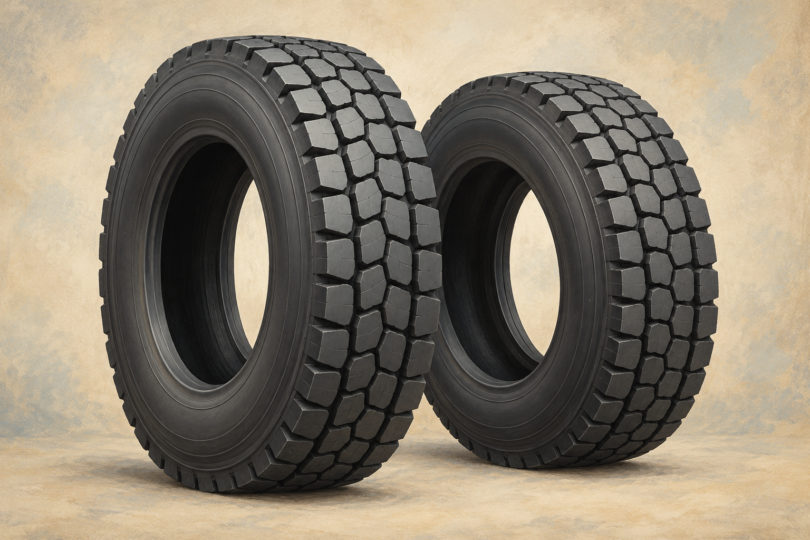
Image note: Generic editorial illustration of commercial truck tires; it does not establish drive-axle suitability, sizing or load rating.