
For a straightforward Slime portable tire inflator, compare the 40050 analog model, the 40088 digital model and the 40026 Heavy-Duty 2X. The first two use a suitable 12-volt accessory outlet. The 40026 connects directly to a vehicle battery and suits buyers who are comfortable with that different setup.
For ordinary car-tire top-ups, the 40088 is the most convenient starting point because it stops at a selected pressure. Choose the 40050 if you prefer a simple dial and manual control. Consider the 40026 when its battery connection and longer hose better fit your vehicle and inflation needs.
Slime portable inflators at a glance
| Model | Power connection | Pressure control | Main reason to consider it |
|---|---|---|---|
| 40050 12V Tire Inflator | 12V vehicle accessory outlet | Analog gauge; manual stop | Simple occasional top-ups |
| 40088 12V Digital Tire Inflator | 12V vehicle accessory outlet | Digital display; preset automatic shutoff | Convenient pressure setting |
| 40026 Heavy-Duty 2X | Direct battery clips | In-line analog gauge; manual stop | Dual-cylinder design and extended hose |
Slime 40050: a simple analog option
The 40050’s current manufacturer page describes a compact 12V inflator with an on/off switch, LED lighting and a dial gauge marked from 0 to 60 psi. Adapters for balls and other inflatables are included.
It makes sense if your priority is a small unit for occasional pressure corrections and you do not mind watching the gauge. It lacks the digital model’s preset shutoff, so you must stop inflation yourself. A simple control layout is useful, but it does not remove the need to stay with the inflator.
Slime’s linked instruction sheet specifies a 10-foot power cord and 12 feet of total reach. Check whether that reaches your vehicle’s farthest tire without stretching the cord across an unsafe position.
Listing detail to check: some 40050 retail titles say “100 psi,” while Slime’s current page and linked specifications show a 0–60 psi dial. Do not buy it on the strength of the larger title number. Confirm the gauge and instructions on the actual unit, especially for high-pressure tires.

Slime 40050 12V Analog Tire Inflator
As an Amazon Associate we earn from qualifying purchases.
Slime 40088: digital pressure setting and automatic shutoff
The current 12V Digital Tire Inflator is model 40088. Slime lists a 0–99 psi digital display, LED light, 12V accessory power and Inflate-Right automatic shutoff at the selected pressure.
This is the more convenient choice for a driver who wants to enter the vehicle’s target pressure instead of watching a moving dial. Stay nearby and verify the result with a tire-pressure gauge; automatic shutoff is a convenience feature, not permission to leave the running unit unattended.
Watch the model number: this retail listing has a legacy 40051 history. Its current title and model-number field identify 40088, and one listed UPC, 716281512780, matches Slime’s current 40088 product. Some older fields still say 40051. Confirm 40088 on the selected item and packaging rather than assuming every older review describes the current revision.

Slime 40026 Heavy-Duty 2X: a battery-powered alternative
The 40026 uses a direct-drive, dual-cylinder design with battery clips, a coiled air hose, an in-line dial gauge and a carrying case. Slime’s model comparison sheet identifies it as a direct-battery inflator with a 0–150 psi analog gauge and no preset automatic shutoff.
The power connection is the deciding difference. It does not plug into a dashboard accessory socket. Before choosing it, check your vehicle manual’s requirements for accessing the 12V battery or designated connection points. This is particularly important on vehicles where the battery is concealed or connection procedures differ from a conventional under-hood layout.
Its longer hose can be useful around a larger vehicle, but published hose and total-reach figures vary across document revisions and listings. Check the supplied configuration if reach is critical. A high gauge range also does not establish a practical fill time for every truck or RV tire.

How to read the advertised inflation times
Slime advertises eight minutes for the 40050 and six minutes for the 40088. The instruction sheets currently linked from those product pages specify a 205/55R16 tire filled from 0 to 35 psi. The older comparison sheet gives the 40026 a two-minute figure using a P195/65R15 tire, also from 0 to 35 psi.
Those figures use different tire sizes and document generations. Treat them as manufacturer reference conditions, not a head-to-head result or a promise for your vehicle. Tire volume, starting pressure, target pressure, power supply and temperature all affect the job. A few-psi top-up is also a different task from filling a completely deflated tire.
Power and cooling matter as much as pressure
The current 40050 instruction sheet and 40088 instruction sheet require a 12V DC outlet rated for at least 15 amps. A socket that looks compatible may have a lower permitted load, so check the vehicle’s documentation. Never replace its fuse with a larger one to run an inflator.
Those sheets limit continuous operation to ten minutes and call for about 25 minutes of cooling between uses. Plan for cooling time if you have several tires to fill. Keep the inflator on a hard, clean surface, keep its air openings clear and remember that the unit and fittings can become hot.
Engine-running instructions differ across Slime models and manual revisions. The 40026 manual linked from its listing says not to run the vehicle while that inflator operates. Follow the instructions supplied with your exact unit and your vehicle’s guidance. The current accessory-powered sheets recommend a running engine and say never to start the vehicle with the inflator plugged in. Never run a vehicle in a garage or other enclosed area to power an inflator.
Use the correct tire pressure
NHTSA recommends checking tire pressure at least monthly when tires are cold, meaning the vehicle has not been driven for at least three hours. Use the vehicle’s tire-information label or owner’s manual for the specified cold pressure. The tire sidewall’s maximum is not the normal target pressure for every vehicle.
Check whether front and rear pressures differ, and include the spare where applicable. Keep a separate pressure gauge in the vehicle and recheck after inflation. If a tire repeatedly loses air, arrange an inspection instead of making repeated top-ups the permanent solution.
What these inflators cannot fix
A tire inflator adds air; it does not repair a puncture, damaged valve, cracked wheel or sidewall damage. A tire that has been driven flat may be unsafe even after it holds pressure. Do not try to force a tire back onto its rim with one of these units. Use roadside assistance or a tire professional when damage or an unseated bead is involved.
These are portable tire inflators, not substitutes for a tank compressor selected to run workshop air tools. For balls or recreational inflatables, confirm the included adapter and the item’s pressure requirements. None of the three models compared here is a cordless rechargeable unit.
Which one should you buy?
Start with the 40088 for car-tire maintenance with digital pressure setting. Pick the 40050 for a basic manually controlled unit, after checking its current gauge range. Choose the 40026 only when its direct-battery setup and hose arrangement are a good match for your vehicle. In every case, verify the model, power requirements and included instructions before the first roadside use.
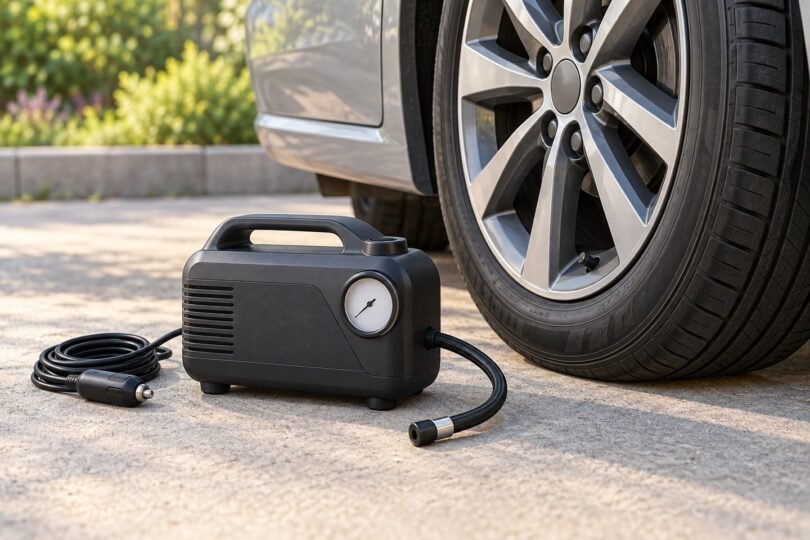
Image note: Original AI-generated editorial illustration; generic objects shown, not branded product photography.