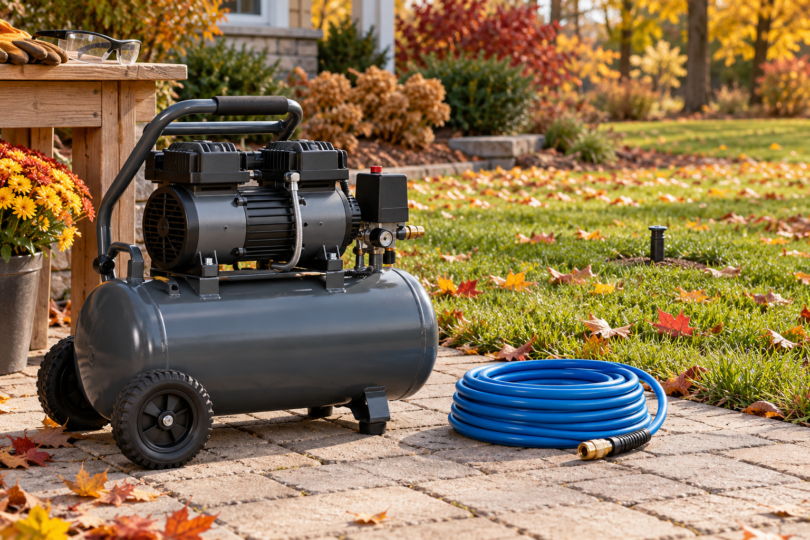

The best air compressor for sprinkler blowout is one that can deliver your system’s required airflow at a controlled, safe pressure for the necessary operating cycle. For whole-system winterization, start with a qualified irrigation contractor and a correctly sized rental compressor. A small tank compressor’s high maximum PSI does not establish that it can clear your lines.
Our first option is a documented 185-CFM diesel rental class for professional selection and operation. We also compare the Makita MAC5200 and Metabo HPT EC914S for readers considering a portable compressor for other jobs or an independently approved small setup. These two compact models are not default recommendations for whole-system sprinkler blowout.
Air compressors for sprinkler blowout at a glance
| Option | Documented airflow | Useful distinction | Buying decision |
|---|---|---|---|
| 185-CFM diesel rental, Sunbelt class 0010030 | 185 CFM; supplier lists a 100-PSI rated operating point | High-airflow equipment class documented for professional irrigation work | Ask a qualified contractor to select and regulate the actual unit; local model and availability require confirmation |
| Makita MAC5200, 5.2-gallon | 6.5 SCFM at 90 PSI; 6.9 SCFM at 40 PSI | Oil-lubricated wheeled compressor; 88 lb net weight | Portable comparison only; documented output below Rain Bird’s cited 10–25-CFM guidance |
| Metabo HPT EC914S THE TANK, 6-gallon | 4.0 CFM at 90 PSI; 5.1 CFM at 40 PSI | Oil-free hand-carry design; two installed couplers | Portable comparison only; less airflow than the Makita at the same listed pressures |
The pressure figures above are manufacturer or supplier rating points, not sprinkler blowout settings. CFM describes airflow; tank gallons describe stored capacity. Confirm delivered airflow at the actual regulated pressure, hose and fittings, along with duty-cycle limits. Do not interpolate an unlisted performance figure or assume that a bigger tank cures inadequate pump output.
1. A professionally selected 185-CFM rental: the useful starting point
Sullair’s irrigation application bulletin identifies 185-CFM portable compressors as a class used on smaller residential and commercial properties. That makes a professional rental consultation more relevant to this job than choosing a tire inflator by its maximum pressure. It is an equipment category to assess, not a universal size prescription.
A concrete option to discuss is Sunbelt’s 185-CFM diesel compressor rental, class 0010030. Its specification table lists Doosan C185 and Sullivan-Palatek D185P examples. The rental class does not guarantee which model your branch supplies, its availability, or an included irrigation adapter kit. Have the contractor and supplier confirm the exact machine, appropriate regulation, hoses, couplings and delivery or towing arrangements.
The advantage is substantially more documented airflow than the compact compressors below, plus access to a rental supplier’s equipment selection. The tradeoffs are diesel fuel, transport, trained operation and a larger machine. High output still needs careful control: the rental machine’s normal operating-pressure range must not be applied directly to irrigation components. A qualified contractor should specify a suitable regulated setup and safe operating method.
2. Makita MAC5200: higher-output portable comparison
The Makita MAC5200 is the stronger airflow option of these two compact comparisons. Its manual lists 6.5 SCFM at 90 PSI and 6.9 SCFM at 40 PSI, with a 5.2-gallon tank. Wheels and a folding handle help with moving and storing it; the manufacturer lists an 88-pound net weight.
Its useful features include a pressure regulator, readable gauges and an oil-lubricated pump. The tradeoffs are weight and oil maintenance. The manual limits operation to a 50% duty cycle, so it is not a continuous-air source. Even its listed 40-PSI output is below the 10–25-CFM equipment guidance in Rain Bird’s homeowner winterization document. Buy it for an approved application and other compatible shop work, not on an assumption that it will winterize every yard.
The linked choice is one Makita MAC5200 compressor, with the listing’s MAC5200 air-compressor style selected. Its included-components field names compressor oil and a coupling. It does not establish a complete irrigation winterization kit. Confirm all connections with the irrigation professional; a matching thread alone does not establish a safe system connection.

Makita MAC5200 5.2-Gallon Air Compressor
As an Amazon Associate we earn from qualifying purchases.
3. Metabo HPT EC914S: oil-free portable comparison
The Metabo HPT EC914S THE TANK provides a six-gallon tank, oil-free design, hand-carry handle and two installed quarter-inch couplers. The manufacturer rates it at 4.0 CFM at 90 PSI and 5.1 CFM at 40 PSI. It is the option to compare if avoiding pump-oil maintenance matters more than the Makita’s higher listed airflow.
The limitation is airflow and intermittent operation. Its manual specifies an S3 50 duty cycle, described as five minutes on and five minutes off. Neither that timing nor the tank’s 200-PSI maximum is an irrigation operating instruction. This remains a compact jobsite compressor to consider only when a professional has verified its suitability for the particular application; it is below Rain Bird’s cited 10–25-CFM range.
Select EC914S THE TANK, six-gallon pancake, one compressor. The selected listing identifies model EC914S and also uses EC914SM in its manufacturer-part-number field. No irrigation hose or backflow connection kit is promised with this selection.

How to choose without relying on tank PSI
Have a qualified licensed irrigation contractor establish the winterization method, required airflow, lowest-rated component, connection point and backflow or pump protection before choosing equipment. Hunter recommends professional winterization because compressed air can cause serious injury. Different guidance covers different systems and equipment classes: Rain Bird’s homeowner document cites 10–25 CFM, while Sullair describes much larger commercial compressors used by contractors. Those figures are not interchangeable universal requirements.
Never charge a tank and dump a burst of high-pressure air into the system to make up for insufficient airflow. Hunter says not to blow compressed air through a backflow device or pump, and not to stand over pressurized irrigation components. Flow sensors and other components need their own manufacturer-directed winterization. Use the complete system-specific instructions and appropriate eye protection; this comparison does not provide a DIY blowout sequence or a universal regulator setting.
Plan power, fuel and placement as part of the equipment choice. Keep electric equipment within its manual’s environmental and electrical limits; the Metabo manual prohibits rain and damp locations. A diesel rental needs safe outdoor engine placement and exhaust management. CDC warns that fuel-burning engines produce carbon monoxide, which can build up indoors. Have the operator follow the specific machine’s safety manual.
For a once-a-year job, compare a contractor’s winterization quote with the full rental or ownership cost: equipment, transport, fuel or power, approved connections and maintenance. A portable compressor can be worth owning for other compatible work, but buying one that cannot supply the required air is poor value even if its headline PSI is high.
Frequently asked questions
Can a six-gallon compressor blow out sprinklers?
Tank size alone cannot answer that. The EC914S has a six-gallon tank but lists only 5.1 CFM at 40 PSI, below Rain Bird’s cited 10–25-CFM equipment range. A professional must compare the actual system requirements and duty cycle with the compressor’s documented performance.
What PSI should I use?
There is no safe universal setting for every irrigation system. The lowest-rated component and the irrigation manufacturer’s procedure govern the allowable pressure. The PSI printed on a compressor tank or rental listing is not permission to apply that pressure to your sprinklers.
Should I rent or buy?
Start with an irrigation professional’s equipment specification. If a compact compressor cannot meet it, compare professional service with a properly equipped high-airflow rental. Buy a portable unit only when its documented performance suits the approved task and you have enough other uses to justify ownership.