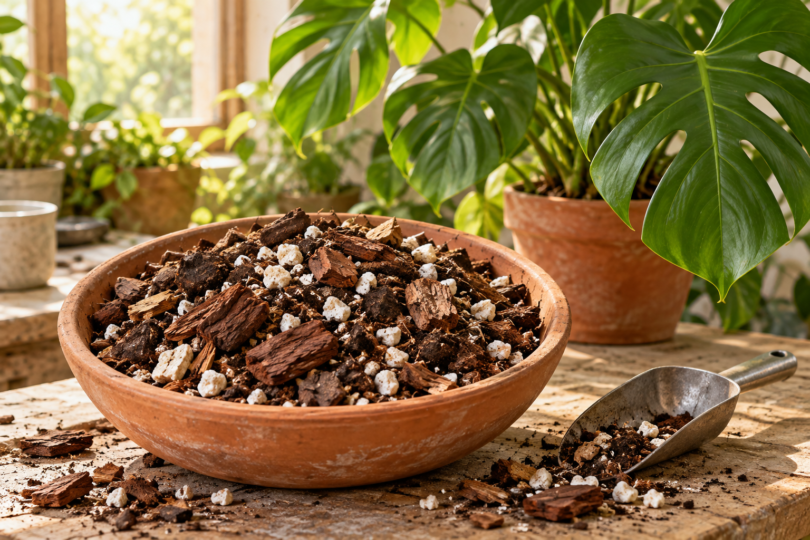

A good soil mixture for Monstera holds some moisture while leaving room for air around the roots. For a DIY starting point, combine 2 parts indoor potting mix, 1 part orchid bark, and 1 part horticultural perlite by volume. Adjust that blend to your pot and growing conditions rather than treating it as a universal formula. A ready-made tropical potting mix is another reasonable option if you would rather skip mixing.
For indoor Monstera deliciosa, the University of Connecticut recommends an organic-rich, well-draining potting medium. Neither a specialty label nor extra fertilizer can make up for a pot that traps water. Read UConn’s Monstera care guidance.
A simple Monstera soil-mix recipe
The following is our adaptable starting recipe for an established plant in a conventional pot with drainage holes. It is an editorial recommendation based on the need to balance moisture and aeration, not a university-tested optimum or a recipe for a self-watering reservoir.
| Ingredient | Proportion | What it contributes |
|---|---|---|
| Indoor potting mix | 2 parts, or 50% | The moisture-holding base. Start with a mix labeled for containers rather than soil dug from the garden. |
| Orchid bark | 1 part, or 25% | A coarser organic component that changes the texture of the blend. |
| Horticultural perlite | 1 part, or 25% | A lightweight mineral component used to increase pore space and limit compaction. |
For example, measure 2 quarts of potting mix, 1 quart of bark, and 1 quart of perlite. The ingredients total 4 quarts before mixing; the finished volume can settle somewhat. Do not buy all three components automatically if your existing potting mix is already coarse and your plant is growing well.
Lightly dampen the ingredients and mix them evenly before potting. Avoid breathing dust and follow each bag’s handling directions. Use bark sold for horticultural potting, rather than treating decorative landscape mulch as interchangeable. Illinois Extension explains how container-media ingredients affect moisture retention and texture.
How to adapt the recipe
- If the root zone stays wet: first check the drainage holes, standing water, pot size, and watering frequency. At the next necessary repot, consider a modest increase in the coarse fraction if the current blend is dense.
- If the pot dries too quickly: check whether the plant is root-bound and whether water is actually wetting the mix. A slightly larger share of the moisture-holding base may suit a warm room or porous pot better.
- If the base already contains plenty of bark and perlite: reduce or omit the extra amendments. Ingredient names alone do not reveal particle size or the proportions already in the bag.
Make small changes and observe your own plant. There is no useful promise that one recipe will stay moist for a fixed number of days in every home. Plant size, light, temperature, humidity, and the container all affect watering needs.
Three useful products, each with a different job
These are alternatives and components, not three interchangeable complete soils. Choose the first for a premixed option; the other two are ingredients for adjusting a suitable base mix.
| Product and checked size | Best fit | Main limitation |
|---|---|---|
| Miracle-Gro Tropical Potting Mix, 6 qt | A complete bagged option for someone who wants minimal preparation | Contains fertilizer; still requires careful watering |
| Better-Gro Orchid Bark, 4 dry qt | A bark component for a custom blend | Not our recommended stand-alone Monstera medium |
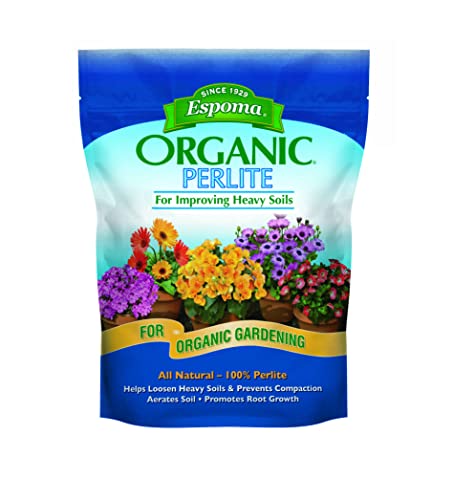
| Espoma Organic Perlite PR8, 8 qt | An additive-free mineral amendment | Not a complete potting mix or fertilizer |
1. Miracle-Gro Tropical Potting Mix, 6 qt: the premixed option
Miracle-Gro lists Monstera among the plants suited to this mix and includes lava rock. The manufacturer now also sells it as Indoor Potting Mix for Tropicals, saying the name and packaging changed while the formula stayed the same. The Amazon listing checked for the box below was the single 6-quart Tropical Potting Mix bag.
- Pros: Ready to use as a container medium; no need to buy several ingredients for one repot.
- Cons: Includes a nutrient charge advertised to feed for up to six months. It is less suitable if you want an unfertilized base and full control of feeding.
Choose it when: convenience matters most. Check the bag’s feeding directions before adding another fertilizer. Do not assume lava rock makes overwatering impossible. Manufacturer details and renamed packaging.

Miracle-Gro Tropical Potting Mix 71276430, 6 Quart, 1 Bag
As an Amazon Associate we earn from qualifying purchases.
2. Better-Gro Orchid Bark, 4 dry qt: the bark component
Better-Gro identifies this product as graded western fir bark and lists it as a base for custom potting mixtures. That makes it a straightforward choice for the bark portion of the recipe. Select Orchid Bark; the brand’s other orchid mixes have different ingredients.
- Pros: A clearly identified bark ingredient, with a resealable bag for leftovers.
- Cons: You still need a moisture-holding base and a feeding plan. A bag intended for orchids is not automatically a complete Monstera mix.
Choose it when: you want to adjust the organic texture of an existing potting medium. Our recommendation is to blend it, rather than move an established Monstera straight into bark alone. Manufacturer ingredients and sizes.

3. Espoma Organic Perlite PR8, 8 qt: the plain mineral amendment
Espoma states that its perlite contains no additives. It is a practical choice when you want to alter the physical mix without adding another fertilizer product. The checked Amazon listing identifies model PR8, an 8-quart bag, pack of one.
- Pros: A single-ingredient amendment intended to loosen mixes and improve aeration.
- Cons: It cannot replace the complete growing medium. Pour and mix carefully to limit dust; follow the manufacturer’s safety guidance.
Choose it when: the base mix needs a mineral component and you want to keep nutrient additions separate. Use it throughout the blend, not as a layer underneath it. Manufacturer specifications and safety information.
Drainage and overwatering are different problems
Drainage is the ability of excess water to leave the growing medium and container. Overwatering can still happen in a draining pot when the root zone stays too wet between waterings. Roots need oxygen as well as moisture; repeatedly watering an already-wet mix can displace the air they need.
Water thoroughly when the plant needs it, let excess water escape, and empty the saucer or outer pot. For Monstera, UConn suggests allowing the top 2 to 3 inches to dry between waterings. Use that as a starting check, not permission to ignore a persistently wet lower root zone. UConn’s watering guidance and Illinois Extension’s houseplant-watering advice support checking the medium instead of following a calendar.
Water racing out of the bottom is not proof that the root ball has been watered well. Very dry potting media can shrink away from the pot, allowing water to bypass it. Check that the mix itself becomes evenly moist. Illinois Extension discusses this problem in its container-watering guidance.
Choose a pot that works with the mix
- Use drainage holes. A decorative pot without holes works as an outer cover if you remove the inner pot for watering and drain away collected water.
- Size for the roots. When the plant needs more room, move up about 1 to 2 inches in pot diameter rather than giving a small root ball a large volume of wet mix. Illinois Extension warns that overpotting can keep the medium wet for too long. Pot-size guidance.
- Account for material. Unglazed terracotta loses water through its porous walls; plastic generally retains moisture longer. Neither is automatically the best choice. How container materials affect maintenance.
- Skip the gravel layer. Stones below the potting mix do not fix drainage. Water can accumulate in the finer medium above that layer. Illinois Extension’s explanation.
At repotting, keep the plant at its previous planting depth, fill around the roots without crushing the mix into a solid mass, and leave space below the rim for watering. For a climbing plant, plan its support while the roots and pot are accessible. Repotting instructions and Wisconsin Extension’s Monstera support guidance.
Frequently asked questions
Can I use ordinary potting mix for Monstera?
Yes, a container mix can work if it provides adequate moisture and aeration in your setup. A Monstera-specific label is not essential. If the mix is dense or stays wet, review the pot and watering habits before deciding whether to amend it.
Is equal parts potting mix, bark, and perlite better?
It is a coarser starting blend than the 2:1:1 recipe here, but it is not universally better. The ingredients’ particle sizes and your growing conditions matter. Avoid adding more coarse material simply to reach a ratio when the existing mix already works.
Should I use orchid bark or orchid potting mix?
Read the ingredients. Bark is one component; an orchid mix may combine bark, moss, perlite, charcoal, or other materials. Substituting a moisture-retentive orchid blend for plain bark changes the finished recipe.
Do I need charcoal, worm castings, or fertilizer in the recipe?
They are not required for this starter blend. Keep the ingredient list manageable and check what the base mix already contains. Fertilizer supplies nutrients; it does not correct a waterlogged root zone.
Will changing the soil cure yellow leaves or root rot?
Not necessarily. Yellowing alone does not diagnose a soil problem. Check moisture and root condition before adding water or fertilizer. UConn describes diseased roots as dark and soft or mushy; correcting watering and drainage is important, but a new bag of mix is not a guaranteed treatment. Seek help from a local extension service if the cause is unclear.
How we researched this guide
We used university-extension guidance for Monstera care, container drainage, watering, and pot choice. Manufacturer pages supplied the product ingredients and intended uses; Amazon product pages were checked for the exact linked bag sizes and identifiers. The three choices serve different purposes and are not ranked by unmeasured performance.
We did not conduct growing trials, measure drainage rates, or verify claims of faster growth. The recipe is an adaptable recommendation, and the pros and cons describe ingredient and workflow trade-offs. Prices, availability, and customer ratings are omitted because they change and do not establish whether a mix suits your plant.