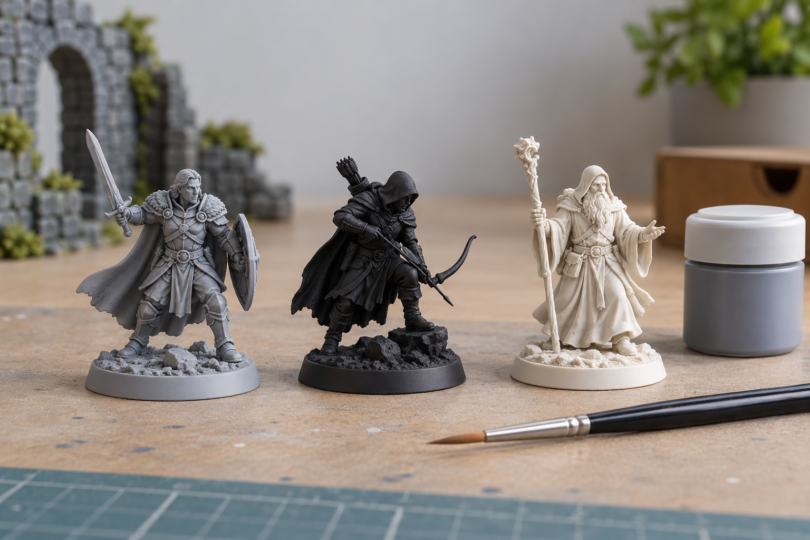

The Army Painter Colour Primer Matt Black is our first pick for dark miniature schemes; Tamiya Fine Surface Primer L Light Gray is the stronger match for a neutral model-building undercoat. For bright colours and translucent paint methods, The Army Painter Matt White provides a light starting point. Choose by the miniature’s material and your painting plan before choosing by can size.
These are aerosol hobby primers. Bottled brush-on primers, clear varnishes, automotive adhesion promoters and cosmetic setting sprays serve different jobs.
Best spray primers for miniatures: the shortlist
| Primer | Exact version | Best fit | Main consideration |
|---|---|---|---|
| The Army Painter Colour Primer Matt Black | CP3001S, black, one 400 ml can | Dark or metallic miniature schemes | Bright topcoats can need more work over black |
| Tamiya Fine Surface Primer L | 87064, Light Gray, one 180 ml can | A neutral undercoat on supported model plastics and metal | Do not assume compatibility with every resin, flexible plastic or foam |
| The Army Painter Colour Primer Matt White | CP3002S, white, one 400 ml can | Bright colour schemes and a light base for translucent paints | A thin, even coat matters; avoid flooding small details |
1. The Army Painter Colour Primer Matt Black: best for dark schemes
Matt Black CP3001S combines an acrylic primer and coloured basecoat in a 400 ml aerosol. The manufacturer designs the Colour Primer range for metal, plastic and resin miniatures. Black is a practical starting colour when much of the finished figure will be dark, or when you want recesses to remain dark beneath later layers.
The tradeoff is colour planning. A pale yellow or bright white finish over black usually asks more of the later paint layers than starting with a light undercoat. Choose it for the scheme you intend to paint, rather than treating black as the automatic answer for every figure.
The exact option here is one Matt Black can. It is not a white primer, a varnish or a bundle of several sprays. Although the product is described as acrylic, it contains solvent and carries flammable-aerosol warnings; “acrylic” does not mean suitable for spraying at an ordinary indoor desk.

The Army Painter Colour Primer Matt Black, 400 ml, 1 Can
As an Amazon Associate we earn from qualifying purchases.
2. Tamiya Fine Surface Primer L Light Gray: best neutral model primer
Tamiya item 87064 is the Light Gray version of Fine Surface Primer L in a 180 ml can. The neutral colour is useful when you want to see the model’s surface clearly before building up colour. Tamiya positions it as a fine undercoat for plastic and metal.
This is a solvent-borne aerosol primer. The official European product page and linked safety sheet describe a pressurised mixture of binders, pigments and solvents. It should not be confused with a water-based bottled primer.
Choose the exact 87064 Light Gray can: Tamiya also makes other colours and surface-primer products. Its fine finish does not mean unlimited material compatibility. For a resin print, unusual plastic, existing paint layer or foam terrain, follow the material maker’s guidance and test on a spare matching piece before coating the model. Do not assume that a general model-plastic description covers every formulation.
3. The Army Painter Colour Primer Matt White: best light starting colour
Matt White CP3002S is a 400 ml acrylic aerosol primer and basecoat. It is the light-colour alternative in the same miniature-focused range. Choose it when a bright starting surface suits the finish you want, especially if the next paint layers are translucent.
White does not remove the need for careful coverage. Heavy application can obscure sculpted texture regardless of colour. Check the result under good light and build the undercoat gradually instead of trying to make every recess opaque in one wet pass. This pick is the Matt White primer, not Anti Shine Matt Varnish or a clear protective finish.
How to choose the right primer
Match the material first
The Army Painter’s range guide lists plastic, resin and metal miniatures. Tamiya’s listed applications include model plastics and metal. Those descriptions are useful starting points, not a guarantee for every casting resin, 3D-print resin, flexible figure or previously painted surface. Prepare and fully dry the model according to its maker’s directions, and use a spare sprue or matching test piece when compatibility is uncertain.
Choose black, gray or white for the next paint layers
A black base supports darker schemes, white supports a brighter starting point, and gray sits between them. The final appearance also depends on the opacity and colour of the paints applied above it. There is no need to buy all three for one project if a single undercoat suits the whole scheme.
Keep primer separate from filler and varnish
Read the product’s intended job. A clear topcoat protects a finished paint layer; it is not the same purchase as a miniature undercoat. A heavy filler primer is intended to fill imperfections, which can be a poor match for fine sculpted details. Bottled primers can be useful for brush or airbrush work, but they are not ready-to-use aerosol cans.
Application conditions and aerosol safety
Read the instructions and safety label on the actual can before use. The Army Painter’s application guide recommends roughly 15–27°C (60–80°F) and 40–60% relative humidity for its Colour Primers. These are that manufacturer’s recommendations, not a universal specification for Tamiya or other sprays. If your can gives a narrower range, follow it; postpone the job when conditions are unsuitable.
For the two Army Painter picks, the product instructions call for at least a minute of mixing, a spray distance of 15–20 cm and several thin coats with drying between them. Test the spray away from the miniature first. Follow Tamiya’s own can directions for distance, drying and recoating rather than borrowing another brand’s numbers. A coat that feels dry is not automatically ready for every handling or painting step.
- Ventilation: use only outdoors or in an appropriately well-ventilated area as directed, and avoid breathing mist or vapour. Keep other people and pets clear of overspray. If you cannot provide the required conditions, choose a suitable brush-on primer or wait.
- Protection: follow the label and safety sheet for protective gloves, clothing and eye/face protection. Do not treat a cloth mask as a substitute for the ventilation and respiratory protection the product requires.
- Fire and heat: keep aerosols away from flames, smoking, sparks and hot surfaces. Do not heat a can, puncture it, burn it or use a heat gun to speed the job.
- Storage: keep cans away from children and direct sunlight. The reviewed warnings prohibit exposure above 50°C (122°F); this is a storage hazard limit, not a spraying temperature. Follow local disposal instructions.
The Army Painter warns of skin and eye irritation and hazardous spray droplets. Tamiya’s safety sheet also warns of serious eye damage and respiratory irritation. Follow the specific can’s precautions even when another primer looks similar.
Which primer should you buy?
Choose Matt Black CP3001S for a dark miniature scheme, Tamiya 87064 Light Gray for a neutral undercoat on its supported model materials, or Matt White CP3002S for a bright starting surface. The best choice is the one that fits the substrate, the next paint layers and the conditions in which you can safely spray.