
A stainless steel Mayo tray should be chosen around the equipment it will sit on and the facility’s processing requirements. Start with the stand manufacturer and model, then verify the replacement tray’s part number, dimensions and shape. A tray described as “standard” or “19-inch” is not enough to establish a safe fit.
This guide compares documented equipment options and the questions worth settling before ordering. It is a purchasing guide, not a clinical-use or sterilization procedure. Healthcare facilities should follow the exact device instructions for use (IFU) and their approved reprocessing policies.
First decide: tray only or complete Mayo stand?
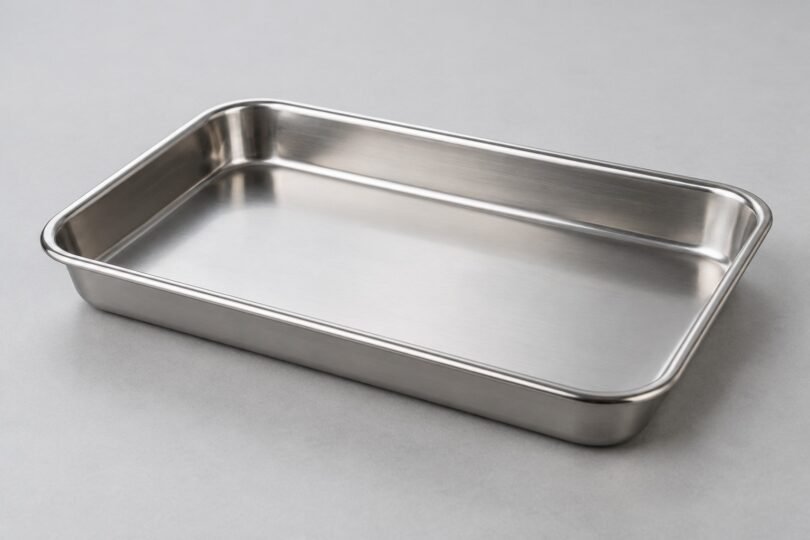
A tray-only purchase supplies the removable metal tray. A complete Mayo stand combines a tray with a support frame, height-adjustment mechanism and base. Product photographs can show a whole assembly even when a selected stock code supplies only one component.
For example, STERIS’s Mayo Stand Tray Only range identifies MCE755 as 12W × 19L, MCE756 as 16W × 21L, and MCE757 as 20W × 25L. These are 304 stainless steel trays, not complete stands. Obtain the dimensional drawing and compatibility confirmation for the selected part rather than treating those abbreviated size labels as a fit guarantee.
Check the order description for the tray, support, base, casters and any accessories. A cover, liner, drape, mounting bracket or replacement adjustment knob should only be treated as included when the selected item’s documentation says so. Similarly, confirm whether an order is for one tray or a case.
Match the tray to the support frame
Three measurements answer different questions: the tray’s outside dimensions across its rim, the usable area inside it, and the opening or seating dimensions of the stand’s support. They are not interchangeable. A raised or rolled rim, tapered sides and rounded corners can affect where the tray rests.
For a replacement, send the supplier the stand model and the existing tray’s part number if available. Ask for the tray’s external length, width and overall height, plus the support-interface dimensions and any required clearance. If the listing does not explain what its dimensions measure, ask rather than assuming they describe the outside rim.
Do not calculate compatibility by subtracting an arbitrary amount from the advertised tray size. A visually similar tray may have a different rim profile or corner shape. For clinical equipment, have the manufacturer or authorized supplier confirm the intended tray-and-support combination before purchase.
Documented options to compare
Grafco flat instrument trays: three clearly identified sizes
Graham-Field’s Grafco flat-tray range specifies seamless 18-8 (304) stainless steel and a raised perimeter. Its individual stock codes are:
- 3261: 13 5/8 × 9 3/4 × 5/8 inches, one each.
- 3262: 15 1/8 × 10 1/2 × 5/8 inches, one each.
- 3264: 19 × 12 1/2 × 5/8 inches, one each.
These are useful comparisons when shopping for a flat tray with a stated material grade. The product page does not establish universal Mayo-stand compatibility. In particular, the 3264’s stated dimensions differ from a 19 1/8 × 12 5/8-inch tray; do not round them into the same specification.
Hayden Medical: rolled-rim trays with stated depth
The Hayden Medical Mayo tray page lists stainless steel trays with a rolled bead edge. PWM19F measures 19 1/8 × 12 5/8 × 3/4 inches. Smaller alternatives include PWM10F at 10 × 6 1/2 × 3/4 inches and PWM12F at 12 3/4 × 10 3/8 × 1 1/4 inches.
The depth difference matters when comparing the space available for supplies. Confirm the selected SKU, usable interior area and intended support before ordering. The page describes stainless steel but does not identify an alloy grade, so do not assign it a 304 specification from appearance alone.
MAC Medical: model-specific replacement parts
For an existing MAC Medical stand, its MAN-047 Rev F manual, page 9, provides a more useful starting point than a generic shopping search:
- MY0007: 19 1/8 × 12 5/8-inch tray for MYO-2001, MYO-3001, MYO-4001 and MYO-5001.
- MY0040-01: 21 1/4 × 16 1/4-inch tray for MYO-2000, MYO-3000, MYO-4000 and MYO-5000.
- MY0064-01: 25 × 20-inch tray for MYO-2002 and MYO-3002.
Match the complete model identifier. The manual also distinguishes stand capacities: the listed dual-post models carry a 50-pound rating, while the listed single-post models carry a 40-pound rating. Those figures describe the specified stands, not every tray of the same size.
Pedigo P-1068-SS: a complete foot-operated stand
If the whole stand needs replacing, the Pedigo P-1068-SS is a documented complete-assembly option. Pedigo lists a removable 12 5/8 × 19 1/8-inch stainless steel tray, foot-operated height adjustment from 36 to 62 inches, welded stainless steel construction and 2-inch dual-wheel swivel casters.
The stated capacity is 50 pounds, evenly distributed. Compare the base clearance and adjustment range with the intended workspace, and retain that loading qualification. These specifications do not establish that a separately purchased, similarly sized tray will fit this stand.
Check material, rim, weight and accessories
A named alloy such as 304 is more informative than an undefined “surgical-grade” label, but material wording alone does not establish regulatory approval, sterile supply or compatibility with a particular processing method. It also does not prove a tray’s load capacity.
Ask for tray thickness or gauge and empty weight if those affect handling or your equipment assessment. Do not substitute shipping weight for product weight. Where the manufacturer does not publish these figures, record them as unknown rather than inferring them from a photograph.
Review the rim profile and underside as well as the top surface. Confirm whether a solid or perforated bottom is required for the intended equipment and facility workflow. Covers, inserts and liners need their own compatibility checks; adding one can change the available interior space. Do not assume an accessory is approved simply because it fits inside the tray.
Cleaning and reprocessing limits are model-specific
Check how the item is supplied. If it is labeled nonsterile, new packaging does not make it ready for a sterile application. If the listing does not state its supply condition, obtain that information and the applicable IFU before use. A clean-looking surface is not evidence of sterility.
Manufacturer instructions also differ between equipment lines. Pedigo’s Mayo Stand Care & Cleaning instructions prohibit cart washing for the listed stands because high temperatures may damage them. They discuss compatible chemical disinfection and removal of residual disinfectant.
By contrast, MAC Medical’s manual, page 10, prohibits bleach or chlorine-containing products on its Mayo stands, along with specified abrasive materials and other agents. These differences are a reason to obtain the correct instructions, not to create a blended cleaning recipe.
Keep instructions for a removable tray separate from those for the stand, casters and other components. Do not infer that the complete assembly can enter an autoclave because a tray listing mentions sterilization. Have qualified facility staff verify the exact device, chemicals, equipment and processing method under the applicable IFU and facility policies.
Before placing the order
- Record the manufacturer, exact tray SKU and stand model.
- Confirm outside dimensions, rim shape, depth and support-interface fit.
- Check the stated alloy, empty weight and applicable equipment load limit.
- Verify the unit of sale and everything included or sold separately.
- Obtain the supply condition, current IFU and replacement-part information.
- Check the supplier’s return conditions before ordering an unconfirmed replacement.
The best match is the tray with a documented fit and a processing pathway your facility can support. An exact replacement part is usually the clearest place to begin; a general-purpose tray needs the same checks before it becomes part of a Mayo-stand assembly.