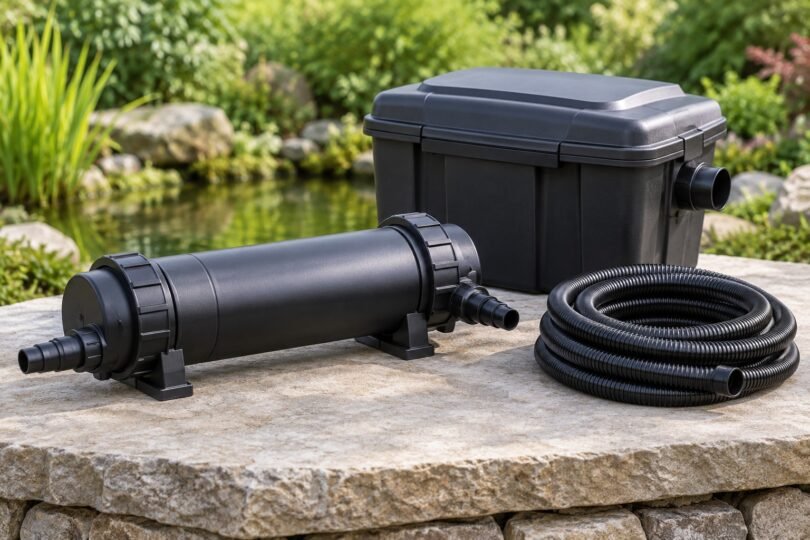

If you are looking for a submersible UV light for a koi pond, the most important distinction is between a complete, enclosed pond filter designed for underwater operation and an exposed germicidal lamp. Do not place an unshielded UV-C tube directly among fish or where people can see or touch its radiation. “Waterproof” alone does not establish suitability for that use.
For many koi-pond installations, an enclosed external UV clarifier connected to the filtration plumbing is the more practical option to assess. You can inspect and service it without retrieving a filter from the pond, and choose its flow capacity separately from the pump. Keep external equipment above water as its manual requires.
What pond UV can and cannot do
UV clarifiers target single-celled algae suspended in the water passing through their treatment chamber. They can help with green water; they do not pull sludge from the pond or scrub attached algae from rocks. Aquascape’s explanation specifically distinguishes suspended green-water algae from string algae, which a clarifier does not control.
Mechanical filtration still needs to collect particles, while biological filtration and aeration perform other jobs. Clear-looking water is not a substitute for checking water quality. UF/IFAS fish-health guidance identifies dissolved oxygen, ammonia, nitrite and biofilter capacity among the important considerations. If fish are gasping, behaving abnormally or showing signs of disease, investigate promptly with a qualified aquatic-health professional rather than treating a larger UV lamp as the solution.
Also distinguish clarification from a specified disinfection duty. Aqua Ultraviolet publishes different flow rates for different UV doses on the same 15-watt unit. That illustrates why wattage alone cannot establish pathogen control. A pond-volume label, or the word “sterilizer,” is not a guarantee that the entire pond becomes sterile.
Four equipment options, with placement made clear
OASE Filtral UVC: truly submersible, with important koi-sizing limits
The U.S. Filtral range combines underwater filtration and UVC equipment in 400, 800 and 1600 models. It is the relevant category when your requirement really is an enclosed unit that sits in the pond.
However, do not translate the model number into a koi-pond recommendation. OASE’s sizing chart distinguishes light, medium and heavy fish loads, includes koi in its heavy-load definition, and leaves the Filtral heavy-load column blank. For example, the Filtral 1600 row lists less than 1,600 gallons for light loads and less than 800 for medium loads, without a heavy-load figure.
For a koi pond, get the manufacturer or a pond specialist to confirm a suitable complete filtration system. The existence of a submersible product does not mean that buying the largest unit in that small-pond range solves your stocking requirements.
Aquascape UltraKlear 2500: external clarifier with a defined flow limit
The UltraKlear range has an enclosed chamber, indicator, safety switch and mounting brackets. It is a separate clarifier, so you still need an appropriate pump and filtration arrangement.
The manufacturer’s manual identifies the UltraKlear 2500 as item 95037: 28 watts, an average pond-size recommendation of 2,500 U.S. gallons and a maximum flow of 1,000 gallons per hour. It explicitly prohibits submerging the housing. Those figures make it a useful comparison for an external green-water installation, subject to confirmation of your actual pond conditions and flow.
TetraPond GreenFree 18-watt: another external green-water option
Tetra’s GreenFree specifications pair the 18-watt version with a 4,400-gallon pond rating and 2,200-GPH flow figure. Its installation instructions identify the clarifier as non-submersible.
Compare the exact 18-watt unit rather than a replacement lamp or another GreenFree size. Confirm the fittings, permitted installation position, pump compatibility and stocking assumptions before ordering. Different manufacturers’ gallon ratings are not controlled head-to-head performance results, so the larger number should not automatically win the comparison.
Aqua Ultraviolet Classic: useful when you need dose-based selection
The Classic 15-watt family illustrates a more detailed selection approach: its official page separates freshwater clarification capacity from sterilization sizing and provides a flow-versus-dose chart. It also lists different inlet/outlet sizes, colors and wiper options.
This is a starting point for a technical sizing conversation, not a universal 15-watt recommendation for koi. Give the manufacturer your treatment objective, pond volume and measured flow, and ask it to identify the appropriate model and installation requirements. The manufacturer’s Classic-series manual expressly says not to submerge these units.
Size the system using flow, volume and fish load
First establish pond volume as accurately as you can. For a roughly rectangular pond, length × width × average depth in feet × 7.48 estimates U.S. gallons; irregular shapes and shelves need additional care. Aquascape uses this volume formula in its pond-sizing instructions. A meter reading during filling is useful to record for future equipment and maintenance decisions.
Next, check the water actually reaching the UV. A pump’s advertised maximum flow is not automatically the flow through installed hoses, bends, elevation changes and filter equipment. Ask your installer how it will be measured or verified, and compare it with the exact clarifier’s specified operating limits.
For example, if a selected UV allows at most 1,000 GPH but your proposed branch would carry 1,800 GPH, that arrangement needs redesigning. Possible solutions include a manufacturer-approved bypass, a different pump arrangement or a suitably rated clarifier. Bypasses are model-specific: UltraKlear documents an optional arrangement, while Aqua Ultraviolet advises against bypassing its Classic units. Follow the exact manual and preserve adequate pond circulation.
Finally, describe the fish load, feeding, sun exposure and existing filter to the supplier. Ask which published rating applies to your situation and whether your whole system has sufficient capacity. Buying by watts per gallon alone leaves too many important variables unanswered.
Installation and electrical safety
- Use an enclosed, pond-rated system. An aquarium lamp, decorative underwater LED or replacement UV bulb is not a complete pond clarifier. An exposed germicidal lamp is not suitable as an open-water accessory among koi.
- Respect placement limits. Submersible equipment must follow its permitted depth, orientation and cable requirements. External units need a secure, accessible location protected as the manual requires.
- Protect the electrical supply. Use correctly grounded, GFCI-protected power and weather-appropriate wiring. Both the UltraKlear and Classic-series instructions address electrical protection. Have a qualified electrician resolve wiring questions.
- Disconnect before servicing. Unplug the relevant pond equipment before opening the UV housing or handling it, following the equipment instructions. Never lift a unit by its cord.
- Keep the shielding intact. Never defeat an interlock or energize a disassembled UV unit to see whether its lamp works. Use only the manufacturer’s safe indicator or checking method.
The FDA warns that UV-C exposure can injure eyes and burn skin, even after brief exposure. Visible brightness is not a safe way to judge risk. If a housing, sleeve, cable or seal is damaged, stop using the equipment and follow the maker’s repair instructions.
Maintenance is part of the purchase
Before buying, locate the exact replacement lamp, quartz sleeve and seals. Check the space required to withdraw the lamp and whether you can reach the housing without disturbing major plumbing. A compact installation is only helpful if its service parts can still be removed.
Follow the manufacturer’s lamp schedule even if the light indicator still works. UltraKlear specifies replacement after 12 months of continuous use; Aqua Ultraviolet specifies 14 months for Classic lamps. Check quartz condition and follow the exact model’s cleaning and winter-storage instructions. UF/IFAS recommends recording routine equipment and water-quality checks, including UV-lamp and sleeve maintenance.
If green water persists, check that the problem is suspended algae, then review flow, lamp age, sleeve condition and filtration. Aqua Ultraviolet’s FAQ discusses sizing, flow and attached algae as separate issues. Avoid adding multiple treatments or promising a fixed clearing time without diagnosing what is limiting the system.
Before you click buy
- Confirm whether you need an underwater all-in-one filter or an external clarifier.
- Write down pond volume, fish load and existing pump/filter details.
- Match the exact model to its flow limits and intended duty.
- Confirm outdoor electrical protection, installation position and service access.
- Identify replacement lamps and seals, and read the maintenance instructions.
For a koi pond, choose a properly sized filtration arrangement first. Add UV as an enclosed, serviceable part of that system, keeping the lamp shielded and its placement consistent with the manual.