
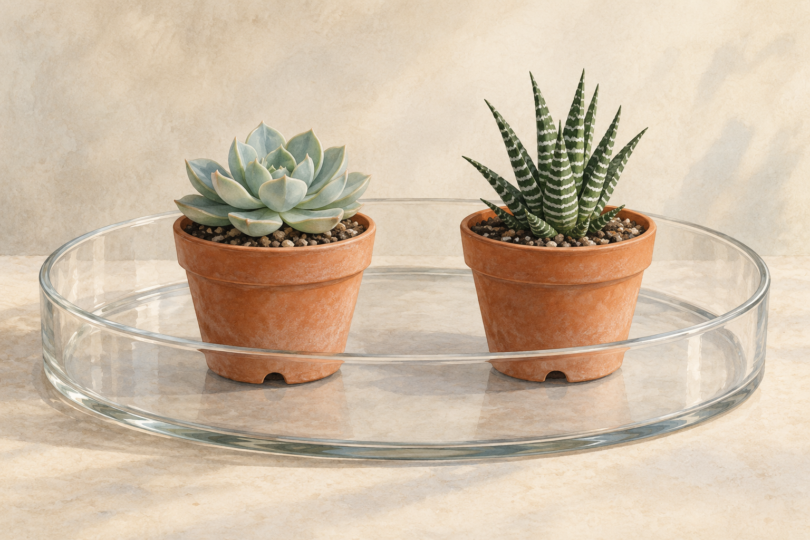

For succulents, choose a wide-open display or a shallow dish garden with drainage. A humid, sealed terrarium is the wrong enclosure for the plants in this guide. Start with the container and available light before choosing a plant that looks attractive in a photograph.
Compare Haworthiopsis fasciata for striped foliage and Echeveria elegans for pale rosettes. The right choice depends on your display’s light and drying conditions.
Research checked October 4, 2026 using university extension guidance and botanical plant profiles. We have not grown these plants in a comparative trial or tested a terrarium kit. These are growing-condition-based recommendations, with no claims about a seller’s plant quality, prices or availability.
First decide whether your enclosure is suitable
Mississippi State University Extension distinguishes open and closed terrariums: a broad opening allows a drier environment, while a lid or narrow opening supports moisture-loving plants. Its guide specifically excludes succulents and cacti from the closed setup.
- Sealed jar, bottle or lidded case: choose plants suited to a humid terrarium instead.
- Wide-open bowl: a possible succulent display, provided the planting arrangement has a way to drain and the plants receive appropriate light.
- Shallow container with drainage holes: our preferred starting point for an accessible, easy-to-inspect succulent dish garden.
A tiny ventilation hole or briefly removing a lid is not the same design as an open dish. If keeping the lid is important to you, change the plant selection rather than relying on a supposedly special “terrarium succulent.”
Two succulents for an open display
| Plant | Why consider it | Light direction | Main limitation |
|---|---|---|---|
| Haworthiopsis fasciata | Slow-growing striped rosette, typically 4–6 inches tall and wide | Bright indirect light | Verify the species label; similar plants are often confused with it |
| Echeveria elegans | Pale green-blue rosettes and offsets | A brighter site; extension guidance lists full sun to partial shade | Overwatering is a major problem; do not put a glass enclosure in hot sun |
Haworthiopsis fasciata: a small, striped candidate
NC State Extension’s profile describes a slow-growing plant that prefers bright indirect light and a well-drained cactus or succulent mix. Allow the soil to dry between waterings. Its modest size makes it worth considering for an open display, with room left around the rosette.
Verify the botanical label. H. fasciata has a smooth upper leaf surface with raised white bands outside. NC State warns that H. attenuata is often mislabeled as this species.
Buying check: allow room for offsets and future repotting instead of filling every inch of the display.
Echeveria elegans: a rosette for a brighter position
NC State’s Echeveria elegans profile describes clumping rosettes with pale green-blue to silvery-green leaves. It is used in shallow containers and produces offsets. The species profile lists full sun to partial shade and emphasizes dry, well-drained soil.
Consider it for a flower-like rosette in a bright, open arrangement. A low-sided planter avoids surrounding the foliage with tall glass walls.
Buying check: a small rosette at purchase does not establish its eventual footprint. Leave space to grow and access for repotting.
Drainage requires somewhere for water to leave
A decorative layer of pebbles cannot create an outlet in a sealed-bottom bowl. Oklahoma State University Extension explains that layers of rock, sand or charcoal can hinder movement of water out of the potting medium rather than solve drainage. Do not treat a gravel layer as protection against wet roots.
Iowa State recommends double potting for undrained decorative containers: put a smaller draining pot inside. Our adaptation uses removable pots in a wide-open vessel. Take them out to water, drain fully, and empty collected water before returning them.
Check this arrangement before buying. Can you lift each pot out without pulling on the plant? Can you see and empty the bottom? Will decorative stones block access? If maintenance requires dismantling the whole display, simplify it.
Light and water: make the routine fit the plant
Use a cactus or succulent mix. Iowa State’s care guidance recommends watering thoroughly and allowing complete drying. Water the draining inner pot; do not saturate undrained glass. Frequency varies with the container, mix and growing conditions.
Use reminders to check the root-zone moisture rather than water automatically.
For placement, balance light with heat. Mississippi State’s terrarium guidance warns about heat building up near sunny windows. If your chosen succulent needs a sunnier site than the glass display safely provides, move it to a suitable open planter. A dim shelf is not fixed by reducing watering alone.
Keep the planting simple
Oregon State Extension recommends matching plants’ light and water needs and using a wide opening for succulents. Buy one well-identified specimen first, or keep different plants in separate removable pots. That makes it easier to adjust their positions and water them individually.
Live moss is a poor automatic addition to this dry-growing arrangement: keeping it lush may require a different moisture routine. Leave room between plants and keep decorative material from making it hard to inspect the soil or remove a plant.
These displays change. Oregon State also cautions that small plants eventually outgrow terrariums. Treat repotting and rearranging as normal care, rather than trying to keep a plant tiny by leaving it crowded indefinitely.
Buying checks for plants and kits
- Botanical identity: ask for the species and cultivar, if applicable. “Assorted mini succulents” does not tell you their eventual size or requirements.
- Actual size: confirm the plant and root-pot dimensions, not just the outer shipping box.
- Growing condition: inspect the base, leaves and potting mix. Ask the nursery about any soft tissue, visible pests or unexplained damage.
- Container access: check opening width, pot removal and how excess water will be emptied.
- Kit contents: confirm drainage, substrate and plant identities independently of the display photograph.
- Maintenance plan: leave a place for the plant to move when it outgrows the arrangement.
If you want to keep a closed terrarium
Consider a dwarf Fittonia albivenis, or nerve plant, for a separate humid terrarium design. NC State identifies dwarf forms as terrarium candidates, and Mississippi State includes nerve plant in its closed-terrarium project. It provides colorful leaf veins rather than the dry-growing succulent look.
Its care is different: do not apply the succulent dry-out routine to it. Select the exact dwarf form and suitable companions, and still avoid waterlogging or excessive heat. A humidity-tolerant choice does not make a sealed garden maintenance-free.
Frequently asked questions
Can succulents live in a closed terrarium?
The two dry-growing succulents recommended here should not be put in a sealed, humid jar. Choose an open arrangement or redesign the closed terrarium around suitable moisture-loving plants.
Is an open terrarium automatically suitable?
No. You still need appropriate light, access for care and a planting arrangement that drains. An open top solves only part of the problem.
Should I mist a succulent terrarium every day?
No daily misting schedule is recommended here. Check the soil and water the draining pot when appropriate, then let it dry again. The glass display should not remain continually damp.
Can I buy any plant labeled zebra plant?
Ask for the botanical name and match it to a reliable plant profile before choosing a display.
Image note: AI-generated generic editorial illustration of an open succulent display using removable pots; remove pots for watering, let them drain fully and empty the outer vessel.


