
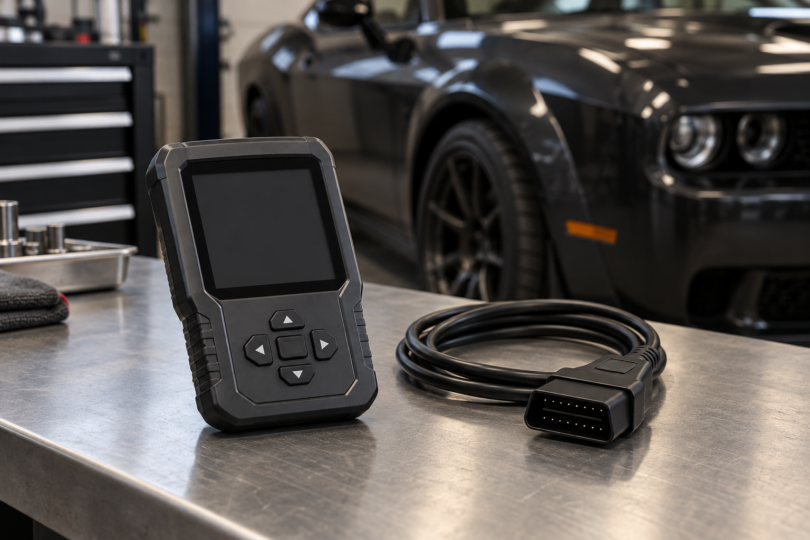

For a 2009–2014 Dodge Challenger with the 5.7L Hemi, the DiabloSport inTune i3 8300 is the better starting point if you want a handheld programmer, while the Trinity 2 EX 9300 makes more sense if you also want an in-cabin display. Both have matching Challenger 5.7L entries in CARB Executive Order D-770. Those entries have conditions; they do not make every tune, modification or later-model Challenger compatible.
This comparison is limited to those exact part numbers and model years. Before ordering, have DiabloSport confirm your VIN, engine, automatic or manual transmission, PCM calibration and existing modifications. The published EO table does not identify transmission or individual controller calibrations, so neither recommendation guarantees support for every controller configuration or transmission-tuning feature.
Two tuners worth comparing
| Exact product | Best fit | Vehicle scope in this guide | Main limitation |
|---|---|---|---|
| DiabloSport inTune i3, part 8300 | A handheld programmer with data logging | 2009–2014 Dodge Challenger, 5.7L; confirm transmission and calibration | No in-cabin monitoring or CMR custom-tune support listed for this part |
| DiabloSport Trinity 2 EX, part 9300 | A programmer with a 5-inch in-cabin display | 2009–2014 Dodge Challenger, 5.7L; confirm transmission and calibration | More equipment to position in the cabin; this part does not accept CMR custom tunes |
1. DiabloSport inTune i3 8300: best for handheld use
The 8300 version of the inTune i3 has a color touchscreen, Wi-Fi updating, OBD-II data logging and diagnostic-code reading. Holley’s exact-part specification table lists performance tunes and Windows/Mac compatibility, but marks in-cabin monitoring and CMR custom-tune acceptance as unavailable.
Choose it when your priority is a handheld device and you do not need a permanent gauge display. The distinction between logging data and watching an in-cabin monitor matters here: the 8300’s logging feature is not a reason to buy it as a substitute for the Trinity display.
Match part 8300 explicitly. An inTune i3 family name on a marketplace listing is insufficient, and a Platinum model is not interchangeable with this recommendation. The relevant D-770 application entries must match the vehicle, and only the covered configuration should be considered.
2. DiabloSport Trinity 2 EX 9300: best for an in-cabin display
The Trinity 2 EX 9300 adds a 5-inch touchscreen and in-cabin monitoring to its tuning and data-logging functions. Its exact product page also lists Wi-Fi updates and diagnostic-code reading. As with the 8300, the specifications say this part does not accept CMR custom tunes.
Choose it if seeing supported vehicle data inside the car is worth the additional display and cable placement. Plan a position that does not obstruct your view or distract you while driving. If you only need a handheld programmer, the i3 is the simpler fit for that requirement.
The Trinity manual says transmission tunes are available only on certain applications. Do not read the Challenger engine/year match as a promise of shift-point control, support for every automatic transmission, or any change to a manual gearbox. Ask the manufacturer which functions apply to your exact car.
What the model-year and emissions limits mean
CARB Executive Order D-770 lists Challenger 5.7L applications for part 8300 and for the Trinity group that includes 9300. This guide uses the 2009–2014 rows. The order ties its exemption to the listed applications and submitted device specifications; changes that adversely affect emissions-control performance invalidate it.
The EO is not a blanket endorsement of performance claims and does not settle a vehicle manufacturer’s warranty obligations. It also says emission-related data files cannot be modified by the end user. Keep the required emissions systems functioning and check the exact covered calibration, existing parts and local inspection requirements before any tuning decision.
EPA’s tampering policy explains that an ECU tuner can be an unlawful defeat device when it bypasses or disables emissions-control functions. A vendor’s claim, a cleared warning light or a device fitting the diagnostic port is not enough to establish that a proposed configuration is compliant.
What about a 2015 or newer Challenger?
Do not buy either shortlisted part on the assumption that it covers a later car. Holley’s 2015 Challenger PCM information describes a separate unlocked-PCM requirement, and its 8320-R package for 2015–2017 V8 cars includes a PCM swap. That package is a different product and requires its own fitment and emissions review.
The 8320-R product page explicitly marks it as not CARB compliant and not legal for sale or use in California. It is excluded from this shortlist. This comparison does not transfer the 8300 or 9300 EO coverage to a PCM-swap kit, Platinum device or later vehicle.
What to verify before you order
Give the manufacturer the car’s exact model year, 5.7L engine identification, transmission, current PCM calibration and modification list. Ask it to confirm the device part number, supported functions, required fuel for the covered tune, and applicable emissions documentation. For a previously used device, also confirm its licensing and vehicle-association status before paying.
Choose between these two for their documented functions, not a promised horsepower number. No dyno test was performed for this comparison, and it does not predict your car’s power increase, fuel economy, reliability or warranty outcome.
Frequently asked questions
Is the 8300 the same as every inTune i3?
No. Check the complete part number. This guide recommends 8300 only within its stated application limits and does not treat Platinum or PCM-swap variants as equivalent.
Will either tune my transmission?
That has to be checked for your exact application. The Trinity manual limits transmission tunes to certain applications, and the EO’s vehicle rows do not identify each transmission or controller calibration.
Why are there only two recommendations?
These two offer a clear handheld-versus-display choice with identifiable application documentation. Holley’s current page directs shoppers to DS-MFD replacement coverage for the former Predator 2 7301, so it is not added merely to make the list longer.
Does an emissions EO approve all modifications on the car?
No. Its conditions apply to the listed product and applications. Verify the full configuration rather than assuming one exempt device covers unrelated changes.


